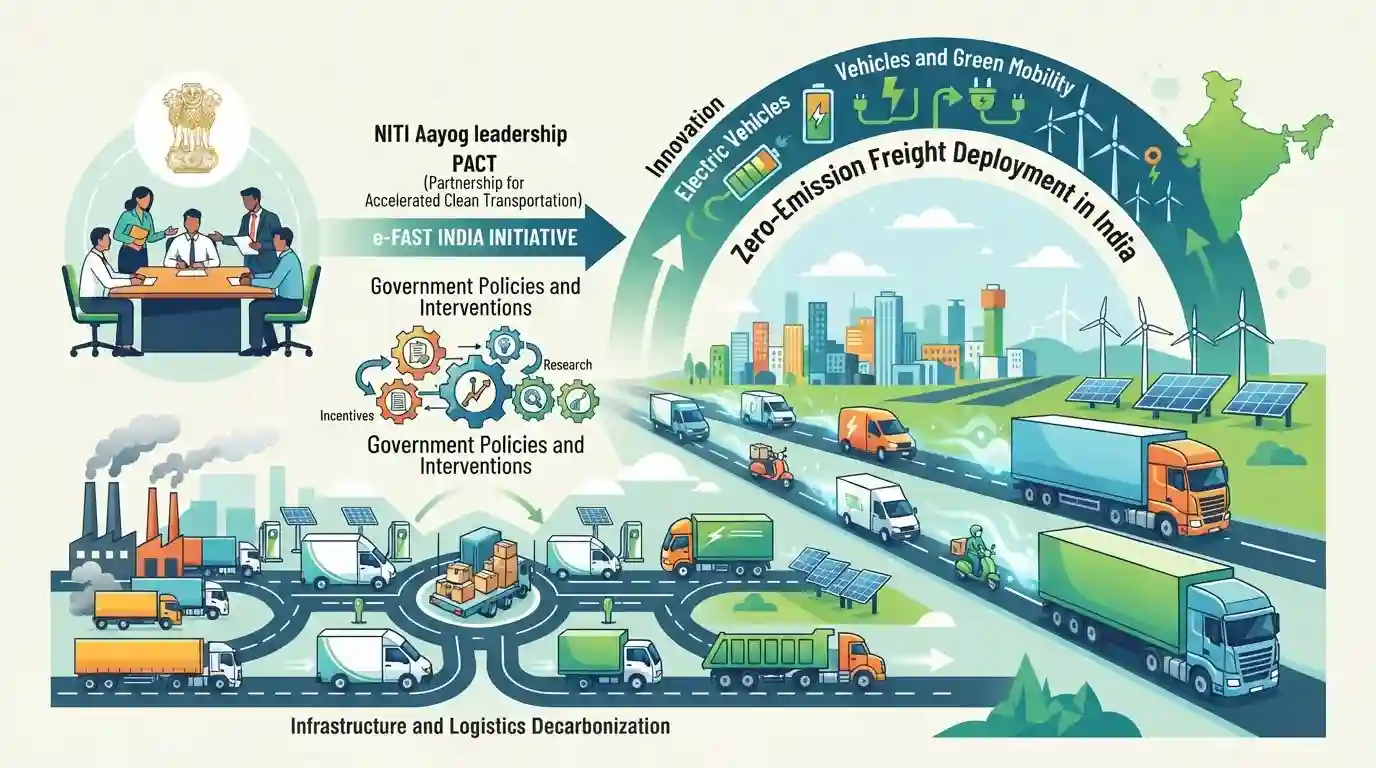
NITI Aayog PACT Initiative for Zero-Emission Freight Deployment
Source:PIB ↗
ఇది ఎందుకు ముఖ్యం
Freight transport is a major source of carbon emissions and air pollution in India. Initiatives like e-FAST India and PACT by NITI Aayog represent critical policy and institutional frameworks aimed at scaling up zero-emission vehicle deployment, overcoming infrastructure barriers, and achieving India's net-zero targets.
సారాంశం
NITI Aayog's e-FAST India initiative has launched PACT (Partnership for Accelerated Clean Transportation) to accelerate zero-emission freight deployment in India, supporting decarbonization and clean mobility integration in the logistics sector.
ముఖ్య అంశాలు
- NITI Aayog's e-FAST India initiative launched PACT (Partnership for Accelerated Clean Transportation) to support zero-emission freight deployment in India.
- Aims to decarbonize the freight transport sector, which is a major contributor to greenhouse gas emissions and air pollution.
- Brings together stakeholders from government, industry, and academia to streamline the transition toward clean mobility and electric freight.
- Focuses on policy support, pilot projects, infrastructure development, and financing mechanisms for green freight.
ముఖ్యమైన పదాలు
NITI Aayog

The apex public policy think tank of the Government of India, providing both directional and policy inputs and fostering cooperative federalism across states.
UPSC context
Crucial for GS Paper II (Governance, Bodies Constitutional/Statutory/Non-Statutory) and economic development/planning policies.
e-FAST India
Electric Freight Accelerator for Sustainable Transport India is a NITI Aayog-led multi-stakeholder platform designed to accelerate freight electrification and zero-emission vehicle deployment in India's logistics sector.
UPSC context
Important for GS Paper III (Infrastructure, Electric Vehicles, Green Mobility, and Carbon Decarbonization).
PACT
Platform for Aggregating Clean Transport is a flagship initiative under e-FAST India designed to aggregate freight demand from shippers and logistics providers to scale up zero-emission truck deployments.
UPSC context
Relevant for GS Paper III (Logistics Efficiency, Sustainable Transport Policies, and Emission Reduction Strategies).
అనుసంధానమైన స్థిర భావనలు
What are the key institutional mandates and roles of NITI Aayog in India's policy framework?
- Advisory Body: Think Tank role acting as the premier policy think-tank of the Government of India, providing both directional and policy inputs.
- No Financial Allocation: Unlike its predecessor Planning Commission, NITI Aayog does not allocate financial grants or draft five-year plans; it fosters cooperative federalism.
- Strategic Platforms: It houses specialized platforms and verticals (like AIM, e-FAST India) to drive strategic sectors through multi-stakeholder partnerships.
అంతర-అంశ నమూనాలు
Green Freight + PM GatiShakti Multi-modal Integration
Logistics decarbonization intersects heavily with PM GatiShakti and National Logistics Policy targets to reduce logistics cost and improve multimodal efficiency.
EV Freight + Critical Mineral Supply Chains
Electric freight vehicle transition requires robust battery mineral supply chains, linking domestic EV policies to critical mineral diplomacy (e.g., MSPC).

NITI Aayog's institutional role in green mobility initiatives like e-FAST and PACT is a frequent target for matching-type prelims questions.
అనుసంధాన PYQలు · 2
అనుసంధాన PYQలు · 2
- 2023MainsGS3
The adoption of electric vehicles is rapidly growing worldwide. How do electric vehicles contribute to reducing carbon emissions and what are the key benefits they offer compared to traditional combustion engine vehicles?
- 2025PrelimsGS1
Consider the following types of vehicles : I. Full battery electric vehicles II. Hydrogen fuel cell vehicles III. Fuel cell-electric hybrid vehicles How many of the above are considered as alternative powertrain vehicles?
