Jute Cultivation Government Support Schemes and Industrial Challenges
Source:PIB ↗
આ શા માટે મહત્વનું છે
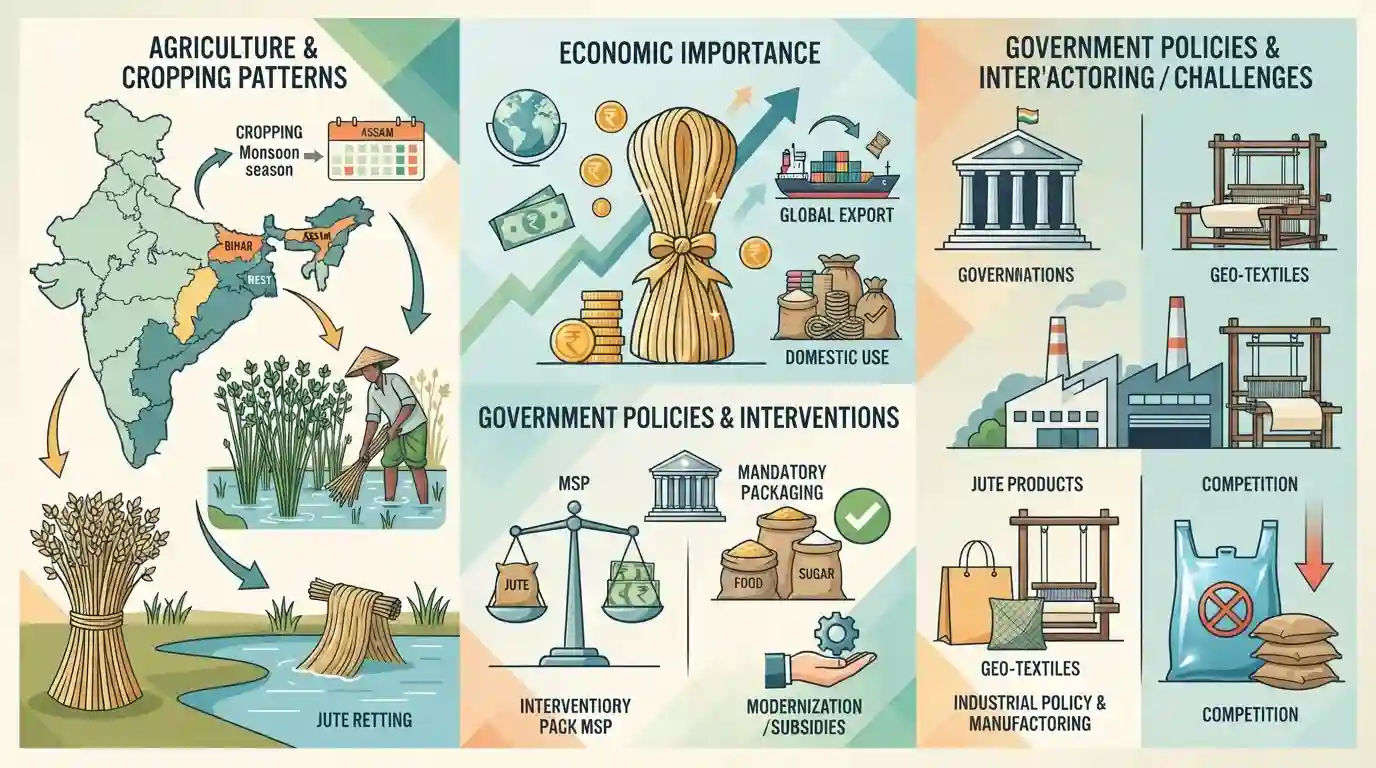
Jute cultivation and its agro-processing industry form a vital pillar of the rural economy in Eastern India. Understanding government interventions like MSP, packaging mandates, and sustainability challenges is essential for questions on cropping patterns, agro-industries, and inclusive manufacturing growth under GS Paper III.
સારાંશ
The PIB article highlights the significance of jute as India's 'Golden Fibre', focusing on its economic importance, geographical distribution, government support mechanisms (such as MSP and mandatory packaging acts), and challenges related to modernization and competition from synthetics.
મુખ્ય મુદ્દા
- Jute is known as India's 'Golden Fibre', playing a crucial role in the rural economy, particularly in eastern India like West Bengal.
- The government supports the jute sector through mandatory packaging laws, Minimum Support Price (MSP) for raw jute, and promotional initiatives by the National Jute Board.
- The industry faces multiple challenges, including competition from synthetic substitutes, modernization needs, and fluctuating raw material supply.
- Sustainable, eco-friendly properties of jute offer immense potential under global green initiatives and circular economy goals.
મહત્વપૂર્ણ શબ્દો
Jute Packaging Materials (Compulsory Use in Packaging) Act, 1987

A legislation that empowers the Central Government to mandate the use of jute packaging material for specific essential commodities, such as foodgrains and sugar, to secure domestic market demand.
UPSC context
UPSC Prelims/Mains (Economy & Polity): Important statutes, government interventions, and industrial protection for traditional sectors.
National Jute Board
The apex statutory body established under the Ministry of Textiles to promote the overall development, R&D, and global competitiveness of the Indian jute sector.
UPSC context
UPSC Prelims: Statutory bodies, organizational mandates, and institutional frameworks under central ministries.
Minimum Support Price (MSP)
An agricultural price policy tool through which the government procures specified crops at a guaranteed floor price to protect farmers from price volatility.
UPSC context
UPSC Prelims/Mains (Agriculture): Price policy, procurement mechanism, food security, and farmers' income support.
સંલગ્ન સ્થિર ખ્યાલો
What are the ideal agro-climatic conditions and geographical concentration of jute cultivation in India?
- Climate Requirements: High temperatures ranging from 25°C to 35°C along with heavy rainfall (120–150 cm) and high humidity.
- Soil Type: Well-drained fertile alluvial soils of the floodplains in the Ganga-Brahmaputra delta.
- Geographical Distribution: West Bengal accounts for the vast majority of India's raw jute production, followed by Bihar, Assam, and Odisha.
આંતર-વિષય પેટર્ન
Jute packaging mandates vs. plastic bans
Jute policy intersects with environmental laws as single-use plastic bans drive demand for biodegradable natural fibres under global circular economy frameworks.
Cash crop support and regional development
Agri-industrial schemes connect traditional cash crops in eastern India with rural employment guarantees and export competitiveness under the Ministry of Textiles.

Expect a statement-based prelims question combining agro-climatic conditions of jute with statutory backing of the Jute Packaging Act.
સંલગ્ન PYQ · 2
સંલગ્ન PYQ · 2
- 2018MainsGS3
What do you mean by Minimum Support Price (MSP)? How will MSP rescue the farmers from the low income trap?
- 2020PrelimsGS1
"The crop is subtropical in nature. A hard frost is injurious to it. It requires at least 210 frost-free days and 50 to 100 centimeters of rainfall for its growth. A light well-drained soil capable of retaining moisture is ideally suited for the cultivation of the crop." Which one of the following is that crop?
