Western Zonal Council and Cooperative Federalism in India
Source:PIB ↗
આ શા માટે મહત્વનું છે
Zonal Councils are vital statutory instruments for promoting cooperative federalism, resolving regional disputes, and aligning developmental and security policies between the Centre and states outside the adversarial litigation framework.
સારાંશ
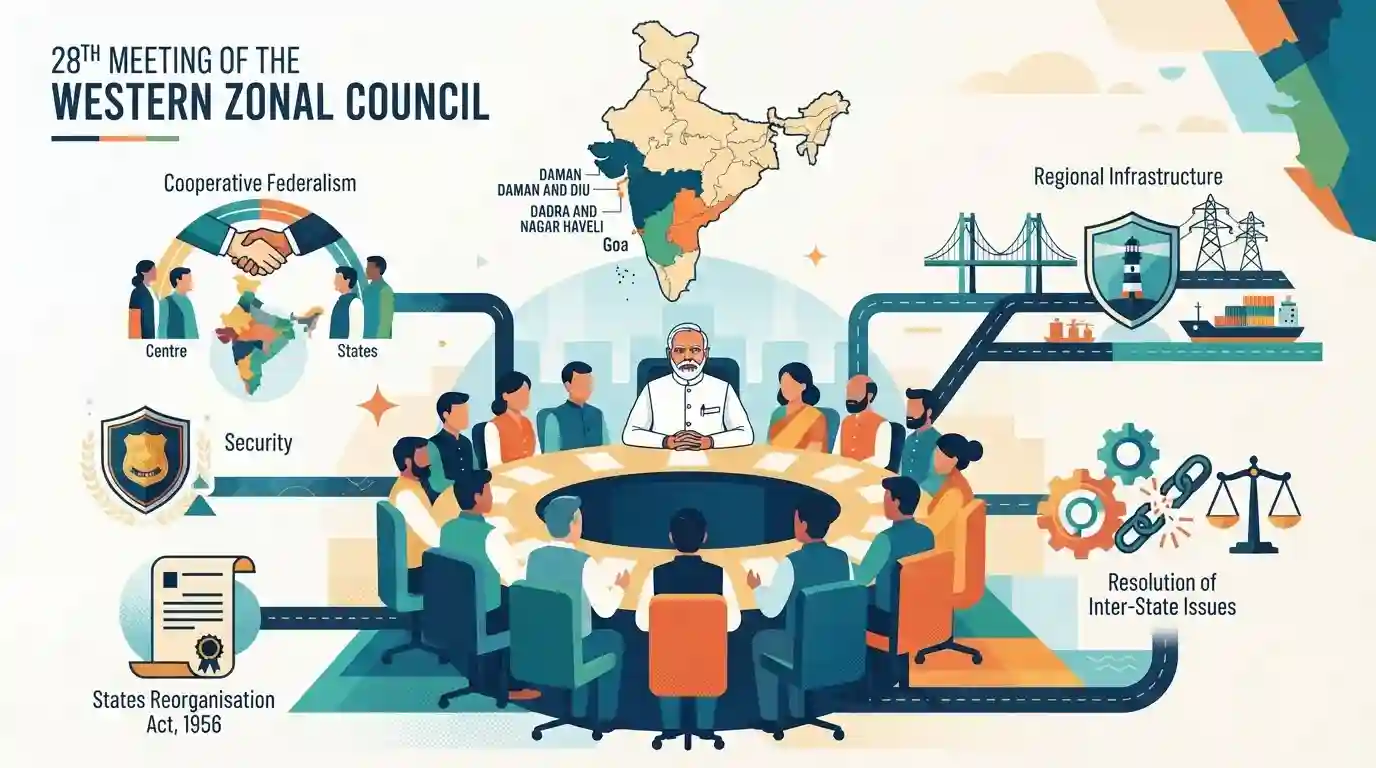
Union Home Minister Amit Shah chaired the 28th meeting of the Western Zonal Council in Panaji, Goa, focusing on cooperative federalism, regional infrastructure, security, and the resolution of inter-state issues under the framework of the States Reorganisation Act, 1956.
મુખ્ય મુદ્દા
- Union Home Minister Shri Amit Shah chaired the 28th meeting of the Western Zonal Council in Panaji, Goa.
- Zonal Councils are statutory bodies established under the States Reorganisation Act, 1956 to promote interstate cooperation and cooperative federalism.
- The meeting discussed regional developmental issues, security matters, infrastructure, and socio-economic integration among member states of the Western Zone.
- Emphasized resolving pending inter-state disputes and enhancing coordination between the Centre and States.
મહત્વપૂર્ણ શબ્દો
States Reorganisation Act 1956

A landmark 1956 legislation enacted under Article 3 of the Constitution that reorganised India's state boundaries primarily on linguistic lines and abolished the old Part A-D state classifications.
UPSC context
UPSC Prelims/Mains (GS Paper 2 - Polity): Tests understanding of evolution of states, federal design, and internal territorial adjustments.
Western Zonal Council
A statutory advisory council comprising Goa, Gujarat, Maharashtra, and associated Union Territories, established to promote regional coordination and cooperative federalism under the 1956 Act.
UPSC context
UPSC Prelims/Mains (GS Paper 2 - Federal Structure): Tests mechanisms of inter-state dispute resolution, regional planning, and cooperative federalism.
Ministry of Home Affairs
The central government ministry responsible for internal security, domestic policy, centre-state relations, and administrative oversight of statutory forums like the Zonal Councils.
UPSC context
UPSC Prelims/Mains (GS Paper 2 - Governance): Tests the role of nodal central ministries in maintaining internal security and coordinating federal administration.
પ્રિલિમ્સ ટ્રેપ
Zonal Councils are constitutional bodies established under Article 263 of the Constitution of India to promote cooperative federalism.
Aspirants often confuse Zonal Councils with constitutional bodies like the Inter-State Council (Article 263). Zonal Councils are statutory bodies created by an Act of Parliament (States Reorganisation Act, 1956).
સંલગ્ન સ્થિર ખ્યાલો
What are the key structural and functional features of Zonal Councils in India?
- Statutory Basis: Statutory origin created under Section 15 to 22 of the States Reorganisation Act, 1956, not the Constitution.
- Chairman: Union Home Minister is the common Chairman of all five Zonal Councils (Northern, Central, Eastern, Western, Southern).
- Vice-Chairman: Chief Ministers of the member states act as Vice-Chairmen by rotation, holding office for one year at a time.
- Advisory Role: Act as purely advisory bodies meant to discuss and make recommendations on socio-economic and security matters of common interest.
આંતર-વિષય પેટર્ન
Zonal Councils vs. Judicial Interstate Dispute Resolution
Zonal Councils handle interstate border, water, and security disputes, overlapping with the Supreme Court's original jurisdiction under Article 131 and Interstate Water Disputes Act, 1956.
Cooperative Federalism: Zonal Councils & NITI Aayog
Zonal Councils provide a structured platform for regional socio-economic planning, complementing NITI Aayog's mandate for cooperative federalism and bottom-up economic strategies.

Expect a statement-based prelims question distinguishing constitutional bodies (like Inter-State Council) from statutory Zonal Councils.
સંલગ્ન PYQ · 2
સંલગ્ન PYQ · 2
- 2015MainsGS2
The concept of cooperative federalism has been increasingly emphasized in recent years. Highlight the drawbacks in the existing structure and the extent to which cooperative federalism would answer the shortcomings.
- 2025PrelimsGS1
With reference to India, consider the following: I. The Inter-State Council II. The National Security Council III. Zonal Councils How many of the above were established as per the provisions of the Constitution of India?
