Narcotics Control and Zero Tolerance Policy Against Drug Trade
Source:PIB ↗
ఇది ఎందుకు ముఖ్యం
This press briefing underlines the highest-level political commitment and strategic framework adopted by India to tackle drug trafficking, which directly threatens internal security, youth welfare, and fuels transnational organized crime and terror financing.
సారాంశం
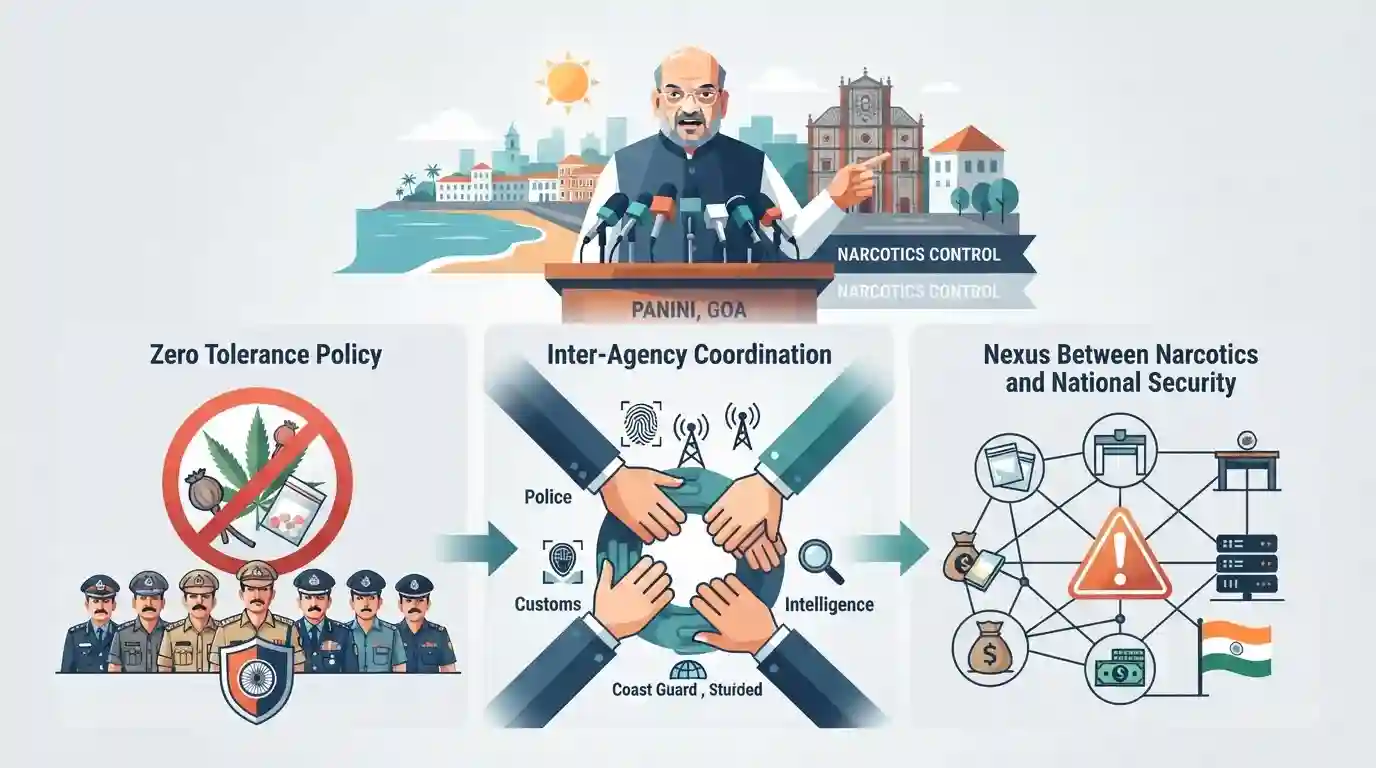
Union Home Minister and Minister of Cooperation Shri Amit Shah addressed a press conference on narcotics control in Panaji, Goa, highlighting India's zero-tolerance policy towards drug trafficking, inter-agency coordination, and the critical nexus between narcotics and national security.
ముఖ్య అంశాలు
- Union Home Minister and Minister of Cooperation Shri Amit Shah addressed a press conference on narcotics control in Panaji, Goa.
- Emphasized a zero-tolerance policy against drug trafficking and illicit narcotics trade in India.
- Highlighted the destruction of seized drugs and concerted institutional synergy among central and state agencies to dismantle drug networks.
- Stressed the link between narco-trade and internal security threats like terror funding and organized crime.
ముఖ్యమైన పదాలు
Narcotic Drugs and Psychotropic Substances (NDPS) Act

India's principal statutory legislation enacted in 1985 that prohibits the production, possession, sale, purchase, transport, or consumption of narcotic drugs and psychotropic substances, prescribing strict penal measures.
UPSC context
Relevant for GS Paper III (Internal Security - drug trafficking, border security, and organized crime nexus).
Narcotics Control Bureau (NCB)
India's apex federal law enforcement and intelligence agency created under the NDPS Act to combat drug trafficking and coordinate inter-agency anti-narcotics operations.
UPSC context
Important for GS Paper III (Internal Security, institutional mechanisms for law enforcement and counter-narcotics).
Ministry of Home Affairs
The central government ministry responsible for internal security, border management, policing, and administration of core anti-narcotics statutes and agencies in India.
UPSC context
Crucial for GS Paper II and III (Government Ministries, governance structure, and internal security apparatus).
Ministry of Cooperation
A distinct ministerial body in India focused on strengthening the cooperative movement, providing a separate administrative framework to deepen cooperative governance across sectors.
UPSC context
Relevant for GS Paper II (Government Policies and Interventions for development and institutional governance).
అనుసంధానమైన స్థిర భావనలు
What are the key geographical drug supply regions flanking India?
- Golden Triangle:: Comprising Myanmar, Laos, and Thailand; major source of synthetic drugs and heroin entering India's Northeast.
- Golden Crescent:: Comprising Afghanistan, Iran, and Pakistan; primary source of opiate trafficking impacting India's western borders.
అంతర-అంశ నమూనాలు
Narco-Terrorism and AML/CFT Compliance
Illicit drug syndicates frequently rely on underground hawala networks and cryptocurrency channels, connecting anti-narcotics enforcement directly with PMLA and FATF compliance evaluations.
Maritime Security and Drug Corridors
Trafficking routes spanning the Golden Triangle and Golden Crescent intersect with maritime security vulnerabilities along India's peninsular coastline.

Expect statements on NCORD, NDPS Act amendments, and the Golden Crescent/Triangle transit vulnerabilities in internal security MCQs.
అనుసంధాన PYQలు · 2
అనుసంధాన PYQలు · 2
- 2018MainsGS3
India's proximity to two of the world's biggest illicit opium-growing states has enhanced her internal security concerns. Explain the linkages between drug trafficking and other illicit activities such as gunrunning, money laundering and human trafficking. What counter-measures should be taken to prevent the same?
- 2023MainsGS3
What are the internal security challenges being faced by India? Give out the role of Central Intelligence and Investigative Agencies tasked to counter such threats.
