National Meet Focuses on State Level Biodiversity Governance Framework
Source:PIB ↗
हे का महत्त्वाचे आहे
It addresses the grassroots implementation mechanisms of India's biodiversity laws, vital for environmental conservation, sustainable development, and fulfillment of international biodiversity commitments.
सारांश
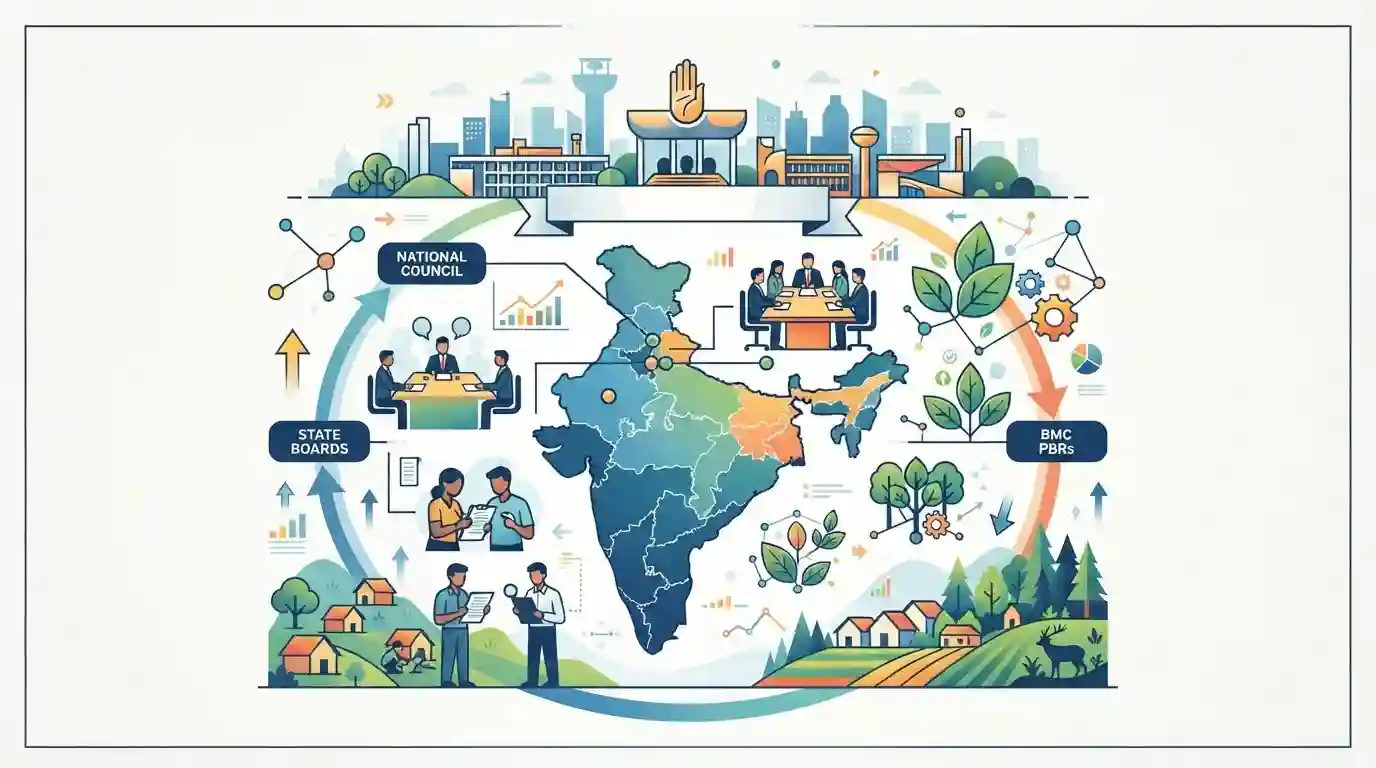
The 16th National Meet of State Biodiversity Boards and Union Territory Biodiversity Councils convened in Chandigarh to deliberate on strengthening biodiversity governance across state and local tiers, reinforcing the implementation of the Biological Diversity Act through decentralized frameworks like BMCs and PBRs.
मुख्य मुद्दे
- The 16th National Meet of State Biodiversity Boards and Union Territory Biodiversity Councils was held at Chandigarh.
- Focus was placed on the effective implementation of the biodiversity governance framework at state, local, and grassroots levels.
- Emphasized decentralized conservation, empowerment of Biodiversity Management Committees (BMCs), and documentation of People's Biodiversity Registers (PBRs).
- Highlighted cooperative federalism and sharing of best practices among states and Union Territories for sustainable biodiversity management.
महत्त्वाच्या संज्ञा
Biological Diversity Act

India's landmark 2002 legislation enacted to conserve biodiversity, ensure sustainable use of its components, and promote fair and equitable sharing of benefits arising from biological resources.
UPSC context
Crucial for UPSC Prelims and Mains (GS Paper III - Environment, Biodiversity, and Statutory Frameworks).
National Biodiversity Authority
A statutory autonomous body established in 2003 under the Biological Diversity Act, 2002, to regulate access to biological resources and advise the central government on conservation.
UPSC context
Important for Prelims and GS Paper III regarding institutional bodies in environmental governance.
State Biodiversity Boards
State-level statutory bodies established under the Act to regulate commercial access to biological resources by Indians and advise state governments on biodiversity preservation.
UPSC context
Tests federal structures and decentralized environmental governance under GS Paper II and III.
Union Territory Biodiversity Councils
Union Territory-level bodies that execute biodiversity governance, streamline local conservation initiatives, and enforce the Biological Diversity Act at the UT tier.
UPSC context
Relevant for decentralized administration and environmental policy implementation in Union Territories (GS Paper II/III).
Ministry of Environment, Forest and Climate Change
The nodal union ministry responsible for planning, promoting, and coordinating environmental and forestry policies, including the oversight of biodiversity legislation in India.
UPSC context
Core ministry for governance questions across GS Paper II (Ministries/Policies) and GS Paper III (Environment & Ecology).
पूर्वपरीक्षा सापळा
Biodiversity Management Committees (BMCs) are statutory bodies constituted directly by the National Biodiversity Authority at village levels.
Aspirants often confuse BMCs as being formed directly by the National Biodiversity Authority, whereas they are constituted by local bodies (panchayats/municipalities) under state-level frameworks.
संबंधित स्थिर संकल्पना
What are the statutory tiers and key documentation tools under India's Biological Diversity Act, 2002?
- Institutional Tiers: Three-Tier Structure comprises National Biodiversity Authority (NBA), State Biodiversity Boards (SBBs), and local Biodiversity Management Committees (BMCs).
- PBR Documentation: People's Biodiversity Registers (PBRs) document local biological resources, floral/faunal diversity, and associated traditional knowledge at the grassroots level.
- Benefit Sharing: Access and Benefit-Sharing (ABS) mechanism ensures equitable sharing of monetary and non-monetary benefits with local indigenous knowledge providers.
आंतर-विषय नमुने
Biodiversity Governance + Decentralized Local Administration
India's three-tier environmental setup mirrors Panchayati Raj devolution, linking grassroots BMCs directly with local self-government bodies for sustainable natural resource governance.
Domestic Environmental Statutes + International Treaty Obligations
The Biological Diversity Act operationalizes India's international commitments under the CBD and Nagoya Protocol at domestic grassroots tiers through PBR documentation.

Expect statements combining NBA's statutory powers, PBR mandates, and the 2023 Amendment's decriminalization/ease-of-doing-business changes.
संबंधित PYQ · 3
संबंधित PYQ · 3
- 2023PrelimsGS1
'Invasive Species Specialist Group' (that develops Global Invasive Species Database) belongs to which one of the following organizations?
- 2015PrelimsGS1
The Genetic Engineering Appraisal Committee is constituted under the
- 2024PrelimsGS1
The organisms “Cicada, Froghopper and Pond skater" are:
