Indore Metro Priority Corridor inaugurated for sustainable mobility
Source:PIB ↗
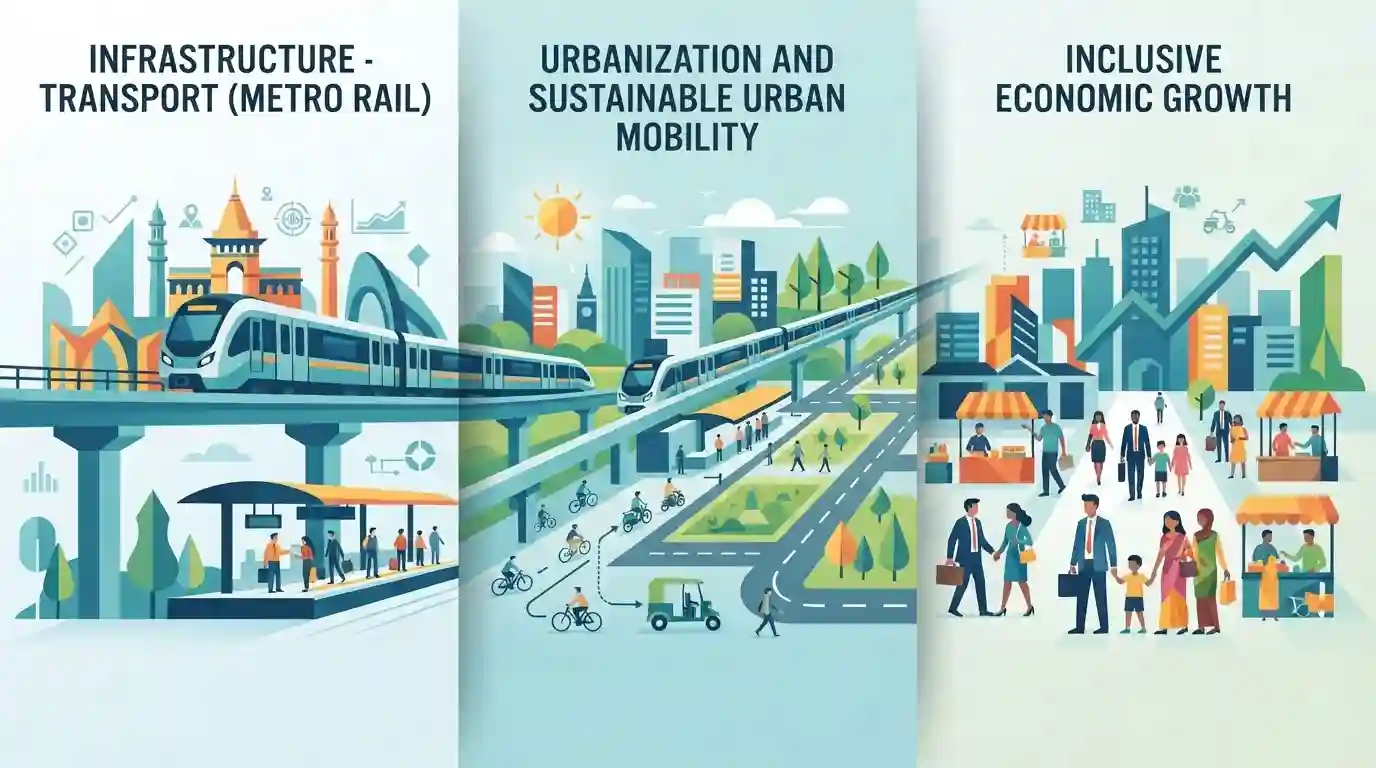
Why It Matters
The expansion of metro rail projects beyond megacities into Tier-2 cities like Indore represents a critical shift in India's urban planning, focusing on sustainable mobility, reducing carbon footprint, and enhancing regional economic productivity.
Summary
The article covers the inauguration of the Indore Metro Priority Corridor, highlighting advancements in urban mass rapid transit systems (MRTS) and infrastructure development in Tier-2 cities of India to bolster sustainable mobility and economic growth.
Key Points
- Inauguration of the Indore Metro Priority Corridor, marking a significant milestone in Madhya Pradesh's urban public transport infrastructure.
- Enhancing mass rapid transit systems (MRTS) to promote sustainable urban mobility, reduce traffic congestion, and lower carbon emissions in Tier-2 cities.
- Integration of modern transit infrastructure with regional development to support inclusive economic growth and urban transformation.
Important Terms
Metro Rail Policy

A framework introduced by the Government of India in 2017 to standardize metro rail project planning, ensure financial viability, mandate private sector participation, and encourage multi-modal integration for sustainable urban mobility.
UPSC context
Relevant for UPSC CSE Mains GS Paper III (Infrastructure - Transport and Urban Planning); tests knowledge of financing and policy frameworks for urban mass transit.
Indore Metro
A rapid mass transit system serving Indore, Madhya Pradesh, developed by MPMRCL to improve urban mobility, lower emissions, and boost economic connectivity in Tier-2 cities.
UPSC context
Important for GS Paper III (Infrastructure and Regional Development); tests understanding of mass rapid transit systems (MRTS) expansion in non-metropolitan urban centers.
Static Concepts Connected
What are the key funding models and provisions under the Metro Rail Policy, 2017?
- PPP Mandate: Mandates private sector participation (PPP) as a mandatory prerequisite for central financial assistance for new metro projects.
- Revenue Streams: Emphasizes Non-Fare Box Revenue (NFBR) monetization from real estate, advertisements, and parking to ensure project financial viability.
- Alternative Analysis: Requires an Alternative Analysis (AA) study to evaluate the most cost-effective mass rapid transit system for the city.
Cross-Topic Patterns
Tier-2 Metros & Decentralized Urban Growth
Tier-2 metro projects reflect India's strategy to decentralize urban economic growth away from overcrowded megacities, linking with PM GatiShakti multi-modal connectivity targets.

Metro Rail Policy 2017 funding criteria and non-fare box revenue models are high-yield areas for Prelims economic infrastructure questions.
Linked PYQs · 2
Linked PYQs · 2
- 2022MainsGS3
Why is Public Private Partnership (PPP) required in infrastructural projects ? Examine the role of PPP model in the redevelopment of Railway Stations in India.
- 2021MainsGS3
“Investment in infrastructure is essential for more rapid and inclusive economic growth.” Discuss in the light of India's experience.
