NCSC seeks time bound response on SC reservation denial
Source:PIB ↗
Why It Matters
It highlights the operational efficacy, powers, and role of the National Commission for Scheduled Castes (NCSC) in investigating grievances and safeguarding constitutional reservation rights for marginalized sections.
Summary
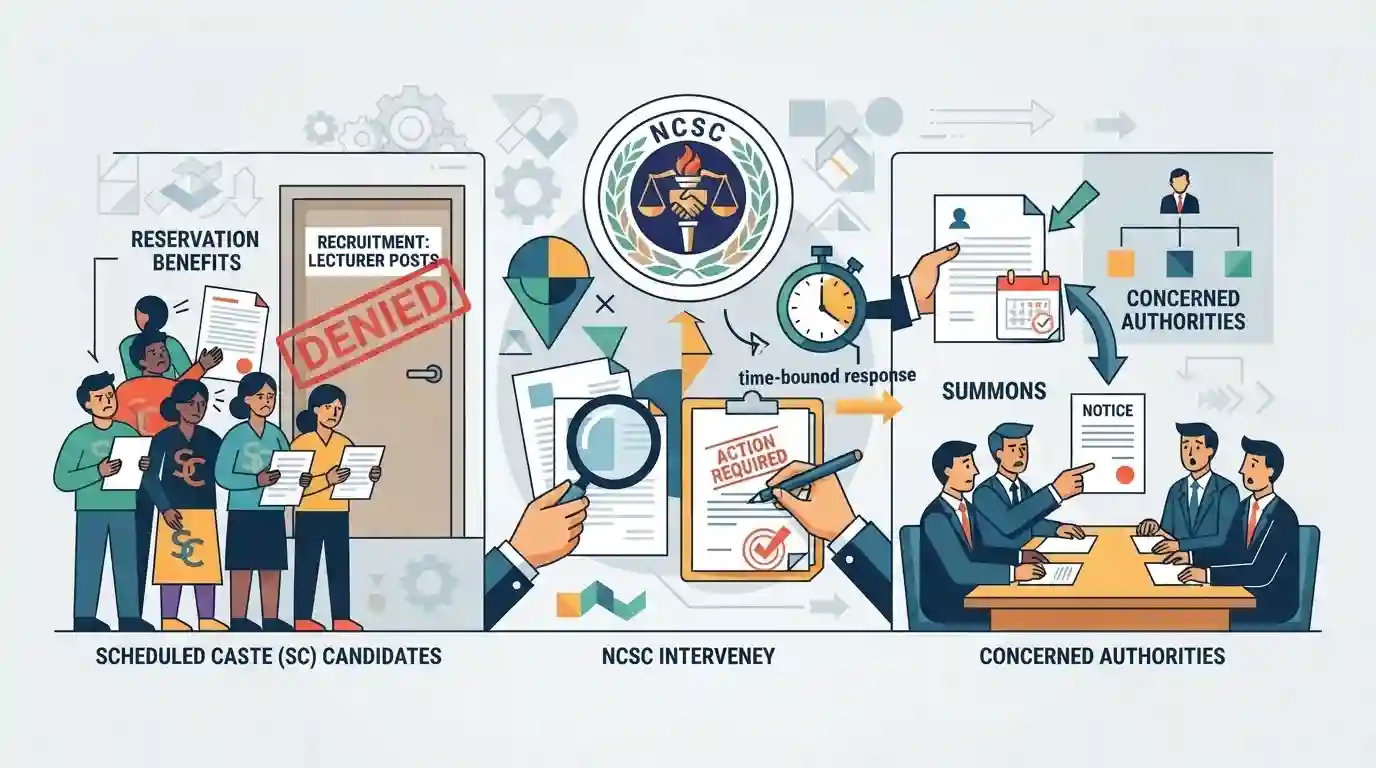
The National Commission for Scheduled Castes (NCSC) has intervened in a complaint concerning the denial of reservation benefits to SC candidates during a recruitment process for lecturer posts, demanding a time-bound response from the concerned authorities.
Key Points
- The National Commission for Scheduled Castes (NCSC) has sought a time-bound response regarding a complaint about the denial of reservation benefits to Scheduled Caste (SC) candidates in lecturer post recruitment.
- NCSC invoked its constitutional mandate to protect the rights and safeguards provided for Scheduled Castes under the Constitution of India.
- The case highlights issues regarding procedural compliance and implementation lapses in reservation policies during institutional recruitments.
Important Terms
National Commission for Scheduled Castes

A constitutional body established under Article 338 of the Constitution to protect Scheduled Castes against exploitation, investigate complaints regarding the deprivation of their rights, and monitor safeguards.
UPSC context
UPSC GS Paper II (Polity and Governance): Important constitutional bodies, statutory bodies, and mechanisms for the protection of vulnerable sections.
NCSC
A multi-member constitutional watchdog vested with civil court powers to examine grievances concerning reservation benefits, discrimination, and socio-economic rights of marginalized classes.
UPSC context
UPSC GS Paper II (Social Justice): Mechanisms, laws, and institutions for the implementation of reservation policies and welfare of SCs.
Prelims Trap
The NCSC has the power to issue binding judicial orders and penalize authorities for non-compliance with reservation policies.
Aspirants often assume NCSC recommendations are legally binding judicial decrees, whereas the Commission possesses inquiry and recommendation powers akin to a civil court but lacks enforcement or punitive authority.
Static Concepts Connected
What are the constitutional powers and structural evolution of the National Commission for Scheduled Castes (NCSC)?
- Article 338: Constitutional Origin: Established under Article 338 of the Constitution to safeguard the interests of Scheduled Castes.
- 89th Amendment: Bifurcation: Formed as a distinct body via the 89th Constitutional Amendment Act, 2003, separating it from the erstwhile combined SC/ST Commission.
- Civil Powers: Civil Court Powers: Vested with powers of a civil court to summon witnesses, examine documents, and requisition public records during investigations.
- Advisory Mandate: Advisory Nature: Its findings and recommendations submitted in annual reports to the President are primarily advisory and persuasive rather than legally binding.
Cross-Topic Patterns
Constitutional Bodies vs. Administrative Tribunals
The NCSC's quasi-judicial inquiry powers intersect with administrative law principles, raising questions about whether commission recommendations are legally binding or merely advisory upon government bodies.
Reservation Implementation and Faculty Rosters
Denial of reservation benefits in institutional faculty recruitment connects directly to debates surrounding roster-point calculations and the creamy layer concept applied to public employment.

Expect a statement-based Prelims question on NCSC's civil court powers under Article 338 and its post-2003 structural bifurcation.
Linked PYQs · 1
Linked PYQs · 1
- 2018MainsGS2
Whether National Commission for Scheduled Castes (NCSC) can enforce the implementation of constitutional reservation for the Scheduled Castes in the religious minority institutions? Examine.
