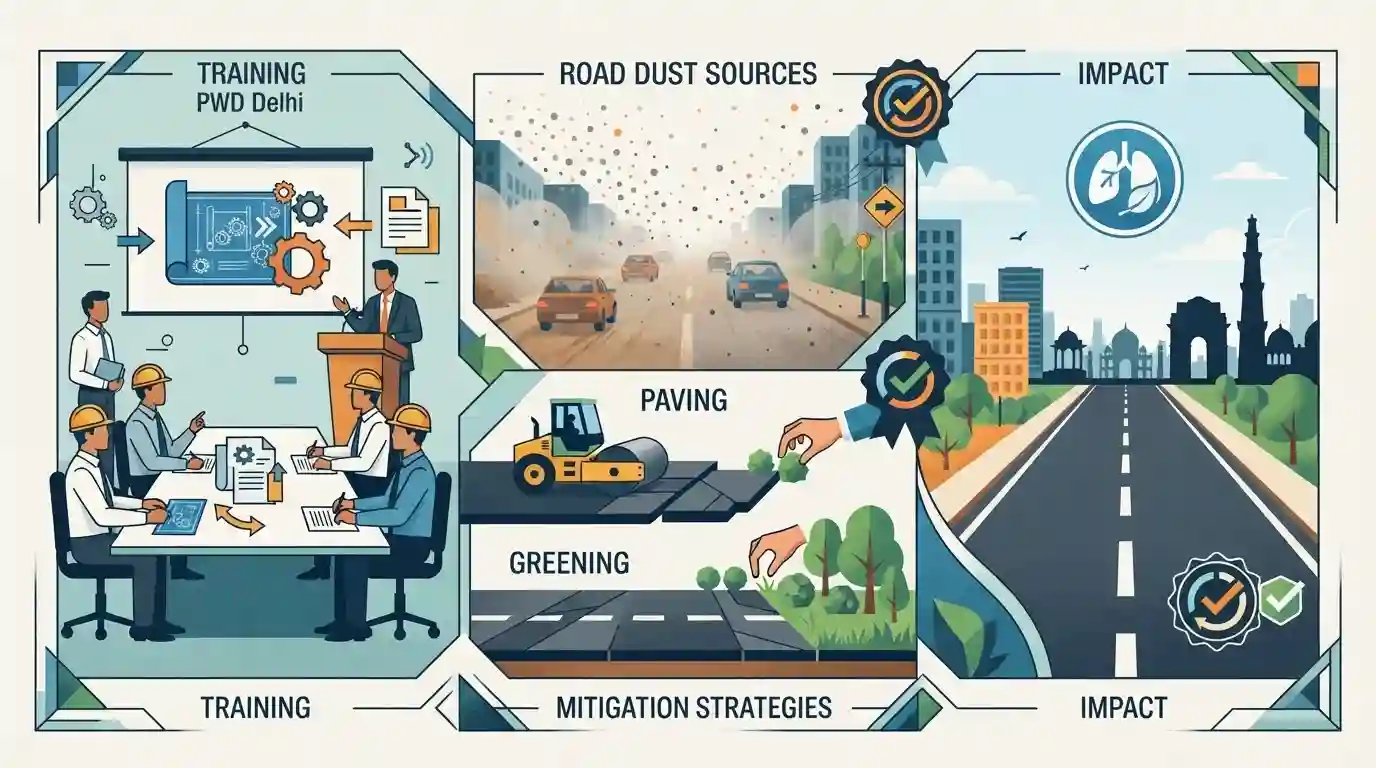
CSIR CRRI training for PWD Delhi on road dust mitigation
Source:PIB ↗
ఇది ఎందుకు ముఖ్యం
Road dust re-suspension is a primary source of particulate matter (PM2.5 and PM10) air pollution in metropolitan areas like Delhi. Training municipal and PWD engineers on standardized paving and greening frameworks bridges the gap between statutory environmental policies (CAQM directives) and grassroots execution.
సారాంశం
CSIR-CRRI organized a specialized training program for PWD Delhi engineers to implement the Commission for Air Quality Management (CAQM) Standard Framework for Paving and Greening of Urban Roads, aiming to mitigate road dust pollution in the National Capital Region.
ముఖ్య అంశాలు
- CSIR-Central Road Research Institute (CSIR-CRRI) conducted specialized training for Public Works Department (PWD) Delhi engineers on the CAQM Standard Framework for Paving and Greening of Urban Roads.
- The initiative aims to curb dust pollution, which is a major contributor to poor air quality in Delhi-NCR, through scientific paving and greening methods.
- The training program focuses on standardizing road construction, maintenance, and green buffer development to minimize road dust re-suspension and improve urban environments.
- Collaborative institutional capacity building is highlighted as a critical step in implementing statutory clean air mandates effectively at the ground level.
ముఖ్యమైన పదాలు
Commission for Air Quality Management (CAQM)

A statutory regulatory body established to coordinate, monitor, and take measures for better air quality management and resolution of air pollution issues in the National Capital Region and adjoining areas.
UPSC context
Important for UPSC Prelims and Mains (GS Paper III: Environment, Pollution Control, and Statutory Regulatory Bodies).
CSIR-CRRI
A premier national research laboratory under the Council of Scientific and Industrial Research specializing in design, construction, maintenance, and traffic management of roads and highways.
UPSC context
Important for UPSC Prelims/Mains regarding scientific institutions, indigenous research, and technology-driven infrastructure solutions for urban management.
CAQM Standard Framework for Paving and Greening of Urban Roads
A comprehensive technical guideline issued to standardize urban road cross-sections, end-to-end paving, and right-of-way greening to mitigate fugitive road dust emissions across the NCR.
UPSC context
Important for GS Paper III (Environmental Degradation, Air Pollution Mitigation Strategies, and Sustainable Urban Planning).
PWD Delhi
The state government engineering agency responsible for the planning, design, construction, and maintenance of public buildings and urban road infrastructure in the National Capital Territory of Delhi.
UPSC context
Important for governance, urban infrastructure execution, and municipal policy implementation in the national capital region.
ప్రిలిమ్స్ ఉచ్చు
The Commission for Air Quality Management (CAQM) is an executive body established through a Ministry of Environment resolution.
Aspirants often confuse CAQM as an executive body or a sub-committee of the MoEFCC, whereas it is an independent statutory body established by a specific Act of Parliament.
అనుసంధానమైన స్థిర భావనలు
What are the key statutory powers and composition of the Commission for Air Quality Management (CAQM)?
- Act of Parliament: Statutory Basis: Established under the Commission for Air Quality Management in National Capital Region and Adjoining Areas Act, 2021.
- Territorial Scope: Jurisdiction: Covers Delhi and adjoining areas in Haryana, Punjab, Rajasthan, and Uttar Pradesh, superseding state pollution control boards on air matters.
- Regulatory Powers: Powers: Can issue binding directions, entertain complaints, impose environmental compensation, and inspect premises to curb air pollution.
అంతర-అంశ నమూనాలు
Statutory Bodies and Urban Federalism Dynamics
The CAQM statutory framework illustrates how central environmental bodies coordinate implementation across state-level executing agencies like PWD Delhi under cooperative federalism mandates.
Urban Infrastructure and Air Quality Governance
Road dust mitigation strategies bridge technological engineering interventions (CSIR-CRRI) with statutory urban air quality management targets in the NCR.

CAQM statutory powers, jurisdiction, and multi-agency enforcement mechanisms are prime targets for Prelims statement-based questions.
అనుసంధాన PYQలు · 2
అనుసంధాన PYQలు · 2
- 2021MainsGS3
Describe the key points of the revised Global Air Quality Guidelines (AQGs) recently released by the World Health Organisation (WHO). How are these different from its last update in 2005? What changes in India's National Clean Air Programme are required to achieve these revised standards?
- 2024MainsGS3
Flooding in urban areas is an emerging climate-induced disaster. Discuss the causes of this disaster. Mention the features of two such major floods in the last two decades in India. Describe the policies and frameworks in India that aim at tackling such floods.
