Western Zonal Council meeting focusing on cooperative federalism
Source:PIB ↗
આ શા માટે મહત્વનું છે
The meeting of the Western Zonal Council highlights the operational mechanism of statutory consultative bodies in promoting cooperative federalism, resolving Centre-State and inter-state disputes, and addressing regional development challenges in India.
સારાંશ
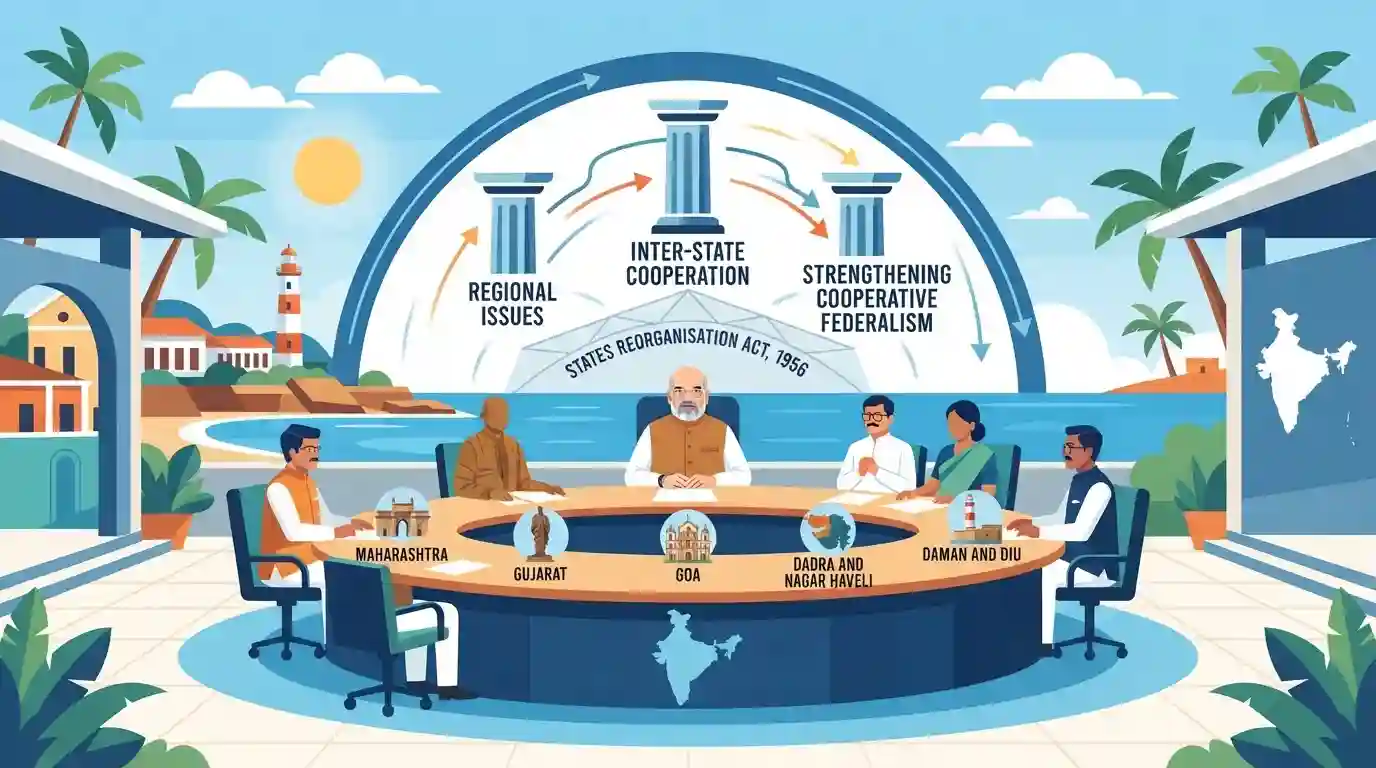
Union Home Minister Amit Shah chaired the 28th meeting of the Western Zonal Council in Panaji, Goa, focusing on regional issues, inter-state cooperation, and strengthening cooperative federalism under the statutory framework of the States Reorganisation Act, 1956.
મુખ્ય મુદ્દા
- Union Home Minister and Minister of Cooperation Shri Amit Shah chaired the 28th meeting of the Western Zonal Council in Panaji, Goa.
- Zonal Councils are statutory bodies established under the States Reorganisation Act, 1956 to promote interstate and Centre-state cooperation and cooperative federalism.
- The Western Zonal Council comprises states and union territories such as Goa, Maharashtra, Gujarat, and Dadra and Nagar Haveli and Daman and Diu.
- Zonal councils provide a regional forum to discuss issues relating to boundary disputes, linguistic minorities, infrastructure, and socio-economic development.
મહત્વપૂર્ણ શબ્દો
States Reorganisation Act, 1956

A landmark 1956 parliamentary legislation enacted to reorganize India's state boundaries largely on linguistic lines, which also statutorily established Zonal Councils under Part III to promote interstate and center-state cooperation.
UPSC context
Important for UPSC Prelims and GS Paper II (Polity & Governance - evolution of states, federal structure, and statutory bodies).
Western Zonal Council
A statutory advisory council comprising western states like Goa, Gujarat, Maharashtra, and nearby Union Territories, established under the States Reorganisation Act, 1956, to resolve regional issues and foster cooperative federalism.
UPSC context
Relevant for GS Paper II (Federalism, Centre-State relations, inter-state forums, and regional councils).
Ministry of Home Affairs
The central government ministry responsible for internal security, domestic policy, centre-state relations, and the administrative oversight of the Zonal Councils via the Inter-State Council Secretariat.
UPSC context
Crucial for GS Paper II (Administrative setup, executive organs, and internal governance architecture in India).
પ્રિલિમ્સ ટ્રેપ
Zonal Councils are constitutional bodies established under Article 263 of the Constitution of India to resolve inter-state disputes.
Aspirants often confuse Zonal Councils with constitutional bodies; they are statutory bodies created by an Act of Parliament (States Reorganisation Act, 1956) and have an advisory role.
સંલગ્ન સ્થિર ખ્યાલો
What are the key structural and functional features of Zonal Councils in India?
- Legal Basis: Statutory Origin: Created under Section 15 of the States Reorganisation Act, 1956, dividing the country into five zones.
- Leadership: Composition: Union Home Minister is the common Chairman; Chief Ministers of member states act as Vice-Chairmen by rotation.
- Nature of Body: Advisory Role: They are deliberative and advisory bodies aimed at promoting cooperative federalism and resolving inter-state friction.
- Special Exclusion: Exclusions: North Eastern states are not part of these five councils; they have a separate North Eastern Council.
આંતર-વિષય પેટર્ન
Zonal Councils vs. Inter-State Council (Article 263)
While Zonal Councils provide a statutory regional forum under the 1956 Act, Article 263 establishes the Inter-State Council as a permanent constitutional body for broader Centre-state consensus building.
Cooperative Federalism and Internal Security Coordination
Regional cooperation mechanisms like Zonal Councils complement India's internal security architecture managed by the Ministry of Home Affairs, particularly in sharing intelligence and coordinating cross-border policing.

Expect a statement-based prelims question distinguishing between the statutory Zonal Councils and the constitutional Inter-State Council.
સંલગ્ન PYQ · 1
સંલગ્ન PYQ · 1
- 2025PrelimsGS1
With reference to India, consider the following: I. The Inter-State Council II. The National Security Council III. Zonal Councils How many of the above were established as per the provisions of the Constitution of India?
