India-EU Free Trade Agreement Creates Export Opportunities for MSMEs
Source:PIB ↗
কেন এটি গুরুত্বপূর্ণ
Bilateral trade agreements like the India-EU FTA play a critical role in shaping India's export growth, market access for MSMEs, and integration into global value chains amidst shifting global economic dynamics.
সারসংক্ষেপ
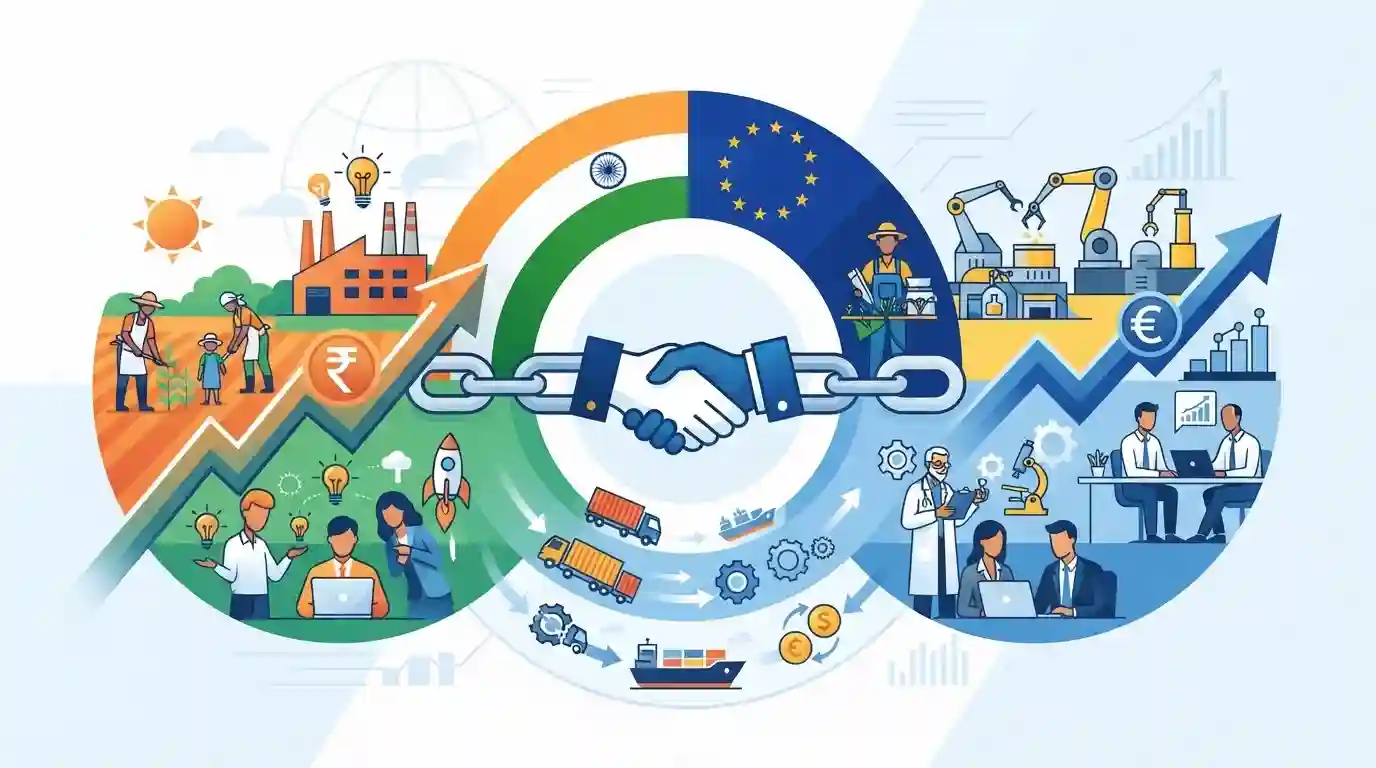
Union Commerce and Industry Minister Shri Piyush Goyal emphasized that the proposed India-EU Free Trade Agreement opens up massive opportunities for farmers, MSMEs, innovators, startups, and businesses in both regions, fostering deeper economic integration and bilateral partnership.
মূল বিষয়
- Union Commerce and Industry Minister Shri Piyush Goyal highlighted that the India-EU Free Trade Agreement (FTA) creates vast opportunities for farmers, MSMEs, innovators, startups, and businesses across India and Europe.
- The agreement aims to strengthen bilateral economic ties, market access, and cooperation across diverse sectors like technology, manufacturing, and agriculture.
- It emphasizes boosting competitiveness for Indian MSMEs and startups by integrating them into global value chains (GVCs).
গুরুত্বপূর্ণ শব্দ
India-EU Free Trade Agreement

A comprehensive trade pact between India and the 27-nation European Union designed to eliminate tariffs, boost market access, and deepen bilateral economic integration across a massive shared consumer market.
UPSC context
Important for GS Paper II (International Relations - Bilateral Groupings & Agreements) and GS Paper III (Indian Economy - Foreign Trade).
European Union
A political and economic union of 27 European member states that operates a single internal market and represents one of India's largest and most crucial trading partners.
UPSC context
Important for GS Paper II (International Relations - Regional Groupings impacting India's interests) and global economic governance.
Ministry of Commerce and Industry
The nodal central government ministry in India responsible for formulating and implementing foreign trade policy, industrial growth strategies, and commercial regulations.
UPSC context
Important for GS Paper II (Government Policies & Functioning) and GS Paper III (Industrial Policy, Growth, and Foreign Trade).
প্রিলিমস ফাঁদ
zero-duty or preferential access eliminates tariffs on all bilateral trade upon entry into force without exceptions.
An FTA completely eliminates all tariffs on all goods immediately upon signing. In reality, FTAs involve phased elimination, negative lists, and Rules of Origin (RoO) criteria to prevent duty circumvention.
সংযুক্ত স্থির ধারণা
What are the key differences between a Free Trade Agreement (FTA), a Custom Union, and a Common Market?
- Free Trade Agreement: Eliminates or reduces tariffs between member countries while each country maintains its own independent external tariff regime against non-members.
- Customs Union: Combines an FTA with a common external tariff policy applied to all non-member countries (e.g., EU Customs Union).
- Common Market: A customs union that additionally allows the free movement of labor and capital among member nations, alongside goods and services.
আন্তঃবিষয় প্যাটার্ন
India-EU FTA vs EU Carbon Border Adjustment Mechanism
India-EU negotiations intersect with WTO trade rules, particularly the 'Enabling Clause' for developing countries and debates on the EU's Carbon Border Adjustment Mechanism (CBAM).
MSMEs and Global Value Chain Integration
Integrating Indian MSMEs into European GVCs directly supports the Make in India initiative and employment targets in labor-intensive manufacturing.

Expect a multi-statement prelims question on India-EU FTA scale (GDP share, GVC integration) and strategic trade complementarities.
সংযুক্ত PYQ · 2
সংযুক্ত PYQ · 2
- 2025MainsGS3
What are the challenges before the Indian economy when the world is moving away from free trade and multilateralism to protectionism and bilateralism? How can these challenges be met?
- 2023MainsGS3
Faster economic growth requires increased share of the manufacturing sector in GDP, particularly of MSMEs. Comment on the present policies of the Government in this regard.
