Geothermal Energy Potential and Exploration Challenges in India
Source:PIB ↗
কেন এটি গুরুত্বপূর্ণ
Geothermal energy provides a reliable baseload power alternative crucial for India's transition to non-fossil fuel targets and long-term energy security. Understanding its distribution, potential, and bottlenecks is vital for Mains GS3 (Infrastructure and Energy).
সারসংক্ষেপ
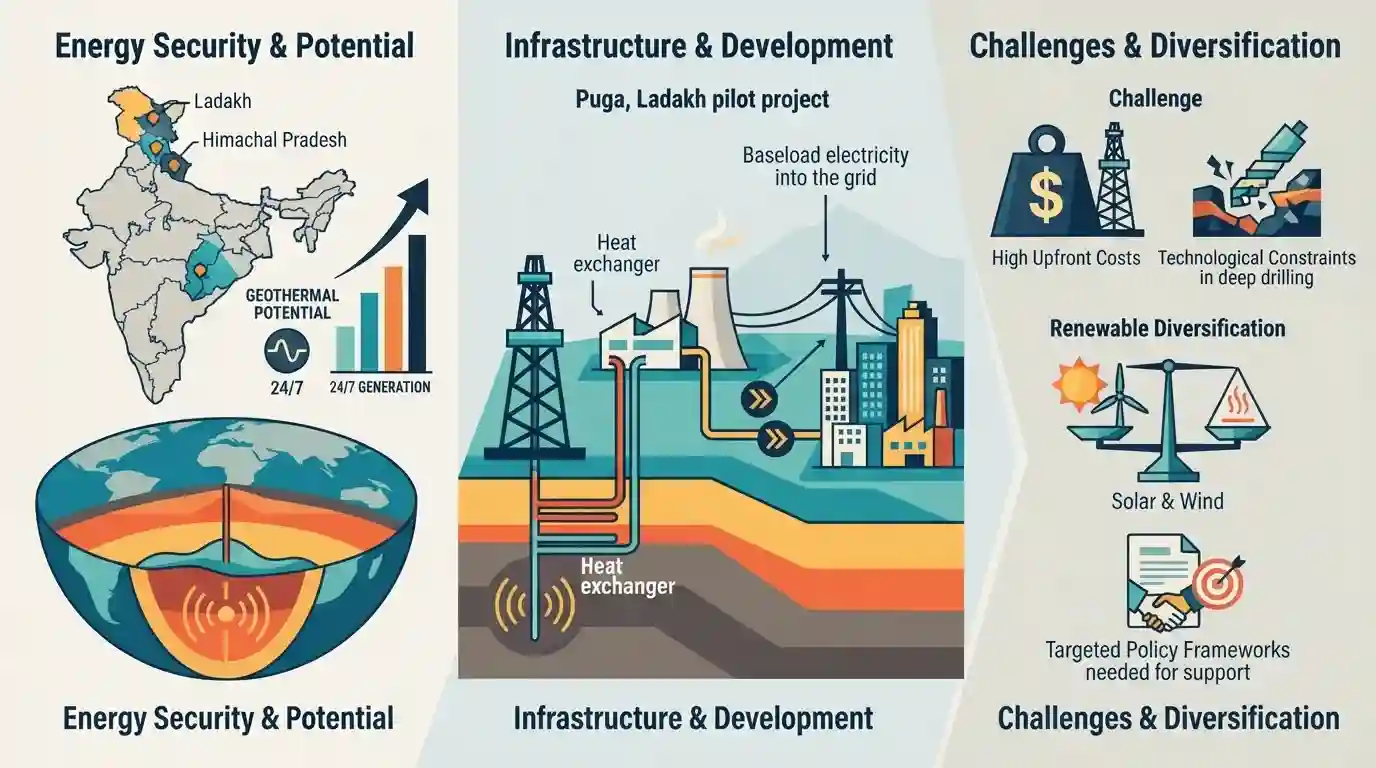
The PIB release outlines the status, potential, and development of geothermal energy in India. Geothermal energy harnesses the natural heat beneath the Earth's surface to generate continuous baseload electricity and direct heat applications. India possesses several geothermal energy provinces with significant potential, notably in Ladakh (Puga and Chhumathang), Himachal Pradesh, Chhattisgarh, and other regions. Projects like the pilot geothermal power plant in Puga, Ladakh, spearheaded by the ONGC Energy Centre, highlight India's steps towards diversifying its renewable energy basket beyond solar and wind. However, realizing the full potential of geothermal energy requires addressing high upfront capital costs, technological constraints in deep drilling, and targeted policy frameworks.
মূল বিষয়
- Geothermal energy is a clean, renewable energy source derived from the earth's internal heat, offering baseload power unlike solar or wind.
- India has several promising geothermal provinces, including Puga and Chhumathang in Ladakh, Manikaran in Himachal Pradesh, and Tattapani in Chhattisgarh.
- Pilot projects and exploratory drilling, such as the Puga Geothermal Field Development Project by ONGC Energy Centre, are driving geothermal exploration in India.
- Challenges include high upfront exploration risks, deep drilling costs, lack of long-term policy incentives, and technological gaps compared to solar/wind.
গুরুত্বপূর্ণ শব্দ
Ministry of New and Renewable Energy

The central government ministry in India responsible for formulating policies, coordinating, and promoting renewable energy sources such as solar, wind, and geothermal energy.
UPSC context
Important for GS Paper III (Environment & Energy Security); questions focus on institutional frameworks driving India's clean energy transition and net-zero targets.
ONGC Energy Centre
The research and development arm of the Oil and Natural Gas Corporation (ONGC) tasked with spearheading alternative energy initiatives, including India's first geothermal power project in Puga, Ladakh.
UPSC context
Relevant for GS Paper III (Infrastructure & Energy); tests public sector undertakings' role in diversifying India's energy basket beyond fossil fuels.
প্রিলিমস ফাঁদ
Geothermal energy requires active volcanic zones and is intermittent like solar and wind power.
Aspirants often assume geothermal energy is weather-dependent or restricted to volcanic zones, but India's geothermal potential primarily relies on hydrothermal convection systems and thermal springs outside active volcanic belts.
সংযুক্ত স্থির ধারণা
What are the major geothermal provinces and key mechanics of geothermal energy in India?
- Baseload Power: Baseload nature: Unlike solar or wind, geothermal provides continuous, weather-independent power generation.
- Key Provinces: Geothermal provinces: GSI has mapped over 381 thermal springs across 10 geothermal provinces, including Puga (Ladakh) and Tattapani (Chhattisgarh).
- Upfront Risks: Exploration challenges: High upfront capital costs and deep drilling risks constrain commercial scalability.
আন্তঃবিষয় প্যাটার্ন
Geothermal Energy + Himalayan Border Infrastructure
High-altitude geothermal projects in Ladakh link energy security with border infrastructure development, fragile Himalayan ecology, and strategic indigenous capability-building.
Upstream Hydrocarbons + Geothermal Transition
Repurposing abandoned hydrocarbon wells for geothermal energy connects upstream petroleum exploration with the transition to India's Net-Zero 2070 climate targets.

Geothermal energy + baseload renewable vs solar/wind intermittency will likely appear as a statement-based prelims question.
সংযুক্ত PYQ · 1
সংযুক্ত PYQ · 1
- 2022MainsGS3
Do you think India will meet 50 percent of its energy needs from renewable energy by 2030 ? Justify your answer. How will the shift of subsidies from fossil fuels to renewables help achieve the above objective ? Explain.
