Tribal Affairs Ministry Reviews PM JANMAN and Development Schemes
Source:PIB ↗
આ શા માટે મહત્વનું છે
PM-JANMAN and DA-JGUA represent critical government interventions targeting last-mile service delivery and holistic development for India's most marginalized tribal communities, making their execution and progress evaluation a core area for UPSC GS-2.
સારાંશ
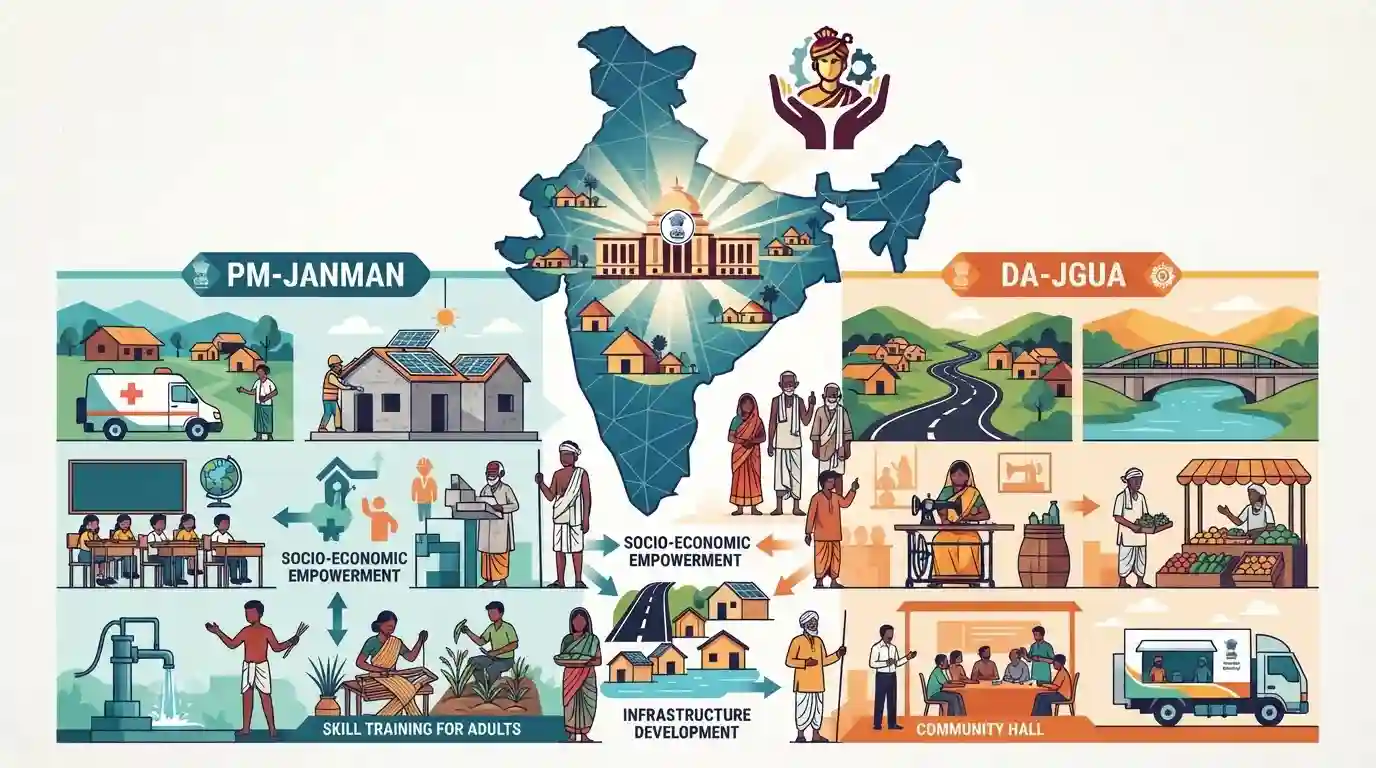
The Ministry of Tribal Affairs conducted a comprehensive review of flagship welfare initiatives—PM-JANMAN and DA-JGUA—aimed at socio-economic empowerment, infrastructure development, and saturation of basic services in particularly vulnerable tribal groups (PVTGs) and tribal habitations across India.
મુખ્ય મુદ્દા
- The Ministry of Tribal Affairs reviewed the implementation progress of PM-JANMAN (Pradhan Mantri Janjati Adivasi Nyaya Maha Abhiyan) and DA-JGUA (Dharti Aba Janjatiya Gram Utkarsh Abhiyan).
- PM-JANMAN focuses on saturated development of Particularly Vulnerable Tribal Groups (PVTGs) by providing basic infrastructure, housing, clean water, healthcare, and education.
- DA-JGUA aims for the comprehensive development and saturation of tribal villages across multiple critical sectors.
- Emphasis was laid on inter-ministerial convergence, real-time monitoring, and accelerated fund utilization to uplift remote tribal communities.
મહત્વપૂર્ણ શબ્દો
PM-JANMAN

A central government mission launched in November 2023 to provide basic infrastructure, housing, clean water, healthcare, and livelihood opportunities to 75 Particularly Vulnerable Tribal Groups (PVTGs) across India through inter-ministerial convergence.
UPSC context
Important for GS Paper II (Vulnerable Sections, Government Policies & Interventions) and Social Justice topics.
DA-JGUA
A comprehensive development campaign launched in October 2024 comprising 25 interventions across 17 line ministries to saturate infrastructural gaps and improve socioeconomic access in tribal-majority villages and habitations.
UPSC context
Relevant for GS Paper II (Welfare schemes for Scheduled Tribes, administrative convergence, and rural development).
Ministry of Tribal Affairs
The apex central government ministry in India responsible for formulating policies, planning, and coordinating programs for the socio-economic development and welfare of Scheduled Tribes and Particularly Vulnerable Tribal Groups.
UPSC context
Core institutional framework study under GS Paper II (Constitutional bodies, Ministries, and Policies for Scheduled Tribes).
પ્રિલિમ્સ ટ્રેપ
PM-JANMAN covers all tribal-majority villages across India just like DA-JGUA.
Aspirants often confuse PM-JANMAN's focus (specifically 75 PVTGs) with the broader DA-JGUA coverage (over 63,000 tribal-majority villages across 30 States/UTs).
સંલગ્ન સ્થિર ખ્યાલો
What are Particularly Vulnerable Tribal Groups (PVTGs) and how are they identified in India?
- Identification Criteria: Criteria include pre-agricultural level of technology, stagnant or declining population, extremely low literacy, and subsistence economy.
- Historical Origin: Dhebar Commission (1960-61) first created the category 'Primitive Tribal Groups' (PTGs), which was renamed PVTGs by the Government of India in 2006.
- Nodal Ministry: Ministry of Home Affairs originally determined the criteria; Ministry of Tribal Affairs now administers and executes targeted schemes for them.
આંતર-વિષય પેટર્ન
Tribal Welfare + Cooperative Federalism
The inter-ministerial convergence model used in PM-JANMAN connects tribal welfare to federal fiscal devolution and administrative coordination under cooperative federalism.
Saturation Schemes + Administrative Capacity
Saturation-approach initiatives mirror welfare delivery designs seen in Aspirational Districts Programme and Mission Indradhanush, testing last-mile administrative machinery.

PM-JANMAN (75 PVTGs, ministry count) + DA-JGUA coverage scale makes a prime target for a matching or multi-statement Prelims question.
સંલગ્ન PYQ · 2
સંલગ્ન PYQ · 2
- 2023MainsGS2
“Development and welfare schemes for the vulnerable, by its nature, are discriminatory in approach.” Do you agree? Give reasons for your answer.
- 2019PrelimsGS1
Consider the following statements about Particularly Vulnerable Tribal Groups (PVTGs) in India : 1. PVTGs reside in 18 States and one Union Territory. 2. A stagnant or declining population is one of the criteria for determining PVTG status. 3. There are 95 PVTGS officially notified in the country so far. 4. Irular and Konda Reddi tribes are included in the list of PVTGs. Which of the statements given above are correct?
