GeM and Textiles Committee Partner for Recycled Textile Procurement
Source:PIB ↗
हे का महत्त्वाचे आहे
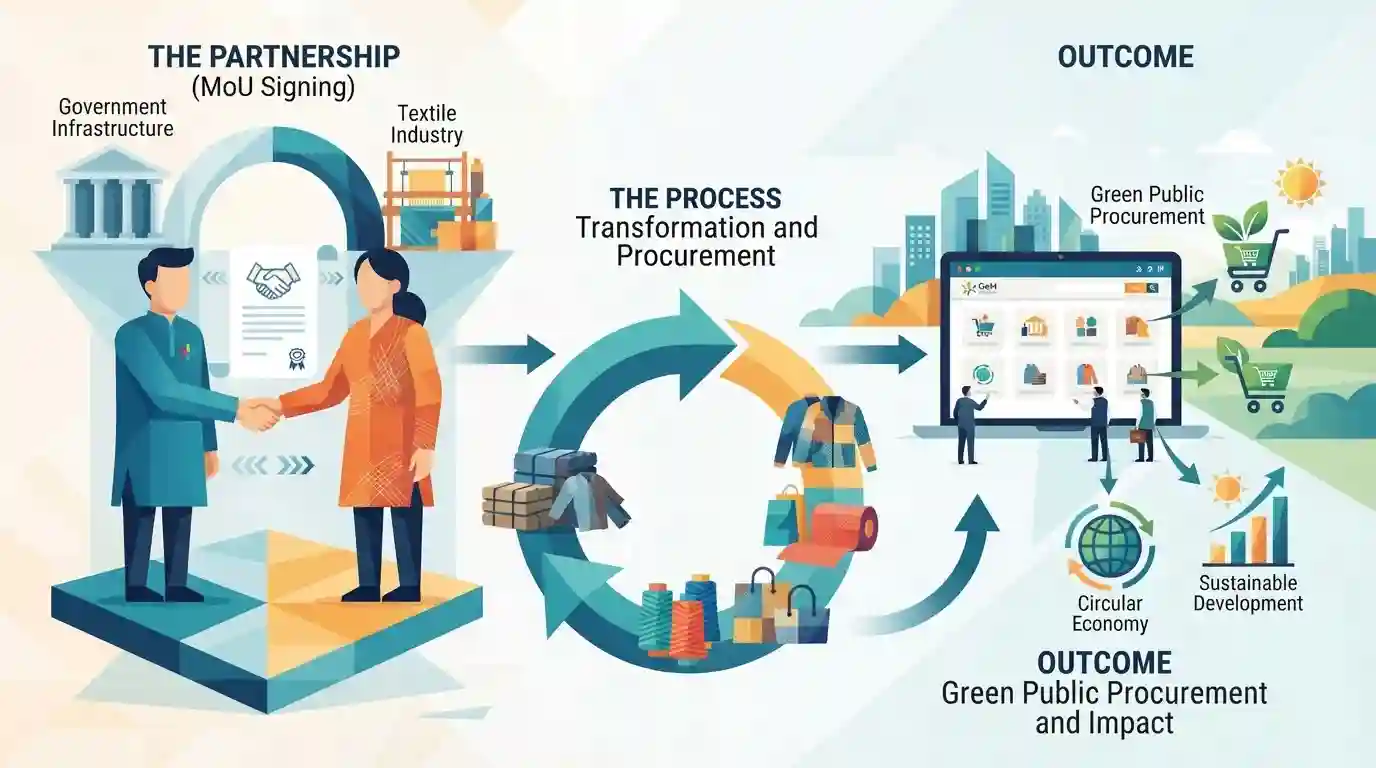
This MoU connects public procurement policies with sustainability goals, leveraging GeM's digital infrastructure to promote recycled and upcycled textiles, thereby driving the circular economy and supporting green manufacturing in India.
सारांश
The Government e-Marketplace (GeM) has signed a Memorandum of Understanding (MoU) with the Textiles Committee to facilitate and boost the procurement of recycled and upcycled textiles in public procurement. This initiative promotes circular economy practices, sustainable textile production, and green public procurement in India.
मुख्य मुद्दे
- Government e-Marketplace (GeM) and the Textiles Committee signed an MoU to promote the procurement of recycled and upcycled textiles through public procurement portals.
- The initiative aims to institutionalize sustainability and circular economy principles within government procurement processes.
- It will help institutional buyers, government departments, and public sector undertakings source eco-friendly textile products easily.
- It supports MSMEs, handloom weavers, and green manufacturing units by providing them with a transparent and direct market access platform.
महत्त्वाच्या संज्ञा
Government e-Marketplace (GeM)

A national public procurement portal launched in 2016 by the Ministry of Commerce and Industry to facilitate transparent, paperless, and efficient acquisition of goods and services by government bodies.
UPSC context
Important for GS Paper II (Governance, Transparency, E-governance initiatives) and GS Paper III (Public Procurement & Economic Reforms).
Textiles Committee
A statutory body established under the Textiles Committee Act, 1963, functioning under the Ministry of Textiles to ensure quality standards and promote research in the textile sector.
UPSC context
Relevant for GS Paper III (Indian Economy, Industrial Growth, Statutory Bodies) and institutional frameworks in manufacturing.
Ministry of Textiles
The union ministry responsible for policy formulation, regulation, development, and export promotion of the textiles industry in India.
UPSC context
Crucial for GS Paper III under government policies and interventions targeting employment-intensive manufacturing sectors like textiles.
Ministry of Commerce and Industry
The central government ministry overseeing foreign trade policies, industrial growth, commercial regulations, and bodies like the Government e-Marketplace (GeM).
UPSC context
Important for GS Paper III (Economic Development, Trade, Foreign Policy, and Public Procurement Reforms).
पूर्वपरीक्षा सापळा
The Textiles Committee is a newly formed executive body created under the Ministry of Commerce and Industry.
The Textiles Committee is a statutory body under the Ministry of Textiles, NOT a private entity or a department under the Ministry of Commerce.
संबंधित स्थिर संकल्पना
What is the institutional and governance framework of the Government e-Marketplace (GeM)?
- Launch Context: Launched in 2016 under the Ministry of Commerce and Industry for transparent public procurement.
- Ownership: Owned 100% by the Government of India through its SPV (GeM SPV).
- Statutory Mandate: Mandatory use for central ministries and public sector undertakings under Rule 149 of GFR 2017.
What is the role and statutory origin of the Textiles Committee in India?
- Statutory Origin: Established under the Textiles Committee Act, 1963 as a statutory body.
- Administrative Control: Functions under the administrative control of the Ministry of Textiles.
- Core Functions: Tasked with ensuring quality standards, textile testing, and promoting the domestic and export textile sector.
आंतर-विषय नमुने
Green Public Procurement + Net-Zero Targets
Green Public Procurement integrates environmental criteria into state purchasing, serving as a powerful demand-side lever for India's net-zero transition and circular economy goals.
Digital Public Infrastructure + Inclusive MSME Growth
GeM leverages digital public infrastructure (DPI) to democratize market access for handloom weavers and MSMEs, bypassing traditional middlemen.

Expect a statement-based prelims question combining GeM governance mandates (statutory status, 100% ownership) with circular economy initiatives.
संबंधित PYQ · 2
संबंधित PYQ · 2
- 2023MainsGS3
Faster economic growth requires increased share of the manufacturing sector in GDP, particularly of MSMEs. Comment on the present policies of the Government in this regard.
- 2019MainsGS3
It is argued that the strategy of inclusive growth is intended to meet the objectives of inclusiveness and sustainability together. Comment on this statement.
