CARA Workshop Focuses on Adoption of Children with Special Needs
Source:PIB ↗
Why It Matters
This article addresses vital policy measures, institutional coordination, and regulatory improvements concerning child adoption and welfare for vulnerable children (special needs), which directly aligns with GS2 syllabus requirements on child rights, social welfare administration, and institutional mechanisms.
Summary
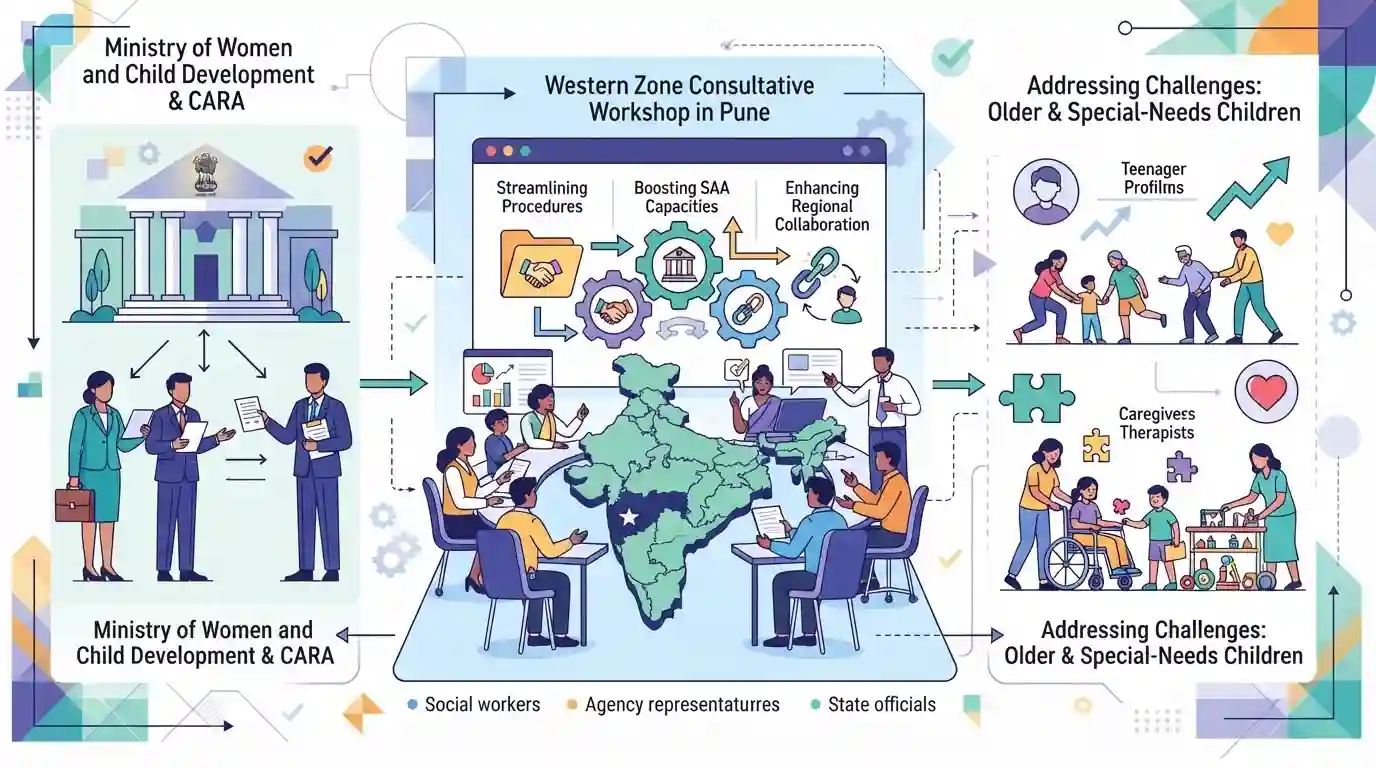
The Central Adoption Resource Authority (CARA), under the Ministry of Women and Child Development, held a Western Zone Consultative Workshop in Pune to enhance regional collaboration for the adoption of children with special needs. The workshop focused on streamlining child adoption procedures, boosting institutional capacities of Specialised Adoption Agencies (SAAs), and addressing challenges related to the adoption of older and special-needs children.
Key Points
- CARA organized a Western Zone Consultative Workshop in Pune focusing on the adoption of children with special needs.
- Emphasized regional collaboration among stakeholders like Specialised Adoption Agencies (SAAs), State Adoption Resource Agencies (SARAs), and child welfare committees.
- Highlighted the need to streamline adoption procedures, reduce pendency, and raise awareness regarding children with special needs and older children.
- Stressed the importance of institutional accountability and empathy in child protection and rehabilitation frameworks.
Important Terms
CARA (Central Adoption Resource Authority)

An apex statutory body under the Ministry of Women and Child Development that functions as the nodal agency for regulating and monitoring in-country and inter-country child adoptions in India.
UPSC context
UPSC Prelims/Mains (GS Paper II): Important statutory bodies, child rights, and institutional mechanisms for vulnerable sections.
Juvenile Justice (Care and Protection of Children) Act
Comprehensive legislation providing a legal framework for the care, protection, and rehabilitation of children in conflict with the law and those in need of care, including uniform adoption regulations.
UPSC context
UPSC GS Paper II: Social justice, legislation concerning child protection, rights, and welfare.
Ministry of Women and Child Development
The nodal central government ministry responsible for formulating policies, legislations, and programs relating to the overall development, welfare, and protection of women and children in India.
UPSC context
UPSC GS Paper II: Government ministries, institutional framework for vulnerable sections, and welfare schemes.
Prelims Trap
CARA is exclusively responsible for domestic adoptions under the Hindu Adoptions and Maintenance Act.
CARA regulates both in-country and inter-country adoptions, but inter-country adoptions are specifically governed by India's ratification of the Hague Convention (2003) alongside the JJ Act.
Static Concepts Connected
What is the statutory framework and jurisdiction of CARA in India's child adoption system?
- Statutory Status: Statutory Apex Body: Constituted under the Juvenile Justice (Care and Protection of Children) Act, as a statutory body under the Ministry of Women and Child Development.
- Hague Mandate: Hague Convention: Designated as the Central Authority in India for the 1993 Hague Convention on Protection of Children and Co-operation in Respect of Intercountry Adoption.
- CARINGS Portal: Digital Tracking: Operates CARINGS, a mandatory online portal ensuring end-to-end transparency, registration, and tracking for prospective adoptive parents and agencies.
Cross-Topic Patterns
Mission Vatsalya and Child Protection Architecture
Mission Vatsalya converges child protection services with institutional frameworks like SAAs and CARA, testable under government scheme architecture and fund-sharing patterns for vulnerable sections.

Expect statement-based MCQs pairing CARA's statutory status under the JJ Act with its role under the Hague Convention on Intercountry Adoption.
Linked PYQs · 1
Linked PYQs · 1
- 2025MainsGS2
The National Commission for Protection of Child Rights has to address the challenges faced by children in the digital era. Examine the existing policies and suggest measures the Commission can initiate to tackle the issue.
