Indian Railways Reviews Safety and Maintenance Deficiencies
Source:PIB ↗
Why It Matters
Railway safety is a vital component of India's critical transport infrastructure and economic growth, making measures to curb accidents and upgrade maintenance protocols critical for GS3 syllabus.
Summary
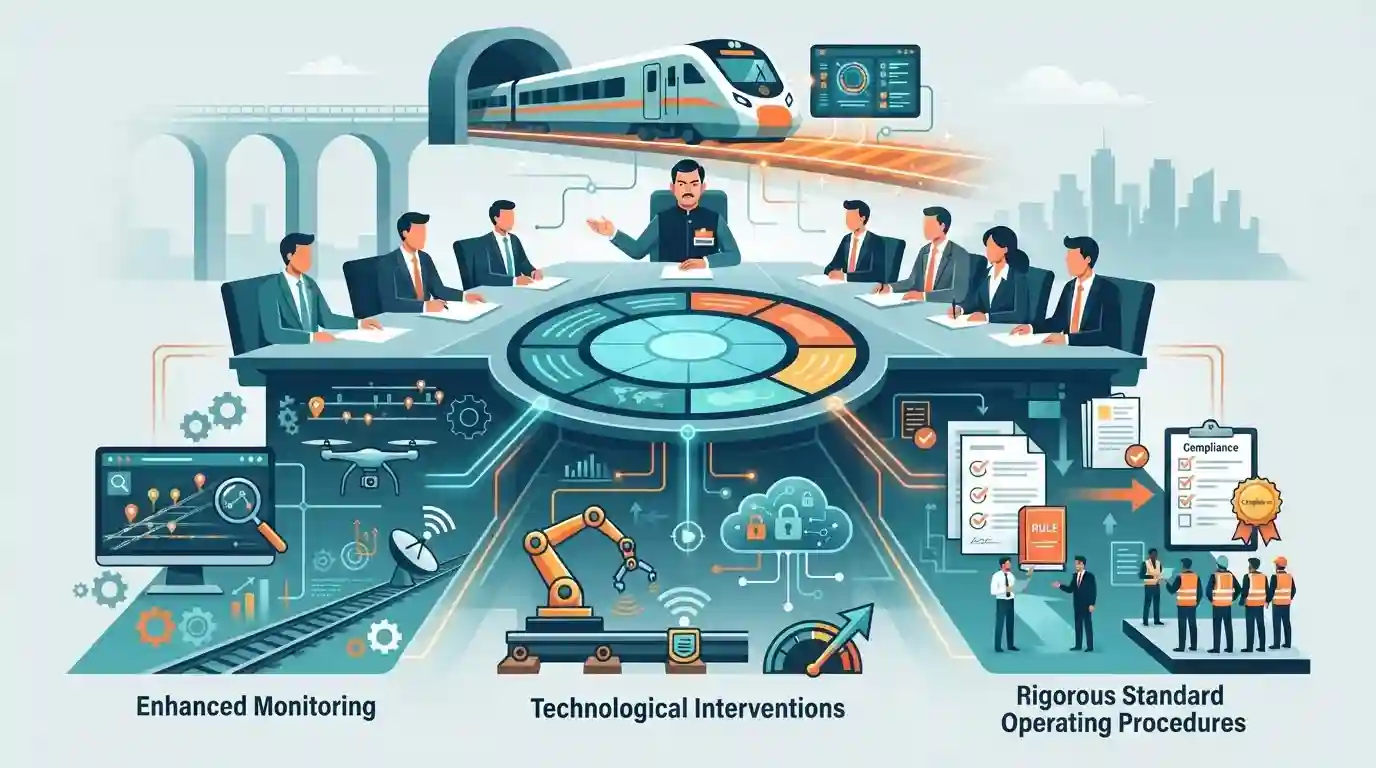
Union Minister for Railways Ashwini Vaishnaw held a high-level review meeting to address safety, technical vulnerabilities, and maintenance-related deficiencies within Indian Railways, emphasizing enhanced monitoring, technological interventions, and rigorous standard operating procedures to ensure secure rail operations.
Key Points
- Railway Minister Ashwini Vaishnaw reviewed railway safety, technical, and maintenance-related deficiencies to enhance passenger safety.
- Directions were issued to upgrade track maintenance protocols, fix technical vulnerabilities, and tighten supervision across railway zones.
- Emphasis was laid on leveraging technology and data-driven monitoring to prevent accidents and improve overall infrastructure reliability.
Important Terms
Ministry of Railways

The central government body responsible for the planning, policy formulation, administration, and development of the country's rail network and services.
UPSC context
Important for GS Paper III (Infrastructure: Railways, Governance, and Budgetary Allocation). Evaluates policy execution, institutional oversight, and modernization strategies.
Indian Railways
One of the world's largest rail networks under single management, serving as the principal transport lifeline for passenger and freight movement across India.
UPSC context
Core topic in GS Paper III (Infrastructure, Energy, Transportation, and Safety Management). Frequently tested regarding safety audits, technical upgrades, and institutional reforms.
Prelims Trap
Kavach is a high-speed rolling stock upgrade aimed at reducing travel time across trunk routes.
Kavach is an indigenous Automatic Train Protection system designed for collision avoidance, but aspirants often mistake it for a passenger amenity or rolling stock upgrade rather than an SIL-4 certified safety system.
Static Concepts Connected
What are the core technical features and safety standards of India's Kavach system?
- Safety Standard: SIL-4 Certified: Highest level of safety certification guaranteeing ultra-low probability of dangerous failures.
- Core Function: Collision Avoidance: Automatically applies brakes if the locomotive pilot fails to control speed or crosses signals (SPAD).
- Technology Used: Radio Frequency: Utilizes RFID tags on tracks and ultra-high frequency radio communication between stations and locomotives.
Cross-Topic Patterns
Rail Safety and Disaster Management Frameworks
Railway infrastructure safety reviews tie directly into the National Disaster Management Authority (NDMA) guidelines on transport accident mitigation and disaster resilience.
Capital Expenditure and Indigenous Tech Financing
Capital outlays for indigenous technologies like Kavach interact with fiscal federalism debates on budgetary vs extra-budgetary resource financing.

Kavach (SIL-4) features and National Rail Plan 2030 modal share targets are high-probability match-the-following or statement questions.
Linked PYQs · 2
Linked PYQs · 2
- 2021MainsGS3
“Investment in infrastructure is essential for more rapid and inclusive economic growth.” Discuss in the light of India's experience.
- 2025PrelimsGS1
Consider the following statements : I. Indian Railways have prepared a National Rail Plan (NRP) to create a 'future ready' railway system by 2028. II. 'Kavach' is an Automatic Train Protection system developed in collaboration with Germany. III. 'Kavach' system consists of RFID tags fitted on track in station section. Which of the statements given above are not correct?
