Legal Metrology Rules 2026 Mandate Uniform Indian Standard Time
Source:PIB ↗
ఇది ఎందుకు ముఖ్యం
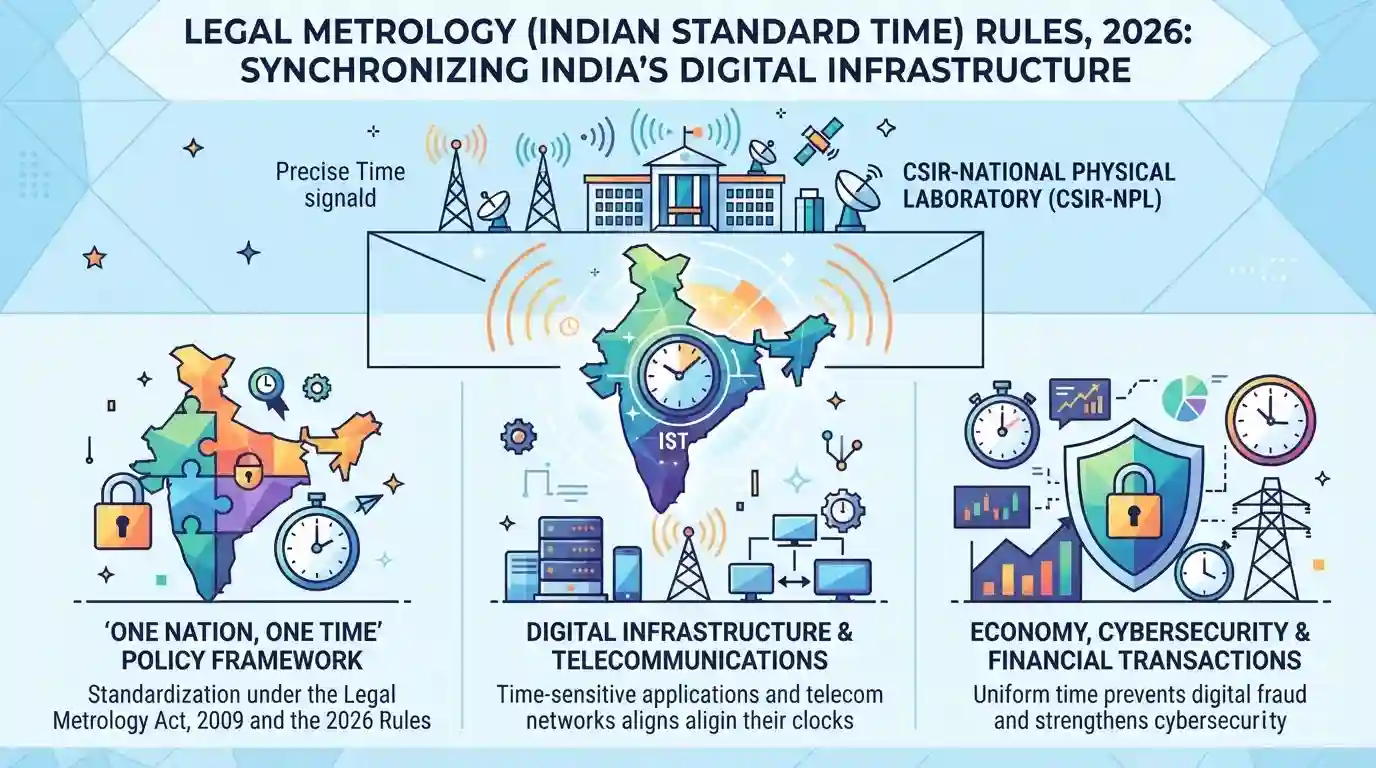
The standardization of IST via the Legal Metrology Rules, 2026 is critical for India's digital economy, financial stability, secure telecommunications, and robust critical information infrastructure (CII), ensuring uniform time-stamping and mitigating cyber vulnerabilities.
సారాంశం
The Central Government has notified the Legal Metrology (Indian Standard Time) Rules, 2026, under the Legal Metrology Act, 2009. This move ensures that all time-sensitive applications, digital infrastructure, telecommunications, financial transactions, and power grids across India synchronize their clocks with the Indian Standard Time (IST) maintained by the CSIR-National Physical Laboratory (CSIR-NPL). It aims to bring uniform time standards, boost cybersecurity, prevent digital fraud stemming from time lags, and strengthen the 'One Nation, One Time' policy framework.
ముఖ్య అంశాలు
- The Department of Consumer Affairs has notified the Legal Metrology (Indian Standard Time) Rules, 2026, mandating the synchronization of Indian Standard Time (IST) for all entities handling official time data.
- CSIR-National Physical Laboratory (CSIR-NPL) is designated as the custodian of Indian Standard Time, responsible for generating and maintaining it.
- The rules aim to eliminate time discrepancies across critical sectors like digital transactions, telecom, power grids, and transport, supporting the 'One Nation, One Time' vision.
- Industries and service providers utilizing time-stamping must sync their clocks with CSIR-NPL or laboratories recognized by the government.
ముఖ్యమైన పదాలు
Legal Metrology (Indian Standard Time) Rules, 2026

Rules notified under the Legal Metrology Act, 2009 that make Indian Standard Time (IST) the mandatory single reference for all legal, administrative, and commercial purposes across India.
UPSC context
Prelims/Mains (Polity/Governance & Economy): Tests knowledge of statutory frameworks for time standardization, digital infrastructure security, and 'One Nation, One Time'.
Legal Metrology Act, 2009
The principal legislation in India governing standards of weights, measures, and time standardization, providing statutory backing for enforcement mechanisms.
UPSC context
Prelims (Economy - Standards and Metrology): Important for questions on statutory consumer protection laws and regulatory jurisdictions.
CSIR-National Physical Laboratory (CSIR-NPL)
The premier research laboratory in India responsible for maintaining the national standard of time (IST) using atomic clocks, ensuring traceability to Coordinated Universal Time (UTC).
UPSC context
Prelims/Mains (Science & Technology): Evaluates institutional roles in national scientific measurements, metrology, and critical infrastructure synchronization.
అనుసంధానమైన స్థిర భావనలు
What are the statutory roles and institutional mechanisms governing Indian Standard Time (IST) and metrology?
- Custodianship: CSIR-NPL serves as the custodian of physical standards, maintaining UTC(NPLI) via atomic clocks and hydrogen masers.
- Statutory Basis: The Legal Metrology Act, 2009 empowers the Central Government to regulate weights, measures, and time standards across commercial and official domains.
- Global Linkage: BIPM (International Bureau of Weights and Measures) coordinates global time scales, with NPL representing India internationally.
అంతర-అంశ నమూనాలు
Legal Metrology + Critical Infrastructure Protection
Time synchronization is critical for India's National Critical Information Infrastructure Protection Centre (NCIIPC), linking metrology standards directly to national cybersecurity resilience.
NavIC + Legal Metrology Integration
The integration of indigenous NavIC with atomic clocks bridges satellite navigation standards with domestic trade metrology under the Ministry of Consumer Affairs.

Expect statements on whether CSIR-NPL or ISRO is the statutory custodian of IST, and the legal backing of the Legal Metrology Act.
అనుసంధాన PYQలు · 2
అనుసంధాన PYQలు · 2
- 2025PrelimsGS1
Consider the following countries : I. United Kingdom II. Denmark III. New Zealand IV. Australia V. Brazil How many of the above countries have more than four time zones?
- 2017MainsGS3
Discuss the potential threats of Cyber attack and the security framework to prevent it.
