GIFT IFSC Performance as International Banking and Capital Hub
Source:PIB ↗
Why It Matters
It demonstrates India's growing capacity to retain and channel international financial transactions domestically through GIFT IFSC, lowering systemic reliance on foreign financial centres and strengthening capital account management.
Summary
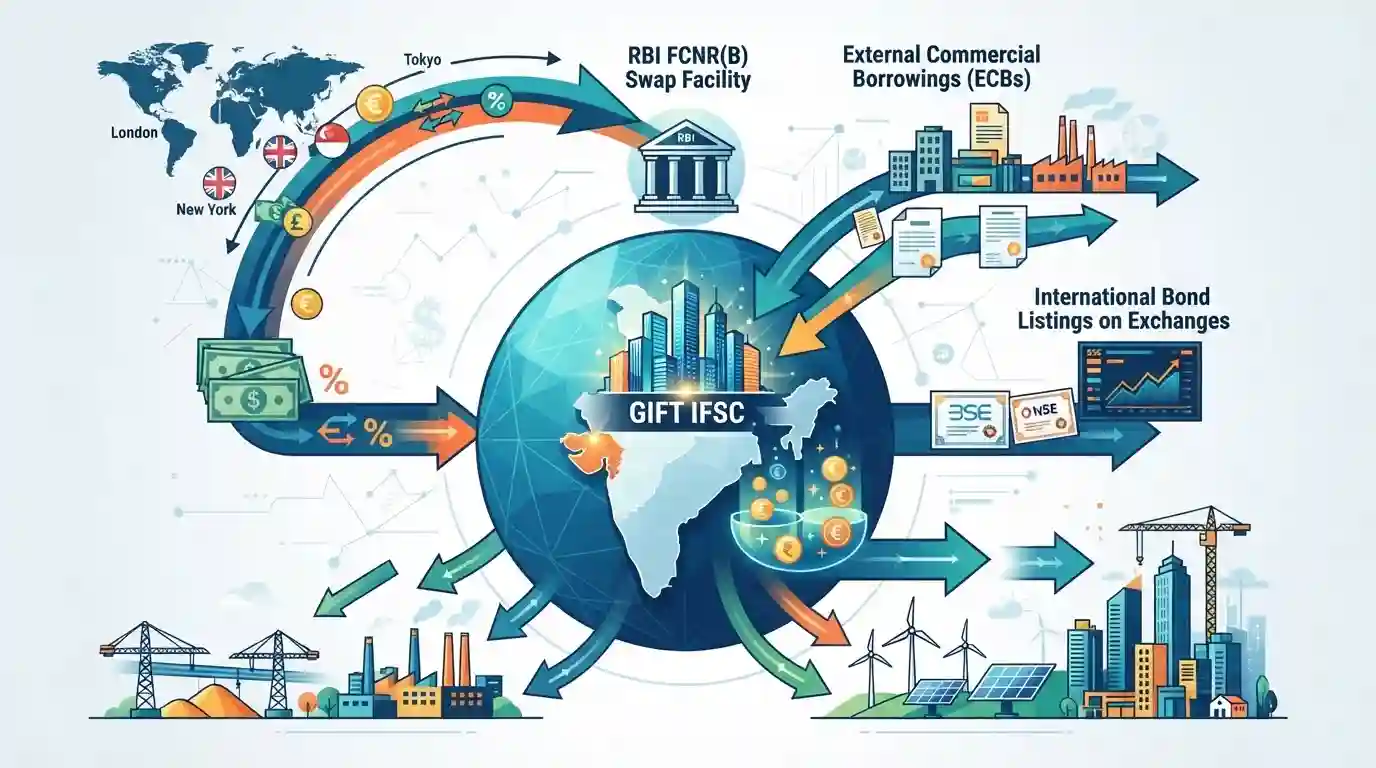
GIFT IFSC has emerged as a vibrant international banking hub, successfully mobilizing substantial foreign currency through the RBI's FCNR(B) Swap Facility, External Commercial Borrowings (ECBs), and international bond listings on its exchanges.
Key Points
- GIFT IFSC has mobilized over $52.8 billion under the RBI's FCNR(B) Swap Facility, demonstrating its depth as an international banking hub.
- Banks in IFSC exchanges have registered significant foreign capital inflows, including $11.62 billion in External Commercial Borrowings (ECBs) and $11.12 billion in bond listings.
- The growth of GIFT IFSC reflects India's integration into global financial markets, facilitating cross-border capital flows and reducing reliance on offshore financial centres like Singapore and Dubai.
Important Terms
FCNR(B) Swap Facility

A special window provided by the Reserve Bank of India for banks to mobilize foreign currency inflows through Foreign Currency Non-Resident (Bank) deposits by offering concessional swap structures to manage liquidity and hedging costs.
UPSC context
Prelims & Mains (GS-III Economy): Tests understanding of central bank monetary management, foreign exchange reserves, and capital account convertibility measures.
GIFT IFSC
India’s first operational International Financial Services Centre located in Gujarat International Finance Tec-City, designed to provide an offshore financial and regulatory environment within domestic geography for cross-border capital flows.
UPSC context
Mains (GS-III Economy): Important for topics relating to financial sector reforms, international trade gateways, resource mobilization, and regional economic development.
Reserve Bank of India (RBI)
India's central banking institution that controls monetary policy, issues currency, regulates the banking system, and manages foreign exchange reserves and external sector stability.
UPSC context
Prelims & Mains (GS-III Economy): Core to questions on central banking functions, macro-prudential regulations, liquidity management, and currency policy.
Prelims Trap
GIFT IFSC is regulated directly and solely by the Reserve Bank of India like domestic banking units.
Aspirants often assume GIFT IFSC is regulated exclusively by SEBI or RBI, missing that IFSCA is a unified, multi-regulator authority for all financial products in the zone.
Static Concepts Connected
What are the key features and regulatory framework of an International Financial Services Centre (IFSC) in India?
- Unified Regulator: IFSCA is the unified regulator for all financial services, products, and institutions in IFSCs, replacing multiple sectoral regulators like RBI, SEBI, IRDAI, and PFRDA.
- Foreign Currency Status: Entities operating in an IFSC are treated as non-residents under FEMA regulations, enabling transactions in foreign currencies rather than Indian Rupees.
- GIFT City Origin: GIFT City in Gujarat is India's first operational smart city and designated IFSC, designed to repatriate offshore financial transactions back to domestic soil.
Cross-Topic Patterns
IFSC growth + Capital Account Convertibility
GIFT City acts as an onshore alternative to traditional offshore hubs like Singapore and Dubai, impacting India's capital account convertibility glide path.
Forex reserves + RBI liquidity management
The success of FCNR(B) swaps in GIFT City directly ties into RBI's forex reserves management and domestic liquidity sterilization tools.

GIFT IFSC capital flows, FCNR(B) swaps, and ECB guidelines will likely be tested via a matching or statement-based Prelims question.
Linked PYQs · 1
Linked PYQs · 1
- 2022MainsGS3
Is inclusive growth possible under market economy ? State the significance of financial inclusion in achieving economic growth in India.
