Reclaimed Asphalt Pavement Technology Demonstration on Highways
Source:PIB ↗
কেন এটি গুরুত্বপূর্ণ
The deployment of 60% Reclaimed Asphalt Pavement (RAP) technology on Indian national highways represents a paradigm shift toward sustainable, resource-efficient infrastructure development, directly aligning with India's carbon reduction commitments and circular economy principles.
সারসংক্ষেপ
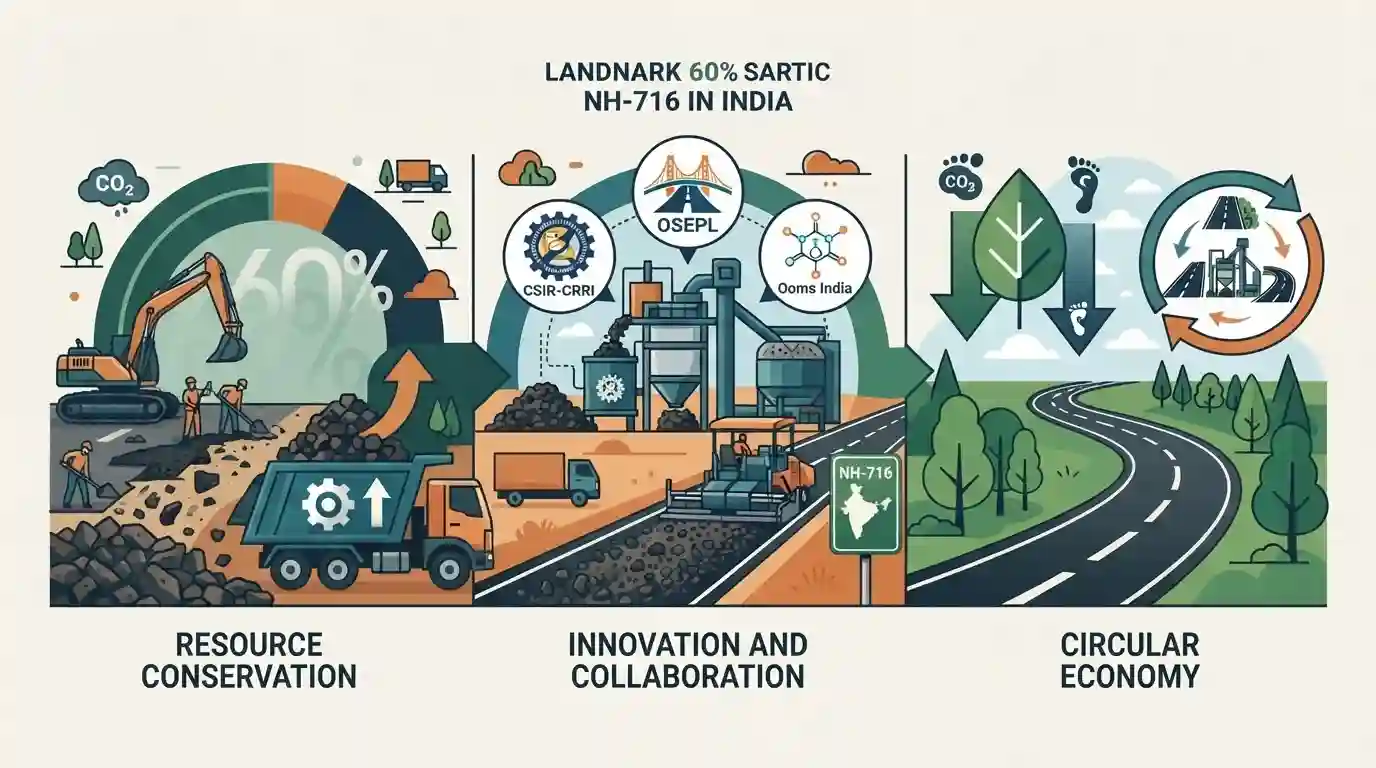
CSIR-CRRI, in collaboration with industry partners OSEPL and Ooms India, successfully demonstrated a landmark 60% Reclaimed Asphalt Pavement (RAP) technology on NH-716. This breakthrough advances sustainable and green road construction in India by promoting resource conservation, lowering carbon footprints, and supporting circular economy principles in infrastructure development.
মূল বিষয়
- CSIR-CRRI, OSEPL, and Ooms India successfully demonstrated a landmark 60% Reclaimed Asphalt Pavement (RAP) technology on National Highway 716 (NH-716).
- This technology marks a major leap in sustainable road construction by utilizing a high percentage of recycled asphalt material, significantly cutting down virgin aggregate and bitumen consumption.
- The initiative supports India's net-zero goals, circular economy framework, and eco-friendly infrastructure development.
গুরুত্বপূর্ণ শব্দ
CSIR-CRRI

A premier national R&D laboratory under India's CSIR, specializing in the design, construction, and maintenance of roads, highways, and transport infrastructure.
UPSC context
UPSC Paper III (Science & Technology / Infrastructure): Tests institutional framework for indigenous R&D in green road construction and highway engineering.
OSEPL
Oriental Structural Engineers Private Limited, a major Indian highway infrastructure development and construction company involved in executing national highway projects.
UPSC context
UPSC Paper III (Infrastructure - Roads & Highways): Relevant for understanding public-private collaboration and industry implementation of advanced sustainable technologies.
Ooms India
Ooms Polymer Modified Bitumen Pvt. Ltd., an industry specialist partnering in indigenous pavement technology and specialty binder innovations like asphalt rejuvenators.
UPSC context
UPSC Paper III (Environment & Infrastructure): Highlights industry partnerships for commercializing resource-efficient, low-carbon highway building components.
সংযুক্ত স্থির ধারণা
What is Reclaimed Asphalt Pavement (RAP) and how does bitumen rejuvenation function in green road construction?
- RAP Definition: Recycled materials recovered from milling old asphalt pavements during road widening or maintenance projects.
- Rejuvenator Role: Chemical additives (rejuvenators) that restore the rheological and mechanical properties of aged, oxidized bitumen to match virgin binders.
- Environmental Benefits: Massively cuts virgin aggregate extraction, reduces petroleum-based bitumen demand, and lowers carbon emissions in highway construction.
আন্তঃবিষয় প্যাটার্ন
Infrastructure Decarbonization + Circular Economy Principles
High-RAP road technology directly operationalizes circular economy principles by turning decaying national highways into resource banks for future infrastructure.
Atmanirbhar Bharat + Indigenous R&D in Roads
Indigenous rejuvenators like REJUBIT illustrate how public-private R&D partnerships between CSIR labs and MSMEs drive self-reliance in strategic infrastructure.

High-RAP road tech and indigenous rejuvenators (like REJUBIT) will likely be tested via a multi-statement question on green infrastructure.
সংযুক্ত PYQ · 2
সংযুক্ত PYQ · 2
- 2021MainsGS3
“Investment in infrastructure is essential for more rapid and inclusive economic growth.” Discuss in the light of India's experience.
- 2020PrelimsGS1
In rural road construction, the use of which of the following is preferred for ensuring environmental sustainability or to reduce carbon footprint? 1. Copper slag 2. Cold mix asphalt technology 3. Geotextiles 4. Hot mix asphalt technology 5. Portland cement Select the correct answer using the code given below:
