NAMASTE Scheme Impact on Sanitation Worker Entrepreneurship
Source:PIB ↗
Why It Matters
This article illustrates ground-level outcomes of flagship welfare initiatives like NAMASTE, offering a strong case study for answers related to the social upliftment, rehabilitation, and dignity of marginalized labor forces in India.
Summary
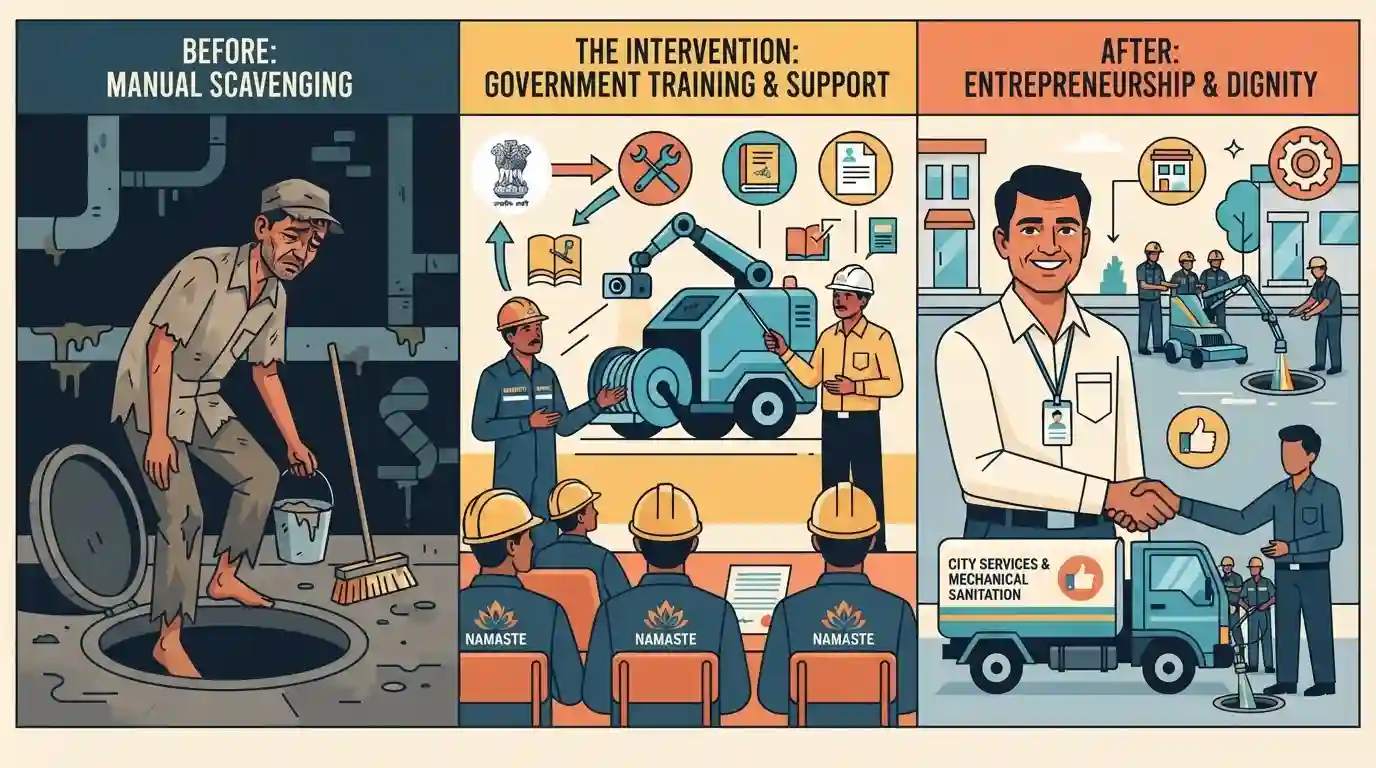
The article highlights the inspiring journey of Kailash Chander, who transitioned from a sewer cleaning worker to a successful sanitation entrepreneur under the NAMASTE-SUY (National Action for Mechanised Sanitation Ecosystem) initiative. The scheme aims to replace hazardous manual scavenging with mechanized operations, ensuring occupational safety, social dignity, and financial independence for sanitation workers by transforming them into business owners.
Key Points
- Kailash Chander transitioned from a sewer cleaning worker to a sanitation entrepreneur under the NAMASTE-SUY initiative.
- The NAMASTE scheme focuses on eliminating hazardous manual cleaning of sewers and septic tanks and promoting mechanized cleaning.
- It provides targeted assistance, skill training, and capital subsidies to enable sanitation workers and their dependents to set up alternative livelihoods as entrepreneurs.
- This intervention addresses social dignity, occupational safety, and economic upliftment of marginalized communities engaged in sanitation work.
Important Terms
NAMASTE (National Action for Mechanised Sanitation Ecosystem)

A central sector scheme jointly implemented by MoSJE and MoHUA to eliminate hazardous manual scavenging, promote mechanized sewer and septic tank cleaning, and ensure safety, dignity, and sustainable livelihoods for sanitation workers.
UPSC context
Important for UPSC CSE Prelims and Mains (GS Paper II - Social Justice / Vulnerable Sections), focusing on welfare policies for sanitation workers.
SUY (Swachhta Udyami Yojana)
A sub-component or scheme linked with national sanitation efforts providing financial assistance, soft loans, and capital subsidies to sanitation workers to purchase cleaning machines and become independent entrepreneurs.
UPSC context
Crucial for UPSC GS Paper II (Government Policies and Interventions for marginalized communities and employment generation).
Ministry of Social Justice and Empowerment
The nodal central government ministry responsible for the welfare, social inclusion, and empowerment of marginalized groups, including Scheduled Castes, Other Backward Classes, and sanitation workers.
UPSC context
Relevant for UPSC Mains GS Paper II under institutional framework and implementation of welfare ministries for vulnerable sections.
Prelims Trap
NAMASTE is a Central Sector Scheme exclusively implemented by the Ministry of Social Justice and Empowerment for manual scavengers only.
NAMASTE is a joint initiative of both MoSJE and MoHUA, not a single ministry scheme, and was expanded to include waste pickers.
Static Concepts Connected
What are the key institutional mechanisms and statutory bodies addressing manual scavenging in India?
- 2013 Act: Prohibits manual scavenging and employment of manual scavengers, outlawing dry latrines and unsafe manual sewer cleaning.
- NCSC/NSKFDC: Statutory body mandated to monitor implementation of the 2013 Act and inquire into deprivation of rights of safai karmacharis.
- NAMASTE Scheme: Central Sector Scheme jointly run by MoSJE and MoHUA to achieve zero sanitation fatalities and mechanize cleaning operations.
Cross-Topic Patterns
Sanitation formalization + Gig worker social security
The formalization of informal waste pickers and sanitation workers mirrors labour integration efforts under PM-SVANidhi and e-Shram portal frameworks.
Financial inclusion + Social welfare targeting
NAMASTE-SUY capital subsidies connect social justice welfare delivery directly to priority sector lending and Mudra loan targets.

NAMASTE-SUY implementation architecture + NSKFDC funding role likely to feature in social justice multi-statement MCQs.
Linked PYQs · 2
Linked PYQs · 2
- 2017MainsGS2
To ensure effective implementation of policies addressing water, sanitation and hygiene needs the identification of the beneficiary segments is to be synchronized with the anticipated outcomes." Examine the statement in the context of the WASH scheme.
- 2023MainsGS2
“Development and welfare schemes for the vulnerable, by its nature, are discriminatory in approach.” Do you agree? Give reasons for your answer.
