India Post Payments Bank Ninth Foundation Day and Digital Initiatives
Source:PIB ↗
ఇది ఎందుకు ముఖ్యం
It highlights the ongoing evolution of payments banks and grassroots digital payment technologies (like sound boxes) in deepening financial inclusion and reaching unbanked rural populations via public infrastructure like India Post.
సారాంశం
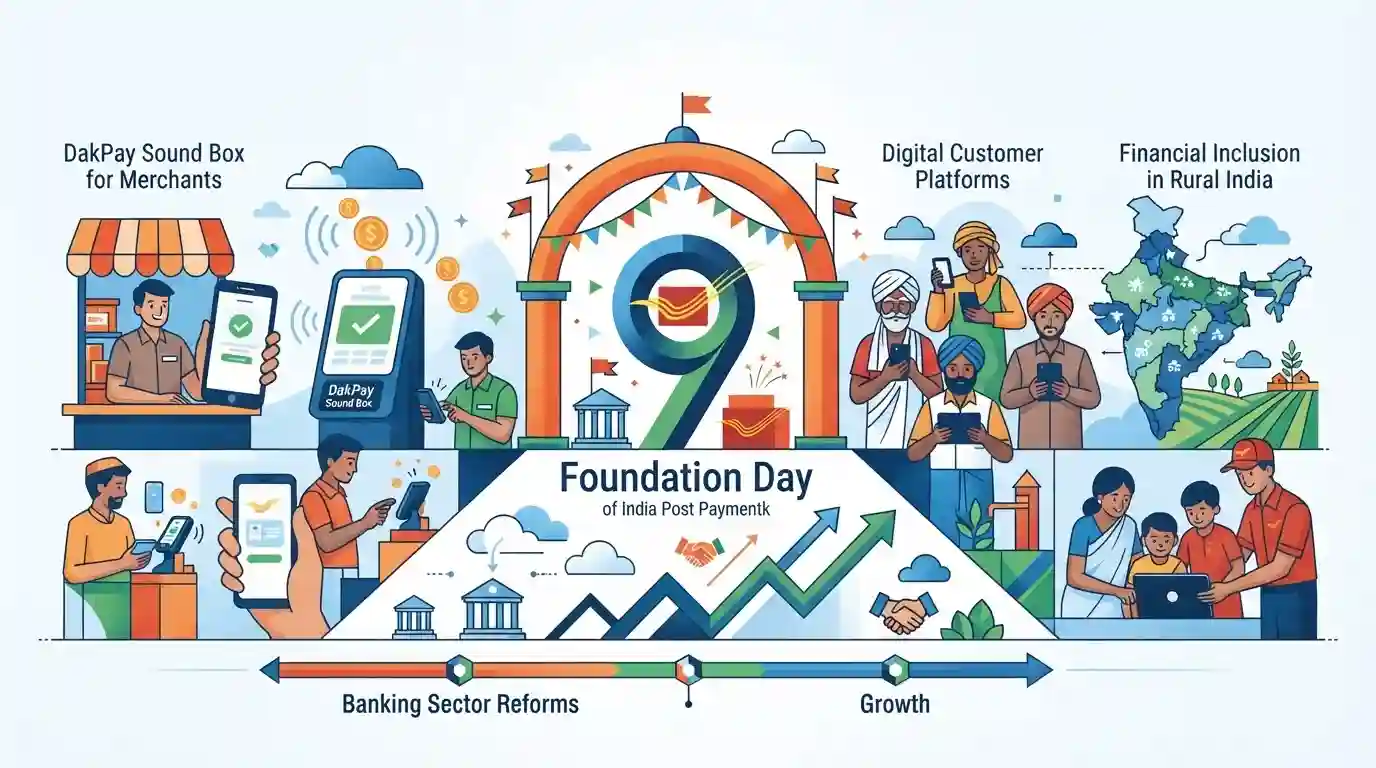
India Post Payments Bank (IPPB) celebrated its 9th Foundation Day by launching new financial technology solutions, including the DakPay Sound Box for merchants and digital customer platforms, reinforcing its mandate of driving last-mile financial inclusion and digital payments across rural India.
ముఖ్య అంశాలు
- India Post Payments Bank (IPPB) celebrated its 9th Foundation Day, marking significant strides in financial inclusion across rural and unbanked areas.
- Launched the DakPay Sound Box for merchants to enable instant payment alerts, boosting digital transactions at the grassroots level.
- Introduced new digital platforms and customer-centric financial services to bridge the digital divide and foster a cash-to-digital economy transition.
- IPPB continues to leverage India Post's vast network of postal touchpoints and Postmen/Gramin Dak Sewaks to deliver last-mile banking.
ముఖ్యమైన పదాలు
India Post Payments Bank (IPPB)

A specialized public sector bank operating under the Department of Posts, Ministry of Communications, with 100% government equity, aimed at driving last-mile financial inclusion across rural and unbanked regions.
UPSC context
UPSC Prelims and GS Paper III (Economy - Financial Inclusion, Banking Sector Reforms). Evaluates last-mile public banking delivery.
Ministry of Communications
The Union ministry responsible for formulating policies and overseeing administration concerning postal services, telecommunications, and digital communications infrastructure in India.
UPSC context
UPSC Prelims and GS Paper II/III (Governance, Infrastructure). Tests administrative framework governing postal utilities and digital connectivity.
Reserve Bank of India (RBI)
India's central banking institution that regulates the monetary policy, issues currency, and supervises the banking sector, including specialized entities like payments banks.
UPSC context
UPSC Prelims and GS Paper III (Economy - Banking and Monetary Policy). Core concept for central banking functions and regulatory oversight.
అనుసంధానమైన స్థిర భావనలు
What are the key regulatory restrictions and permissions governing Payments Banks in India?
- Deposit Cap: Accepts demand deposits up to ₹2 lakh per individual customer (originally ₹1 lakh, enhanced by RBI).
- No Lending: Strictly prohibited from lending operations, issuing loans, or providing credit cards to customers.
- SLR Deployment: Required to invest a minimum of 75% of demand deposit balances in SLR-eligible Government securities.
- Permitted Services: Can issue ATM/debit cards and facilitate net banking, mobile banking, and money remittances.
అంతర-అంశ నమూనాలు
Payments Banks & Rural Credit Delivery
IPPB utilizes Gramin Dak Sewaks for doorstep banking, mirroring how PM Jan Dhan Yojana relied on bank mitras for last-mile benefit transfers.

Expect a statement-based question testing whether Payments Banks can issue credit cards or undertake lending operations.
అనుసంధాన PYQలు · 3
అనుసంధాన PYQలు · 3
- 2022MainsGS3
Is inclusive growth possible under market economy ? State the significance of financial inclusion in achieving economic growth in India.
- 2023MainsGS3
What is the status of digitalization in the Indian economy? Examine the problems faced in this regard and suggest improvements.
- 2016PrelimsGS1
The establishment of 'Payment Banks' is being allowed in India to promote financial inclusion. Which of the following statements is/are correct in this context? 1. Mobile telephone companies and supermarket chains that are owned and controlled, by residents are eligible to be promoters of Payment Banks. 2. Payment Banks can issue both credit cards and debit cards. 3. Payment Banks cannot undertake lending activities. Select the correct answer using the code given below.
