Sone River Water Sharing Agreement and Cooperative Federalism
Source:PIB ↗
Why It Matters
It serves as a key contemporary case study for cooperative federalism and negotiated settlements of inter-state river water sharing outside prolonged judicial or tribunal litigation.
Summary
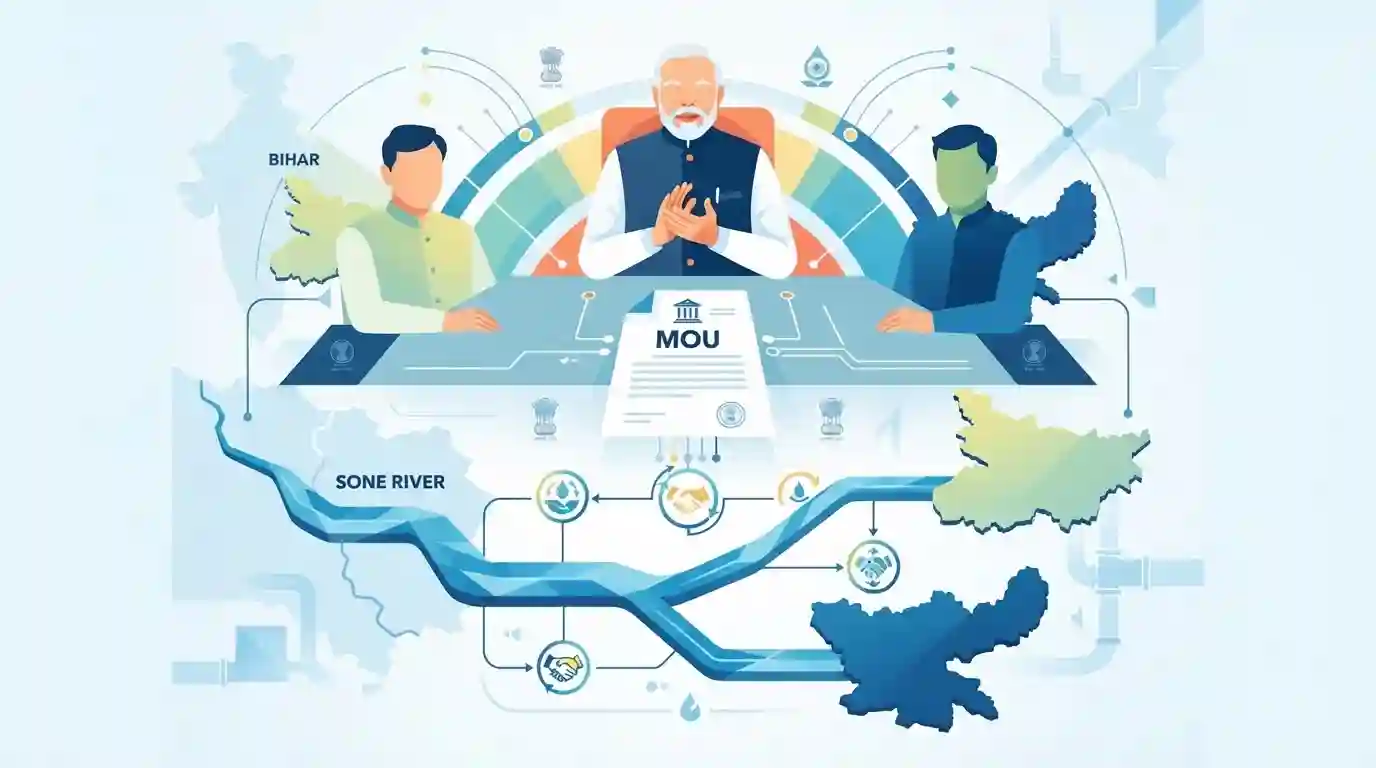
An MoU was signed between the states of Bihar and Jharkhand regarding the sharing of Sone River water, facilitated in the presence of the Union Home Minister. This highlights mechanisms of cooperative federalism, Centre-State engagement, and inter-state consensus-building for resource management.
Key Points
- Bihar and Jharkhand signed a Memorandum of Understanding (MoU) for sharing Sone River water in the presence of the Union Home Minister.
- The agreement exemplifies cooperative federalism and amicable resolution of inter-state resource-sharing issues with central mediation.
- The Sone River is a major southern tributary of the Ganga, crucial for irrigation and drinking water needs in the region.
Important Terms
Memorandum of Understanding on Sone River water sharing

A bilateral pact between Bihar and Jharkhand settling a 25-year-old dispute over Sone River water allocation, granting Bihar 5.75 MAF and Jharkhand 2 MAF.
UPSC context
Relevant for GS Paper II (Polity and Governance - Inter-State Relations, Cooperative Federalism) and GS Paper III (Water Resource Management).
Ministry of Home Affairs
The central government ministry responsible for internal security, police, and matters relating to center-state relations and inter-state coordination in India.
UPSC context
Crucial for GS Paper II under administrative setup, federal structures, and the role of central ministries in resolving disputes.
Government of Bihar
The democratically elected sub-national executive government of Bihar, a key stakeholder in the regional utilization of the Sone River basin.
UPSC context
Important for GS Paper II (State Government, Executive functioning, and regional resource sharing mechanisms).
Government of Jharkhand
The sub-national government of Jharkhand, created in 2000, which secured a formal 2 MAF legal allocation of Sone River water through this accord.
UPSC context
Relevant for GS Paper II (State administration and cooperative federalism in managing post-reorganization assets and natural resources).
Static Concepts Connected
What are the constitutional provisions for adjudication of inter-state water disputes in India?
- Article 262: Parliamentary law under Article 262 empowers the Union to provide for the adjudication of any dispute relating to the use, distribution, or control of inter-state river waters.
- ISWD Act 1956: The Inter-State Water Disputes (ISWD) Act, 1956 provides for the constitution of ad-hoc tribunals for specific dispute resolution.
- Jurisdiction Bar: Under Article 262(2), Parliament may by law provide that neither the Supreme Court nor any other court shall exercise jurisdiction in respect of any such dispute.
Cross-Topic Patterns
Inter-state Water Disputes and Article 262
Inter-state water disputes test the balance between judicial adjudication under Article 262 and executive-led consensus through central mediation.

Inter-state water sharing mechanisms, central mediation, and river geography (tributaries of Ganga) are high-yield for Prelims match-the-following.
Linked PYQs · 2
Linked PYQs · 2
- 2015MainsGS2
The concept of cooperative federalism has been increasingly emphasized in recent years. Highlight the drawbacks in the existing structure and the extent to which cooperative federalism would answer the shortcomings.
- 2024MainsGS2
What changes has the Union Government recently introduced in the domain of Centre-State relations ? Suggest measures to be adopted to build the trust between the Centre and the States and for strengthening federalism.
