Union Government Monthly Accounts and Fiscal Deficit Trends
Source:PIB ↗
Why It Matters
Regular monitoring of government accounts is crucial for understanding fiscal health, deficit trends, public expenditure management, and budget implementation in India, which form core pillars of the GS3 Indian Economy syllabus.
Summary
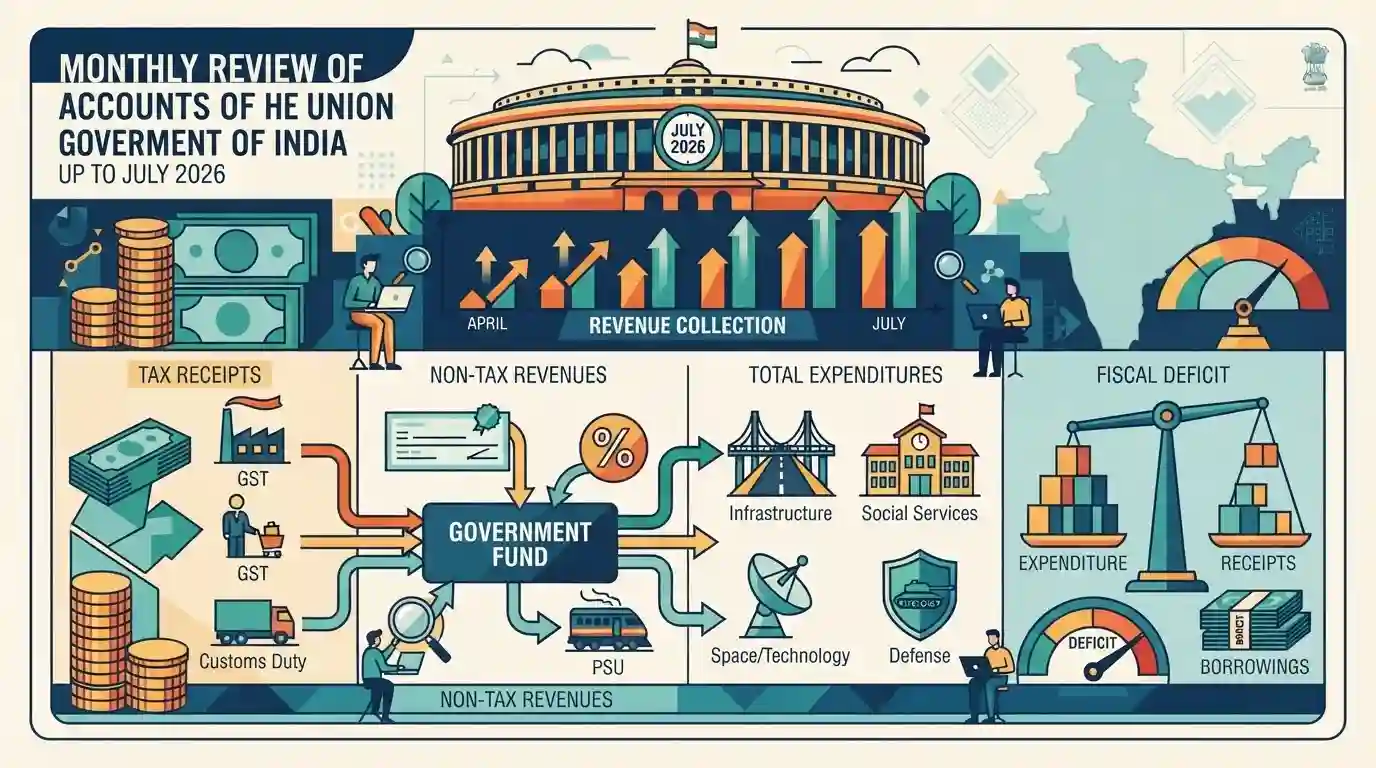
This PIB release presents the monthly review of accounts of the Union Government of India up to July 2026, offering critical insights into government finances, including tax receipts, non-tax revenues, total expenditures, and fiscal deficits for the current financial year.
Key Points
- The monthly review of accounts of the Union Government of India for the period up to July 2026 (FY 2026-27) provides comprehensive data on receipts, expenditures, and fiscal deficit trends.
- Serves as an essential indicator for fiscal management, tax revenue performance, non-tax revenues, and capital versus revenue expenditure allocations of the government.
- Helps monitor fiscal consolidation paths and adherence to targets set under the Fiscal Responsibility and Budget Management (FRBM) framework.
Important Terms
Ministry of Finance

The central ministry responsible for formulating and implementing the economic, fiscal, and financial policies of the Union Government, including the preparation of the Union Budget, taxation, and public debt management.
UPSC context
UPSC Paper II (Polity & Governance - Executive) and Paper III (Economy - Budgeting, Resource Mobilization, Fiscal Policy). Tests knowledge of governance machinery and public finance.
Government of India
The federal governing authority of the Republic of India, comprising the executive, legislature, and judiciary, which oversees national administration, policy formulation, and public financial management.
UPSC context
UPSC Paper II (Indian Constitution and Polity) and General Studies across papers. Tests understanding of institutional frameworks, federal structures, and governance.
Static Concepts Connected
What is the difference between Revenue Deficit, Fiscal Deficit, and Primary Deficit in India's budget?
- Revenue Deficit: Measures the excess of government revenue expenditure over revenue receipts, indicating borrowing for consumption purposes.
- Fiscal Deficit: Total expenditure minus total receipts excluding borrowings; represents the total borrowing requirement of the government.
- Primary Deficit: Fiscal deficit minus interest payments on previous borrowings, showing the actual borrowing needed excluding servicing debt.
Cross-Topic Patterns
Fiscal Deficit and Monetary Policy Operations
Monthly fiscal data releases allow markets and the RBI to track government borrowing requirements, directly influencing open market operations (OMOs) and liquidity management.
Union Capex and Economic Multiplier Effects
Tracking capital expenditure (Capex) pace in monthly budget data is vital for assessing states' capex support schemes and broader economic multiplier effects.

Monthly fiscal data statements are a favourite for matching items: identifying components of revenue vs capital receipts/expenditures.
Linked PYQs · 2
Linked PYQs · 2
- 2021MainsGS3
Distinguish between Capital Budget and Revenue Budget. Explain the components of both these Budgets.
- 2019MainsGS3
The public expenditure management is a challenge to the Government of India in the context of budget making during the post-liberalization period. Clarify it.
