Swachh Bharat Mission Urban Progress and Waste Management Review
Source:PIB ↗
हे का महत्त्वाचे आहे
Urban waste management and legacy dumpsite remediation are crucial for public health, land reclamation, and climate mitigation. SBM-U 2.0 and AMRUT's execution by urban local bodies directly impacts India's Sustainable Development Goals (SDG 6 and SDG 11) and represents a key administrative-environmental challenge frequently tested in the UPSC exam.
सारांश
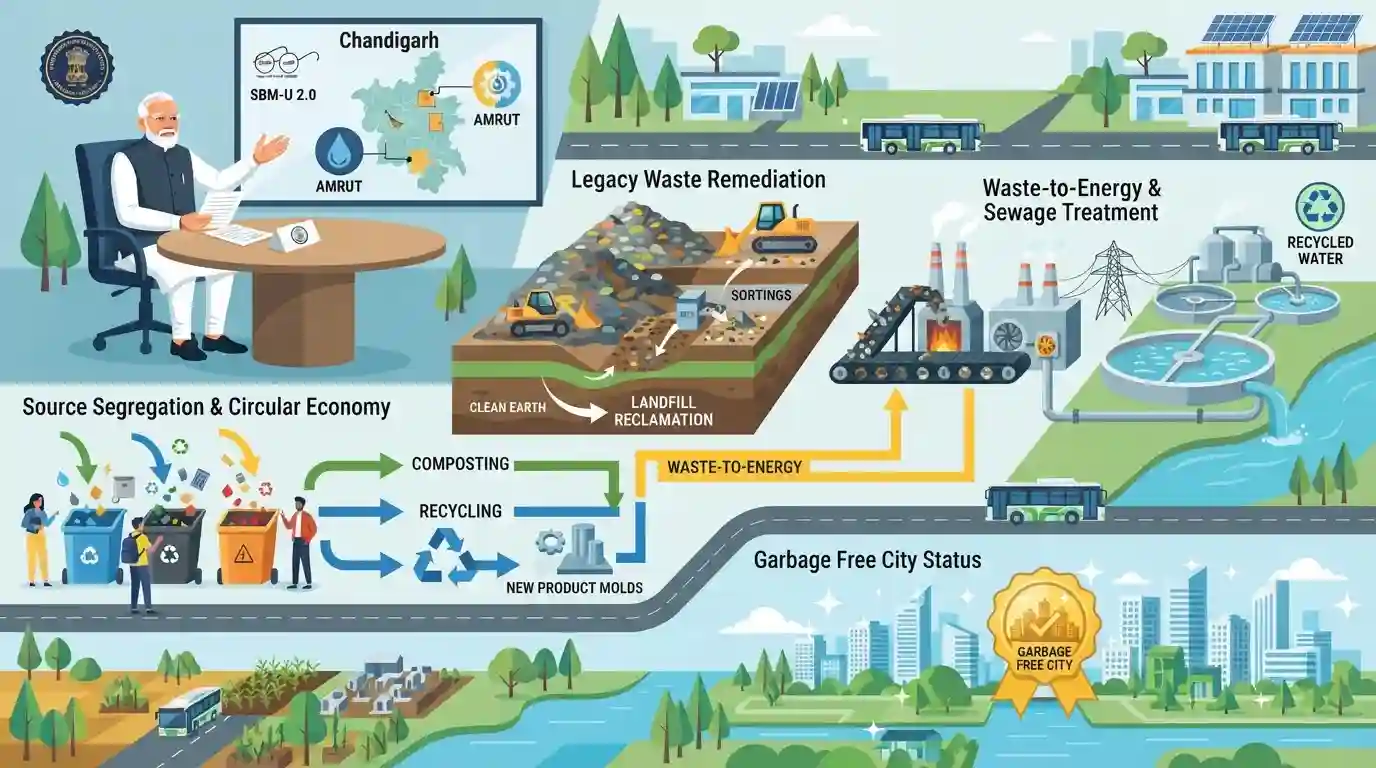
Union Minister Shri Manohar Lal reviewed the implementation of SBM-U 2.0 and AMRUT in Chandigarh. The review focused on accelerating legacy waste remediation, upgrading waste-to-energy and sewage treatment plants, promoting source segregation, and reinforcing the circular economy of water and waste to achieve 'Garbage Free City' status.
मुख्य मुद्दे
- Union Minister Shri Manohar Lal reviewed the progress of Swachh Bharat Mission-Urban (SBM-U 2.0) and AMRUT in Chandigarh, emphasizing fast-track project implementation.
- A primary focus of the review was the remediation of legacy waste dumpsites, such as the Dadumajra dumpsite in Chandigarh, to reclaim land and prevent environmental hazards.
- The Minister directed the expedited setting up of the Integrated Waste Processing Plant (IWPP) and Waste-to-Energy plants to ensure 100% scientific waste management.
- The review emphasized upgrading Sewage Treatment Plants (STPs) to meet strict environmental standards and promoting the circular economy of water by reusing treated wastewater for non-potable purposes.
- The importance of 100% source segregation of municipal waste (wet, dry, and hazardous) and strengthening community-led 'Jan Andolan' (people's movement) for Swachhata was highlighted.
महत्त्वाच्या संज्ञा
Swachh Bharat Mission-Urban (SBM-U 2.0)

A centrally sponsored scheme launched in 2021 aiming to make all Indian cities "garbage-free" by ensuring 100% scientific solid waste management, source segregation, and remediation of legacy dumpsites.
UPSC context
GS Paper 2 (Government Policies and Schemes) & GS Paper 3 (Environmental Pollution and Waste Management).
Atal Mission for Rejuvenation and Urban Transformation (AMRUT 2.0)
A centrally sponsored scheme (2021–2026) aiming to make cities "water secure" by providing universal household water tap connections and complete sewerage/septage management in designated cities.
UPSC context
GS Paper 2 (Urban Infrastructure and Governance) & GS Paper 3 (Water Conservation and Resources).
Solid Waste Management Rules 2016
Statutory regulations notified under the Environment (Protection) Act, 1986, mandating waste generators to segregate dry, wet, and hazardous waste at the source for scientific processing.
UPSC context
GS Paper 3 (Environmental Pollution & Degradation) and GS Paper 2 (Statutory Rules and Urban Governance).
Ministry of Housing and Urban Affairs (MoHUA)
The apex national ministry of the Government of India responsible for formulating policies, administering schemes, and coordinating urban development, housing, and urban sanitation.
UPSC context
GS Paper 2 (Structure and Functioning of ministries) & GS Paper 1 (Urbanization and Urban Issues).
पूर्वपरीक्षा सापळा
Under current waste management rules, domestic waste must be segregated only into three streams: wet, dry, and domestic hazardous waste.
The newly notified SWM Rules 2026 transition India to a mandatory four-stream segregation (wet, dry, sanitary, and special care waste), superseding the 2016 three-stream framework.
संबंधित स्थिर संकल्पना
What is the Star Rating Protocol for Garbage Free Cities (GFC) under SBM-U 2.0?
- Rating Scale: An assessment framework scoring cities on 1, 3, 5, or 7-star ratings based on parameters like source segregation, processing, and plastic bans.
- Mandate: SBM-U 2.0 mandates that all statutory towns in India must achieve at least a 3-star Garbage Free rating.
- Verification: Requires rigorous self-declaration followed by third-party verification and citizen feedback before validation by MoHUA.
What are City Water Balance Plans (CWBPs) under AMRUT 2.0?
- Tool Function: A digital diagnostic tool used by municipal bodies to quantify water source capacity, demand, supply gaps, and transmission losses.
- Circularity Goal: Acts as the baseline to design projects aimed at recycling municipal wastewater to meet at least 20% of urban water demand.
आंतर-विषय नमुने
Circular Economy + Urban Waste Management
Links municipal solid waste and wastewater recycling under AMRUT 2.0 to NITI Aayog's circular economy goals, converting urban centers from resource sinks to resource-recovery hubs.
Gender Empowerment + Urban Infrastructure
The 'AMRUT Mitra' initiative connects women Self-Help Groups under DAY-NULM to high-skilled municipal technical roles (billing, water quality, maintenance) rather than just traditional low-skill jobs.

Multi-statement question contrasting SWM Rules 2016 vs 2026 (4-stream segregation, EBWGR) or AMRUT 2.0 water circularity is highly probable.
संबंधित PYQ · 3
संबंधित PYQ · 3
- 2018MainsGS3
What are the impediments in disposing the huge quantities of discarded solid wastes which are continuously being generated? How do we remove safely the toxic wastes that have been accumulating in our habitable environment?
- 2019PrelimsGS1
As per the Solid Waste Management Rules, 2016 in India, which one of the following statements is correct?
- 2020MainsGS2
The strength and sustenance of local institutions in India has shifted from their formative phase of 'Functions, Functionaries and Funds' to the contemporary stage of 'Functionality'. Highlight the critical challenges faced by local institutions in terms of their functionality in recent times.
