National Biodiversity Authority Disburses ABS Funds for Conservation
Source:PIB ↗
हे का महत्त्वाचे आहे
This article highlights the real-world operationalization of the Nagoya Protocol's Access and Benefit-Sharing (ABS) mechanism in India. It showcases how commercial utilization of genetic resources is linked back to grassroots conservation and local community livelihoods, demonstrating the execution of statutory mandates under the Biological Diversity Act, 2002. Understanding this model is essential for answering questions on environmental governance and biodiversity conservation.
सारांश
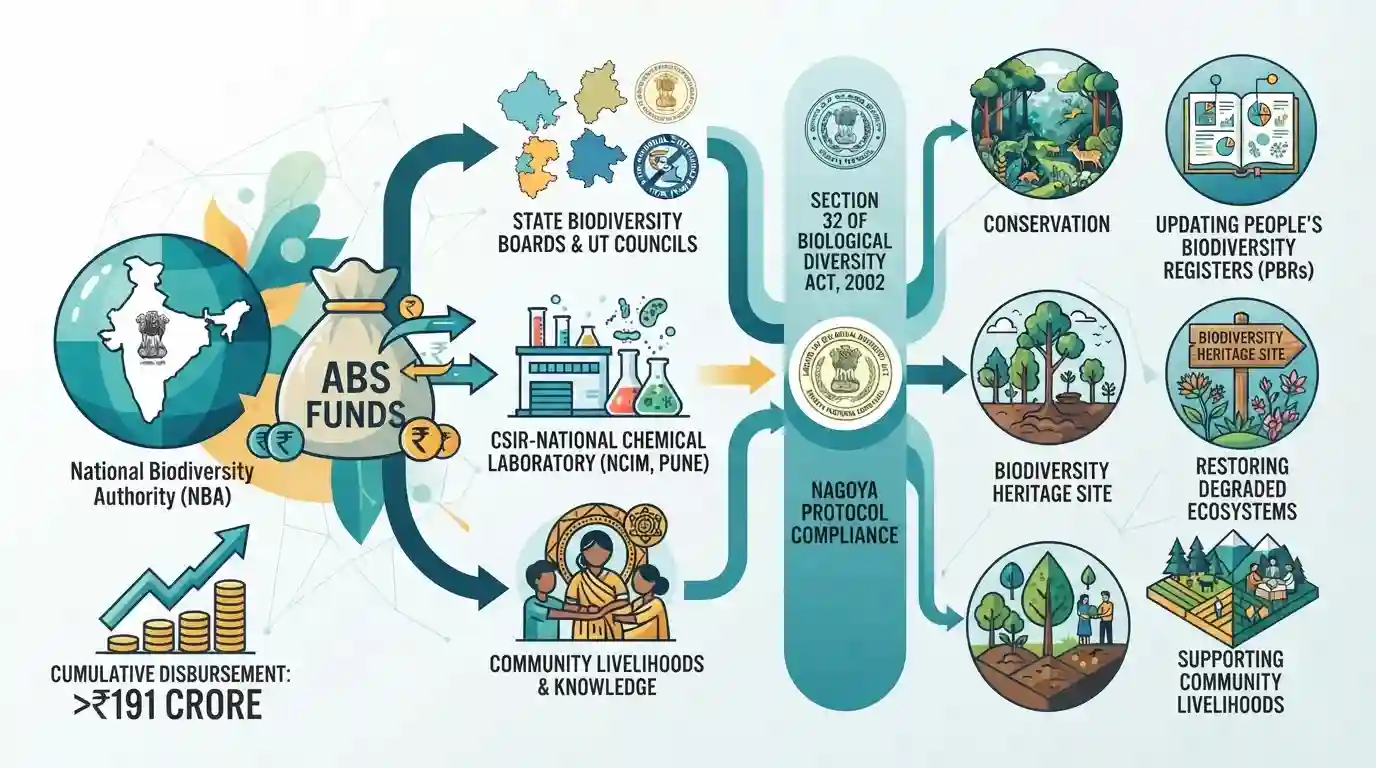
The National Biodiversity Authority (NBA) has disbursed Rs. 5.68 Crore in Access and Benefit-Sharing (ABS) funds to various State Biodiversity Boards, UT Biodiversity Councils, and the CSIR-National Chemical Laboratory (NCIM, Pune). This disbursement, derived from the commercial utilization of biological resources like agricultural and microbial materials, pushes India's cumulative ABS disbursement to over Rs. 191 Crore. Channeled under Section 32 of the Biological Diversity Act, 2002, these funds are utilized for conservation, updating People's Biodiversity Registers (PBRs), strengthening Biodiversity Heritage Sites (BHS), restoring degraded ecosystems, and supporting community livelihoods, exemplifying India's commitment to the Nagoya Protocol.
मुख्य मुद्दे
- The National Biodiversity Authority (NBA) has disbursed Rs. 5.68 Crore in Access and Benefit-Sharing (ABS) funds to State Biodiversity Boards (SBBs), UT Biodiversity Councils (UTBCs), and the CSIR-National Chemical Laboratory (NCL) for biodiversity conservation.
- These ABS funds are generated from the commercial utilization of biological resources, including agricultural crops (like Okra, Cucumber, and Watermelon) and microbial resources, bringing the cumulative ABS disbursement by the NBA to over Rs. 191 Crore.
- The disbursed funds are utilized under Section 32 of the Biological Diversity Act, 2002, to finance the conservation, sustainable use, and restoration of ecosystems, as well as the documentation of local resources.
- Key local activities supported by these funds include the creation and updating of People's Biodiversity Registers (PBRs), protection of wild relatives of cultivated plants, and strengthening of Biodiversity Heritage Sites (BHS).
- This disbursement showcases India's three-tier decentralized framework (NBA at National level, SBBs at State level, and BMCs at local bodies level) which implements the global mandate of the Nagoya Protocol on ABS at the grassroots level.
महत्त्वाच्या संज्ञा
Biological Diversity Act, 2002

An act of Parliament enacted to fulfill India's commitments under the Convention on Biological Diversity (CBD), aiming at biodiversity conservation, sustainable utilization, and fair benefit-sharing of biological resources.
UPSC context
GS Paper III (Environment & Biodiversity); tests legal frameworks for conservation and benefit-sharing mechanisms.
Nagoya Protocol
A supplementary agreement to the Convention on Biological Diversity (CBD) that provides a transparent legal framework for the fair and equitable sharing of benefits arising from the utilization of genetic resources.
UPSC context
GS Paper III (Ecology and Environment); tests international treaties, agreements, and access and benefit-sharing (ABS) mechanisms.
National Biodiversity Authority
A statutory, autonomous body established in 2003 under the Ministry of Environment, Forest and Climate Change to implement India’s Biological Diversity Act, regulating access to bio-resources.
UPSC context
GS Paper III (Environment); tests statutory bodies, regulatory frameworks, and biodiversity governance in India.
State Biodiversity Boards
Statutory bodies established under Section 22 of the Biological Diversity Act, 2002, to advise state governments on conservation and regulate commercial bio-survey and bio-utilization requests.
UPSC context
GS Paper III (Environment); tests the decentralized institutional structure of biodiversity governance in India.
Biodiversity Management Committees
Local-level bodies constituted by local authorities under Section 41 of the Biological Diversity Act, 2002, responsible for promoting local conservation, sustainable use, and documentation of resources.
UPSC context
GS Paper III (Environment); tests grassroots decentralization and local implementation of ABS guidelines.
People's Biodiversity Registers
Comprehensive documents compiled by Biodiversity Management Committees (BMCs) in consultation with local communities, recording local biological resources, habitats, domesticated stocks, and associated traditional knowledge.
UPSC context
GS Paper III (Ecology); tests grassroots documentation and IPR-related aspects of biodiversity.
पूर्वपरीक्षा सापळा
The Biological Diversity (Amendment) Act, 2023 exempts all domestic Indian companies from paying Access and Benefit-Sharing (ABS) fees.
The 2023 Amendment only exempts registered AYUSH practitioners, local communities, and growers of medicinal plants. Commercial Indian corporate entities still fall under the ABS fee and registration net.
संबंधित स्थिर संकल्पना
What is the statutory three-tier architecture under the Biological Diversity Act, 2002?
- National Biodiversity Authority (NBA): National level statutory body (headquartered in Chennai) that advises the Central Government, regulates access, and approves intellectual property requests by foreign entities.
- State Biodiversity Boards (SBB): State-level boards that advise State Governments, regulate commercial utilization or bio-survey by Indian citizens, and coordinate with local bodies.
- Biodiversity Management Committees (BMC): Statutory local-body committees (Panchayats/Municipalities) mandated to prepare People's Biodiversity Registers (PBR) and empowered to levy collection fees on bio-resource extraction.
What is the Nagoya Protocol and how does it relate to Access and Benefit-Sharing (ABS)?
- Core Mandate: Adopted in 2010 under the Convention on Biological Diversity (CBD) to implement its third objective: fair and equitable sharing of benefits.
- Operational Mechanism: Creates legal certainty and transparency for both providers and users of genetic resources by establishing clear rules for Prior Informed Consent (PIC) and Mutually Agreed Terms (MAT).
आंतर-विषय नमुने
Traditional Knowledge Protection + IPR Regimes
Blends the protection of genetic assets under the BD Act with international intellectual property regimes like the TKDL to check global biopiracy.
FRA 2006 + Local BMC Governance Overlaps
Explores potential governance overlaps and jurisdictional friction between BMCs under the BD Act and Gram Sabhas exercising Community Forest Rights under the Forest Rights Act (FRA), 2006.

Decentralized ABS rules, BMC fee-levying powers, and 2023 Amendment exemptions for AYUSH are primed for multi-statement Prelims questions.
संबंधित PYQ · 2
संबंधित PYQ · 2
- 2023PrelimsGS1
Consider the following statements: 1. In India, the Biodiversity Management Committees are key to the realization of the objectives of the Nagoya Protocol. 2. The Biodiversity Management Committees have important functions in determining access and benefit sharing, including the power to levy collection fees on the access of biological resources within its jurisdiction. Which of the statements given above is/are correct?
- 2012PrelimsGS1
How does National Biodiversity Authority (NBA) help in protecting the Indian agriculture? 1. NBA checks the biopiracy and protects the indigenous and traditional genetic resources. 2. NBA directly monitors and supervises the scientific research on genetic modification of crop plants. 3. Application for Intellectual Property Rights related to genetic/biological resources cannot be made without the approval of NBA. Which of the statements given above is/are correct?
