Tri Services Future Warfare Course Concludes in New Delhi
Source:PIB ↗
Why It Matters
The training highlights India's ongoing efforts to modernize its armed forces in response to the changing, tech-driven landscape of modern conflict. Understanding 'jointness', technology integration (AI, space, cyber), and theaterisation is vital for GS Paper 3 (Security and Science & Tech) and for writing comprehensive answers on defense reforms and contemporary security threats.
Summary
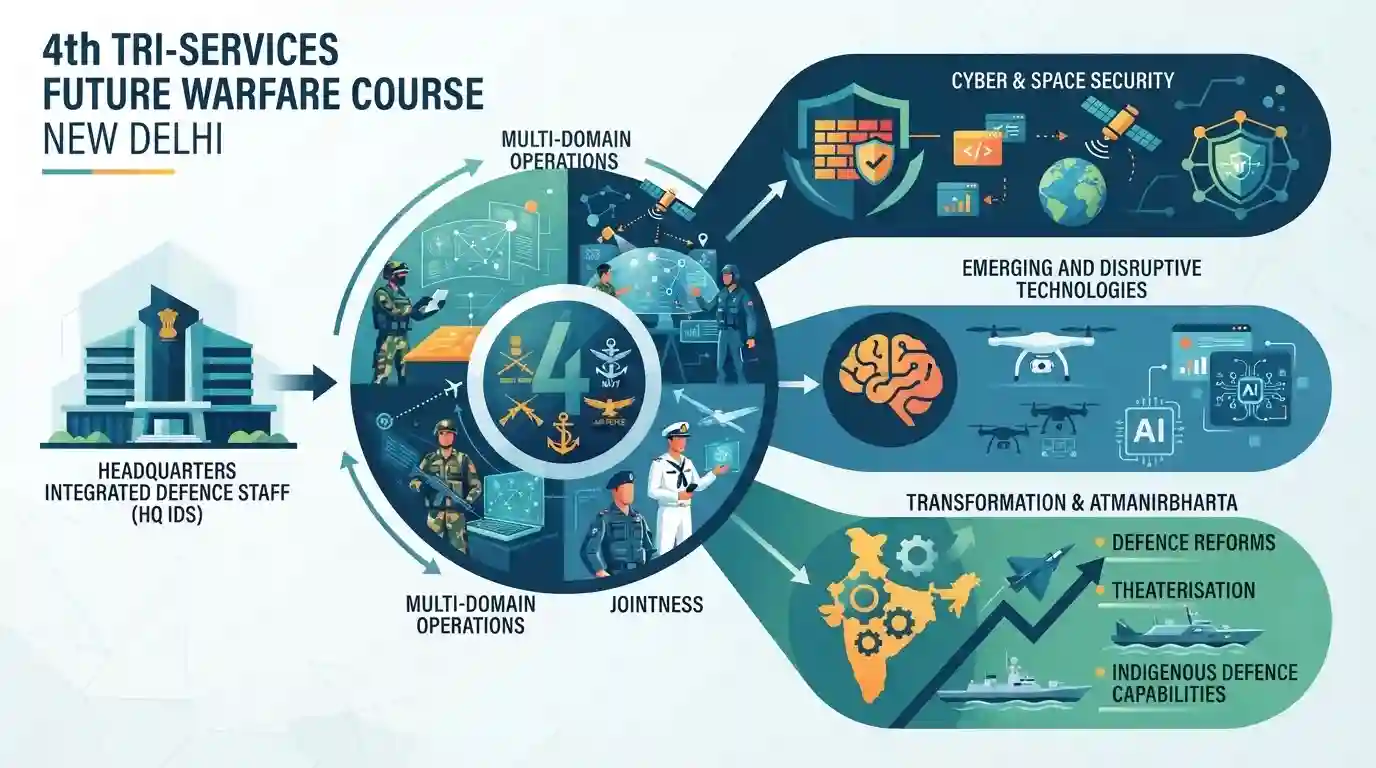
The 4th Tri-Services Future Warfare Course, organized by Headquarters Integrated Defence Staff (HQ IDS) in New Delhi, concluded successfully. The course aims to groom future military commanders from the Army, Navy, and Air Force, preparing them for the complexities of modern conflict. It focused on Multi-Domain Operations (MDO), integrating Emerging and Disruptive Technologies (EDTs) like Artificial Intelligence (AI), cyber and space security, and cultivating 'jointness' within India's armed forces. The initiative is key to India's transformation toward theaterisation and indigenous defense capabilities (Atmanirbharta).
Key Points
- The 4th Tri-Services Future Warfare Course, organized by the Headquarters Integrated Defence Staff (HQ IDS), concluded in New Delhi to equip officers across the three services with future-ready military leadership skills.
- The course focused on shifting from traditional warfare models to Multi-Domain Operations (MDO), where land, air, sea, cyber, space, and electromagnetic spectrum operations are integrated seamlessly.
- It emphasized the adoption of Emerging and Disruptive Technologies (EDTs) such as Artificial Intelligence (AI), machine learning, quantum technology, and autonomous weapons like drone swarms to ensure technological superiority on the battlefield.
- A major component of the training targeted hybrid and gray-zone threats, cognitive warfare, cyber defense, and space-based challenges that blur the traditional lines of conflict.
- The program serves as a critical structural and cultural enabler for inter-service 'jointness' and integration, laying the groundwork for India's upcoming transition to Integrated Theatre Commands (ITCs).
- Developing domestic capabilities and indigenization (Atmanirbharta) in defense technologies was highlighted as a critical pillar for maintaining tactical sovereignty and supply chain resilience.
Important Terms
Integrated Theatre Commands

Unified military commands combining assets of the Army, Navy, and Air Force under a single operational commander for specific geographical regions to improve combat effectiveness.
UPSC context
GS Paper 3 (Security). Tests understanding of higher defense reforms and joint military strategy.
Atmanirbharta in Defence
India's strategic push to achieve self-reliance in military manufacturing by prioritizing domestic R&D, reducing import dependency, and boosting indigenous defense production.
UPSC context
GS Paper 3 (Security/Economy). Tests knowledge of technology indigenization and strategic autonomy.
Headquarters Integrated Defence Staff (HQ IDS)
A tri-service staff organization established in 2001 to promote integration, joint planning, shared doctrines, and coordinated capability development across the Indian armed forces.
UPSC context
GS Paper 3 (Security). Tests institutional frameworks for tri-service coordination and command reforms.
Ministry of Defence
The Union government ministry charged with protecting national security, administering the armed forces, managing national budget allocations, and overseeing domestic defense production.
UPSC context
GS Paper 2 (Polity/Governance). Tests civilian oversight mechanisms over the nation's military.
Prelims Trap
The Inter-Services Organisations Act, 2023 merges the separate Army, Navy, and Air Force Acts into a single, unified military code.
The Act does not merge or replace individual service acts; it only grants statutory disciplinary and administrative powers to ISO commanders over personnel from other branches.
Static Concepts Connected
What is the origin and mandate of the Headquarters Integrated Defence Staff (HQ IDS)?
- Origin: Established in November 2001 based on the Group of Ministers (GoM) recommendations post the 1999 Kargil Review Committee report.
- Primary Mandate: To foster jointness and synergy among the three services, serving as the secretariat to the Chief of Defence Staff (CDS).
- Leadership Structure: Led by the Chief of Integrated Defence Staff to the Chairman, Chiefs of Staff Committee (CISC).
What are India's existing functional tri-service/unified commands?
- Andaman and Nicobar Command: India’s first and only integrated geographical theatre command, established in 2001 to guard strategic sea lanes in the Bay of Bengal.
- Strategic Forces Command: An integrated functional command established in 2003, responsible for managing the country’s strategic and nuclear assets.
- Comparison: While these two are unified, the other 17 military commands in India remain strictly single-service commands.
Cross-Topic Patterns
MDO and Civilian Tech Sovereignty
Modern MDO relies on Civil-Military Fusion, making national security deeply dependent on domestic civilian infrastructure like local space startups, cloud systems, and AI developers.
Theaterisation and Internal Security Architecture
The shift to Integrated Theatre Commands requires synchronizing military operations with state police forces and CAPFs to effectively counter hybrid warfare and gray-zone threats.

Expect questions distinguishing traditional joint operations from MDO, or the precise disciplinary powers under the ISO Act 2023.
Linked PYQs · 3
Linked PYQs · 3
- 2026PrelimsGS1
Which of the following statements with regard to drone swarms is/are correct ? 1. They use Terahertz band of frequency to communicate with the command centre. 2. Individual drones in the swarm can communicate with other drones in the swarm. 3. GPS Spoofing is a commonly used technique to counter drone swarm attack. Select the answer using the code given below :
- 2021MainsGS3
Analyse the multidimensional challenges posed by external state and non-state actors, to the internal security of India. Also discuss measures required to be taken to combat these threats.
- 2022MainsGS3
What are the different elements of cyber security ? Keeping in view the challenges in cyber security, examine the extent to which India has successfully developed a comprehensive National Cyber Security Strategy.
