India Uzbekistan Strategic Partnership and Regional Cooperation
Source:PIB ↗
Why It Matters
This state visit showcases the implementation of India's 'Connect Central Asia Policy' through a multi-dimensional approach. Beyond strategic security and economic ties, India is leveraging soft-power tools (Buddhist site conservation) and environmental diplomacy (Aral Sea restoration fund) to deepen its footprint in a region heavily influenced by other global powers, highlighting its growing leadership in the Global South.
Summary
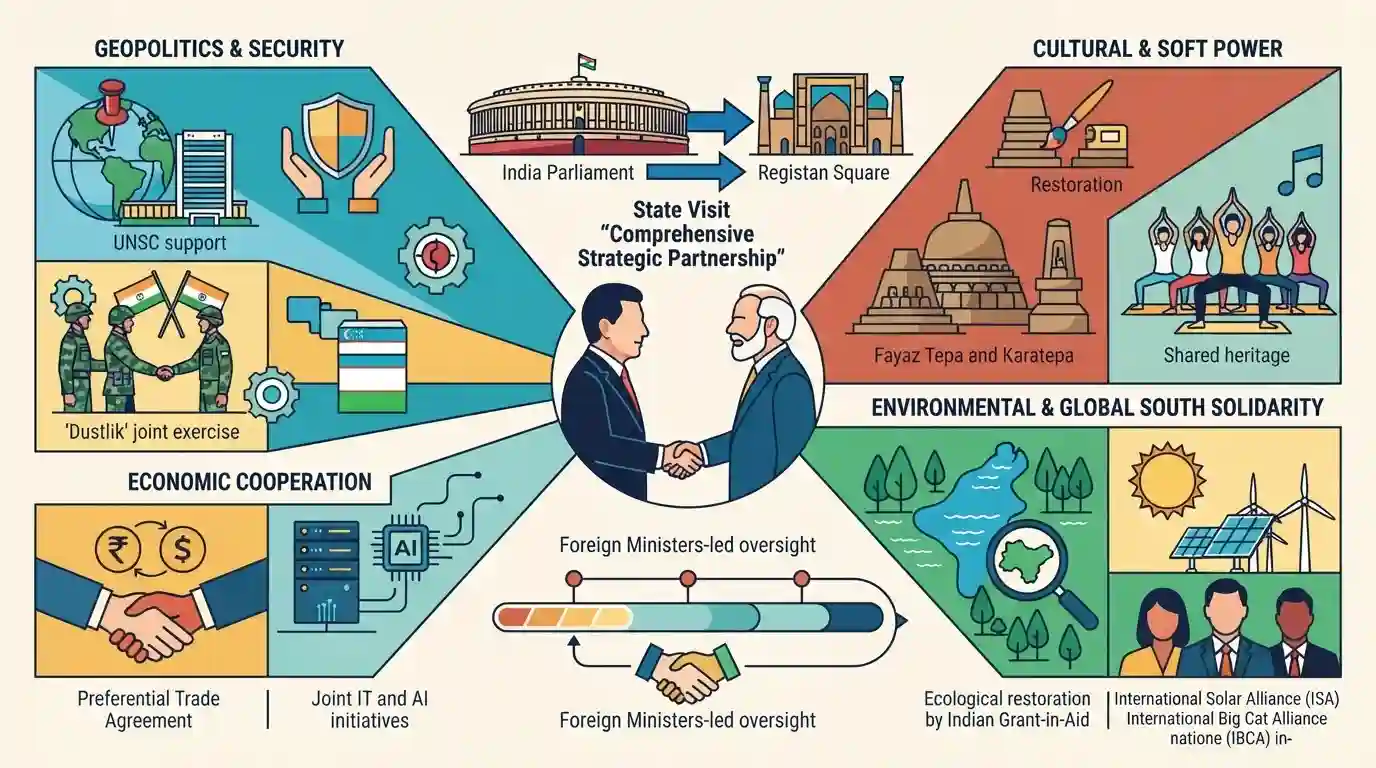
During Prime Minister Narendra Modi's State Visit to Uzbekistan in August 2026, the two countries elevated their ties to a Comprehensive Strategic Partnership. Key agreements span geopolitical, technological, cultural, and environmental spheres. A Foreign Ministers-led review mechanism will oversee bilateral pacts, while security coordination continues via the joint exercise 'Dustlik.' Major milestones include progress towards a Preferential Trade Agreement, joint AI and IT initiatives, Indian-led conservation of ancient Buddhist sites (Fayaz Tepa and Karatepa), and a US $1 million Indian Grant-in-Aid for the ecological restoration of the Aral Sea region. Uzbekistan also reiterated support for India's permanent UNSC seat and expressed interest in joining the ISA and IBCA.
Key Points
- Prime Minister Narendra Modi’s state visit to Uzbekistan (August 29-30, 2026) led to the elevation of bilateral relations to a 'Comprehensive Strategic Partnership.'
- An institutionalized Foreign Ministers-led mechanism is established to coordinate and oversee the timely implementation of bilateral agreements.
- Defense and security cooperation are strengthened through regular joint military exercises ('Dustlik') and close coordination on regional security and counter-terrorism.
- On trade, the two nations are working on a Joint Working Group to resolve non-tariff barriers and advance negotiations for a Preferential Trade Agreement (PTA).
- Technology cooperation is highlighted by the expansion of Tashkent's IT Park (modeled on India’s STPI) and implementing Artificial Intelligence (AI) understandings.
- Cultural diplomacy is elevated through the restoration and conservation of ancient Buddhist sites Fayaz Tepa and Karatepa in Uzbekistan, alongside a new Hindi language scholarship.
- India has committed US $1 million for the greening and ecological rehabilitation of the Aral Sea region, aligning local and national greening campaigns.
- Uzbekistan backed India's permanent candidature for the UNSC and expressed intent to join the International Big Cat Alliance (IBCA) and the International Solar Alliance (ISA).
Important Terms
Joint Military Exercise "Dustlik" (EX-DUSTLIK)

An annual bilateral military exercise conducted alternately between the armed forces of India and Uzbekistan since 2019, focusing on counter-terrorism, interoperability, and tactical operations in semi-mountainous terrain.
UPSC context
GS Paper II (Bilateral Relations) and GS Paper III (Security). Tests understanding of India's strategic partnership with Central Asian nations and defence diplomacy.
Yashil Makon (Green Nation) Initiative
Uzbekistan's national afforestation campaign launched in 2021, aiming to plant one billion trees and shrubs to combat land degradation, desertification, and climate change, particularly in the ecologically fragile Aral Sea region.
UPSC context
GS Paper III (Environment & Conservation). Tests knowledge of global ecological initiatives, bilateral environmental partnerships, and climate action models in the Global South.
Ek Ped Maa Ke Naam Campaign
India’s nationwide tree-plantation campaign launched on World Environment Day 2024, encouraging citizens to plant trees in honor of their mothers to promote environmental sustainability and combat climate change.
UPSC context
GS Paper III (Environment & Conservation). Tests awareness of domestic afforestation initiatives, community-led climate mitigation, and India’s environmental soft power in international forums.
India-Uzbekistan Preferential Trade Agreement (PTA)
A proposed trade agreement between India and Uzbekistan aimed at lowering tariffs on selected goods, removing non-tariff barriers, and helping achieve their targeted bilateral trade of $5 billion by 2030.
UPSC context
GS Paper II (Bilateral Agreements). Tests knowledge of economic diplomacy, trade facilitation tools, and India's "Connect Central Asia" policy.
Indian Technical and Economic Cooperation (ITEC) Program
India’s flagship capacity-building initiative launched in 1964, providing technical assistance, training, and skill development to developing partner nations globally as a core element of its South-South cooperation.
UPSC context
GS Paper II (Foreign Policy & International Relations). Tests understanding of India's development diplomacy, soft power, and institutional capacity-building partnerships.
Prelims Trap
Fayaz Tepa and Karatepa are Mauryan-era Buddhist monasteries located in Jammu and Kashmir.
Aspirants often confuse historical sites in Central Asia with domestic Gandharan or Mauryan sites, or assume Fayaz Tepa and Karatepa are located in India or Pakistan rather than Uzbekistan.
Static Concepts Connected
What are the key features of Kushan-era art and its Central Asian linkages?
- Greco-Buddhist synthesis: Blended Greek, Roman, Persian, and Indian artistic traditions, heavily visible in the Gandhara and Termez schools.
- Mahayana patronage: Emperors like Kanishka I patronized Mahayana Buddhism, transforming Central Asia into a major transit hub for its spread to East Asia.
- Silk Road monasteries: Monasteries like Fayaz Tepa in Termez served as crucial spiritual and economic rest-stops for Silk Road merchants.
How does a Preferential Trade Agreement (PTA) differ from a Free Trade Agreement (FTA)?
- Scope of tariff cuts: PTAs lower tariffs on a positive list of selected goods, whereas FTAs aim to eliminate tariffs on substantially all trade.
- Integration level: PTAs represent the lowest level of economic integration and are often a stepping stone to deeper trade agreements.
Cross-Topic Patterns
Central Asian transit + INSTC corridor
India's Connect Central Asia policy balances the Chabahar/INSTC routes against transit bottlenecks, using bilateral trade pacts to secure access to double-landlocked Uzbekistan.
Buddhist diplomacy + Silk Road soft power
ASI-led restoration of Uzbek Buddhist sites mirrors India's cultural diplomacy in Southeast Asia, utilizing shared historical legacies to strengthen modern strategic partnerships.
South-South cooperation + Aral Sea restoration
India's $1M grant for Aral Sea greening demonstrates its evolving role as an ecological development partner, matching local greening campaigns with global climate action.

Kushan-era Central Asian Buddhist sites (Fayaz Tepa) likely to be matched with modern geographical locations in a Prelims history question.
Linked PYQs · 3
Linked PYQs · 3
- 2018MainsGS2
A number of outside powers have entrenched themselves in Central Asia, which is a zone of interest to India. Discuss the implications, in this context, of India's joining the Ashgabat Agreement, 2018.
- 2022PrelimsGS1
Consider the following countries: 1. Azerbaijan 2. Kyrgyzstan 3. Tajikistan 4. Turkmenistan 5. Uzbekistan Which of the above have borders with Afghanistan ?
- 2022PrelimsGS1
Consider the following countries: 1. Armenia 2. Azerbaijan 3. Croatia 4. Romania 5. Uzbekistan Which of the above are members of the Organization of Turkic States?
