Lucknow Cantonment renames colonial markets after freedom fighters
Source:PIB ↗
Why It Matters
This topic is highly relevant for UPPSC PCS Prelims as it bridges UP-specific history (1857 Revolt leaders, Lucknow siege, and Kakori heroes) with Indian polity (the administration and legal framework of Cantonment Boards under the Ministry of Defence) and current regional development initiatives.
Summary
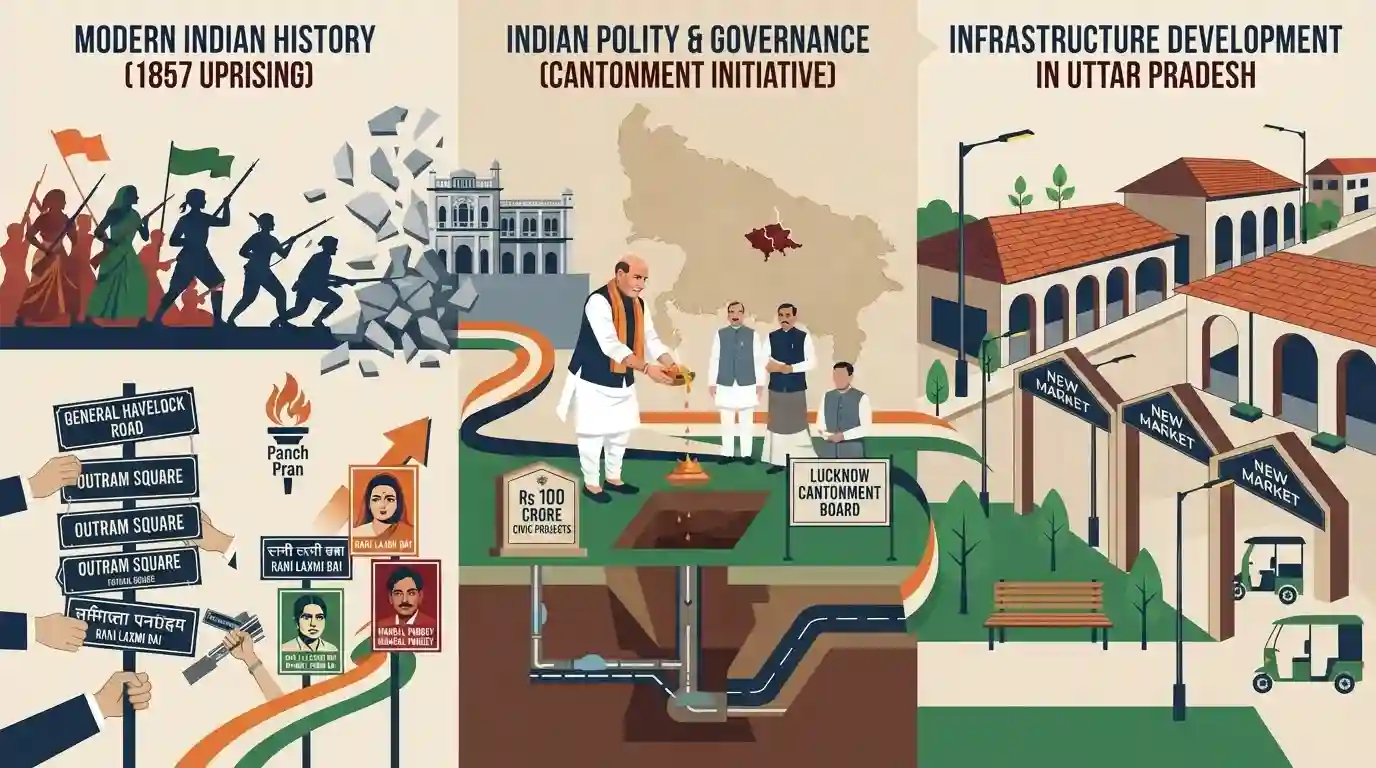
Union Defence Minister Rajnath Singh performed the Bhoomi Pujan for Rs 100 crore civic infrastructure projects in the Lucknow Cantonment. Alongside this, five British-era markets inside the cantonment—originally named after colonial generals responsible for suppressing the 1857 Revolt in Lucknow—were renamed to honor legendary Indian freedom struggle heroes. This initiative aligns with the 'Panch Pran' resolution of removing colonial vestiges and celebrating indigenous history, specifically referencing the region's rich revolutionary past during the 1857 Uprising and subsequent freedom struggles.
Key Points
- Raksha Mantri Rajnath Singh performed the Bhoomi Pujan for civic infrastructure development projects worth Rs 100 crore in the Lucknow Cantonment to upgrade roads, drinking water supply, sewage, schools, and community centers.
- Five British-era markets in the Lucknow Cantonment have been officially renamed after Indian freedom heroes to discard colonial legacies, aligning with the national theme of 'Panch Pran'.
- The original names of the markets and roads in the cantonment were tied to British military officers involved in the suppression of the 1857 Revolt (such as General Henry Lawrence, General James Neill, General Henry Havelock, James Outram, and Colin Campbell).
- The renaming honors legendary Indian icons of the 1857 Uprising and the national movement, such as Begum Hazrat Mahal, Rani Laxmibai, Mangal Pandey, Chandra Shekhar Azad, and Netaji Subhash Chandra Bose.
- Cantonment Boards operate as local municipal bodies under the administrative control of the Union Ministry of Defence, governed by the Cantonments Act, 2006.
- The event highlights the ongoing modernization of Cantonment administrations across India, including discussions around demerging civilian pockets to merge them with municipal corporations for better access to state-level welfare programs.
Important Terms
Cantonments Act, 2006

An Act of Parliament regulating civil administration, democratic structures, and land management of military cantonments in India, replacing the British-era 1924 Act.
UPSC context
GS Paper II (Polity) — Statutory bodies and urban local governance frameworks.
74th Constitutional Amendment Act
A 1992 constitutional amendment that institutionalized urban local bodies. While cantonments are exempt, the Cantonments Act, 2006 incorporates several of its democratic reservation rules.
UPSC context
GS Paper II (Polity) — Structure and devolution of powers in local self-government.
Ministry of Defence
The Union ministry responsible for national security and military affairs, exercising administrative control over all Cantonment Boards through the Director General of Defence Estates.
UPSC context
GS Paper II (Polity) — Union ministries and national administrative structures.
Lucknow Cantonment Board
An autonomous local body under the Ministry of Defence responsible for civil administration, public health, and infrastructure development within the Lucknow Cantonment area.
UPSC context
UP GK & GS Paper II — Municipal governance structures in Uttar Pradesh.
Uda Devi
A heroic Dalit woman warrior from Lucknow who formed a women's battalion in 1857, famously sniping over thirty British soldiers at the Battle of Sikandar Bagh.
UPSC context
GS Paper I (UP History) — Role of Dalit and regional freedom fighters of 1857.
Matadin Valmiki
A Dalit revolutionary and cartridge factory worker whose confrontation with Mangal Pandey regarding the use of animal fat in cartridges catalyzed the 1857 Revolt.
UPSC context
GS Paper I (UP History) — Subaltern heroes and catalyst events of the 1857 Uprising.
Prelims Trap
Cantonment Boards are governed under Part IX-A of the Constitution and fall under state municipal departments.
Cantonments are Union List subjects governed by the Central Ministry of Defence under the Cantonments Act 2006, entirely excluded from Part IX-A.
Static Concepts Connected
How are Cantonment Boards administered under the Indian constitutional and legal framework?
- Ministry Control: Function directly under the administrative control of the Union Ministry of Defence, not State Municipal bodies.
- Statutory Basis: Governed by the central Cantonments Act, 2006, which replaced the colonial-era Cantonments Act of 1924.
- Constitutional Status: Excluded from Part IX-A of the Constitution; they are regulated under the Union List (Entry 3, Seventh Schedule).
- Governance Structure: Composed of both elected and ex-officio members, with the military Station Commander serving as the President.
Who were Uda Devi and Matadin Valmiki, and what was their role in the 1857 Revolt?
- Uda Devi: A Dalit woman warrior of the Pasi community who fought at the Battle of Sikandar Bagh in November 1857.
- Heroic Feat: Climbed a pipal tree dressed in male attire and shot dead over 30 British soldiers during the Siege of Lucknow.
- Matadin Valmiki: An 1857 revolutionary who challenged Mangal Pandey regarding the grease of the new Enfield cartridges at Barrackpore.
- Catalytic Role: His confrontation sparked the greased cartridge controversy that catalyzed the Sepoy Mutiny; he was executed in April 1857.
Cross-Topic Patterns
Subaltern figures in UP freedom struggle
UPPSC increasingly tests marginalized regional icons of the 1857 Revolt like Uda Devi, linking subaltern studies directly with UP's regional history syllabus.
Cantonment demerger and municipal integration
The civilian-municipal merger of cantonments bridges Central defense administration with State urban municipal governance under the 74th Amendment.

Expect a statement question on the roles of Uda Devi and Matadin Valmiki in the 1857 Revolt or the unique legal status of Cantonment Boards.
Linked PYQs · 5
Linked PYQs · 5
- 2011UPPSC_PRELIMSGS1
Who among the following was the one to have escaped being hanged in the 'Kakori Conspiracy Case'?
- 2021UPPSC_PRELIMSGS1
Ministry of Culture, Government of India as part of Azadi ka Amrit Mahotsav celebrated the birth anniversary of Saheed Ram Prasad Bismil in June, 2021 at which one of the following places in Uttar Pradesh ?
- 2023UPPSC_PRELIMSGS1
Which one of the following (Place of the revolt of 1857 – Start of rebellion) is not correctly matched?
- 2023UPPSC_PRELIMSGS1
Who was the leader of rebellion in Bareilly, Uttar Pradesh during 1857?
- 2024UPPSC_PRELIMSGS1
Which Amendment Acts deal with Local Governance Institutions in India ?
