Legal Metrology Indian Standard Time Rules and Digital Sovereignty
Source:PIB ↗
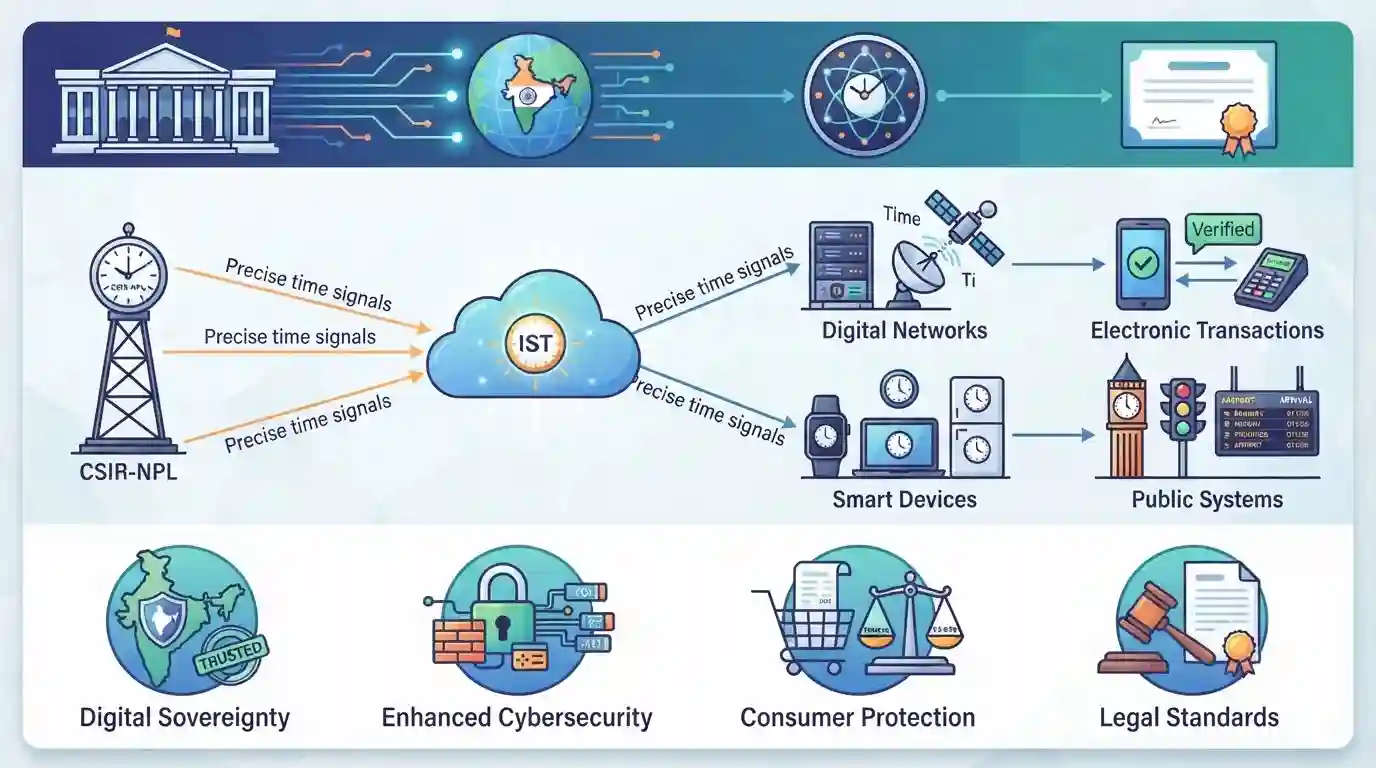
Why It Matters
This notification represents a major step toward digital sovereignty and national security by establishing a domestic, legally traceable time-synchronization standard. It eliminates critical dependencies on foreign time servers, streamlines legal admissibility of digital forensic evidence, and protects consumer transactions from latency-driven billing discrepancies.
Summary
The Department of Consumer Affairs has notified the Legal Metrology (Indian Standard Time) Rules, 2026. These rules mandate that all digital networks, electronic transactions, smart devices, and public systems align their clock synchronization with the official Indian Standard Time (IST) maintained by the CSIR-National Physical Laboratory (CSIR-NPL). The initiative aims to bolster digital sovereignty, enhance cybersecurity, ensure consumer protection in billing and digital transactions, and establish clear legal standards for electronic evidence.
Key Points
- The Department of Consumer Affairs has notified the Legal Metrology (Indian Standard Time) Rules, 2026, to standardize and secure timekeeping across Indian digital and physical infrastructure.
- The rules mandate that all digital clocks, networks, servers, smart meters, and time-stamping devices used in commercial transactions and public services synchronize with Indian Standard Time (IST).
- The official IST is generated and maintained by the CSIR-National Physical Laboratory (CSIR-NPL) in New Delhi, which serves as India's National Metrology Institute.
- All regulated entities must establish traceability to UTC(NPLI)—the Universal Coordinated Time scale maintained by CSIR-NPL, reducing dependence on foreign-controlled time sources (such as US GPS or foreign NTP servers).
- Uniform time-stamping is crucial for cybersecurity, allowing precise correlation of network logs during cyber incident investigations, preventing cybercrime, and securing critical information infrastructure.
- It protects consumers and prevents financial fraud by eliminating timing discrepancies in digital transactions, high-frequency trading, and smart-utility or telecom billing.
- The rules support legal compliance under the Bharatiya Sakshya Adhiniyam, 2023, by ensuring that electronic logs and digital evidence have standardized, legally admissible timestamps.
Important Terms
Legal Metrology (Indian Standard Time) Rules, 2026

Rules notified under the Legal Metrology Act, 2009 mandating Indian Standard Time (IST) as the single official time reference for legal, administrative, and commercial purposes nationwide, requiring synchronization of digital networks within 180 days.
UPSC context
GS Paper III: S&T; tests policy initiatives for cyber-physical security, digital sovereignty, and synchronization in critical infrastructure.
Legal Metrology Act, 2009
An Act of the Parliament of India that establishes and enforces standards of weights, measures, and related transactions to ensure accuracy, transparency, and consumer protection in trade, commerce, and official records.
UPSC context
GS Paper II: Regulatory Laws; tests regulatory bodies, consumer protection, and standards of measurements.
CSIR-National Physical Laboratory (CSIR-NPL)
India's National Measurement Institute responsible for realizing, maintaining, and disseminating national standards of physical measurements, including the atomic time scale that derives the official Indian Standard Time (IST).
UPSC context
GS Paper III: S&T; tests scientific institutions, national measurement standards, and critical timing infrastructures.
Bharatiya Sakshya Adhiniyam, 2023
The modern statute replacing the colonial-era Indian Evidence Act, 1872, laying down modernized rules for the admissibility, relevance, and certification of electronic records and digital evidence in legal trials.
UPSC context
GS Paper II: Judiciary/Polity; tests judicial reforms, modernization of criminal laws, and electronic evidence standards.
Department of Consumer Affairs
A department under the Ministry of Consumer Affairs, Food and Public Distribution responsible for formulating policies, administering legal metrology, protecting consumer rights, and maintaining essential commodities' standards in India.
UPSC context
GS Paper II: Executive Bodies; tests governance structures, market standardization policies, and consumer welfare laws.
Ministry of Consumer Affairs, Food and Public Distribution
The parent Union Ministry of India tasked with ensuring food security through public distribution, enforcing consumer protection laws, maintaining legal metrology, and regulating price controls of essential items.
UPSC context
GS Paper II: Governance/Ministries; tests administrative frameworks, public welfare, and national standardization.
Council of Scientific and Industrial Research (CSIR)
A premier national R&D organization in India, operating a network of laboratories, that spearheads scientific research, industrial development, and technological innovations across multiple domains.
UPSC context
GS Paper III: S&T; tests research and development networks and indigenization of technology.
Prelims Trap
The Legal Metrology (Indian Standard Time) Rules, 2026, were formulated and notified by the Ministry of Science and Technology.
The rules were notified by the Department of Consumer Affairs (Ministry of Consumer Affairs, Food & Public Distribution) under the Legal Metrology Act, 2009, not by the Ministry of Science and Technology.
Static Concepts Connected
How is the legislative power over weights, measures, and standards divided in the Indian Constitution?
- Union List: Entry 50 of List I (Union List) grants the Centre exclusive power over the 'Establishment of standards of weight and measure'.
- Concurrent List: Entry 33A of List III (Concurrent List) covers 'Weights and measures except establishment of standards', inserted via the 42nd Amendment, 1976.
- Enforcement Split: While the Central government enacts uniform standards (e.g., Legal Metrology Act, 2009), state governments enforce these laws through local legal metrology departments.
What is the scientific basis and official custody of Indian Standard Time (IST)?
- Official Custodian: CSIR-National Physical Laboratory (CSIR-NPL), New Delhi is the National Metrology Institute (NMI) and the statutory custodian of IST.
- Geographical Reference: IST is based on the 82.5 degree East longitude, which passes through Mirzapur, Uttar Pradesh.
- Traceability Scale: CSIR-NPL maintains UTC(NPLI), traceable to Coordinated Universal Time (UTC) using a system of high-precision Cesium atomic clocks and hydrogen masers.
Cross-Topic Patterns
Cybersecurity + Judicial Evidence
Standardized time-stamping is vital for CERT-In incident reporting, allowing exact log correlation across networks during cyber investigations and cyber warfare defense.
Strategic Autonomy + Space Technology
Integrating IST with NavIC-based timing devices reduces strategic vulnerabilities to foreign GNSS (like US GPS) spoofing in critical infrastructure like power grids.

Multi-statement questions may test the statutory basis of IST, CSIR-NPL's role, and the constitutional division of weights/measures.
Linked PYQs · 3
Linked PYQs · 3
- 2025PrelimsGS1
Consider the following countries : I. United Kingdom II. Denmark III. New Zealand IV. Australia V. Brazil How many of the above countries have more than four time zones?
- 2017MainsGS3
Discuss the potential threats of Cyber attack and the security framework to prevent it.
- 2016MainsGS2
What is a quasi-judicial body? Explain with the help of concrete examples.
