Mission Rangeen Machhli 2031 Launched for Ornamental Fisheries Sector
Source:PIB ↗
Why It Matters
While food fish dominates India's blue economy discourse, ornamental fisheries represent a highly lucrative, low-footprint, and high-value allied sector. 'Mission Rangeen Machhli 2031' highlights the shift toward agricultural diversification and non-farm rural employment, particularly for women's self-help groups (SHGs). Understanding such missions is critical for GS Paper 3 questions on livestock rearing, technological interventions in agriculture, and rural livelihood diversification.
Summary
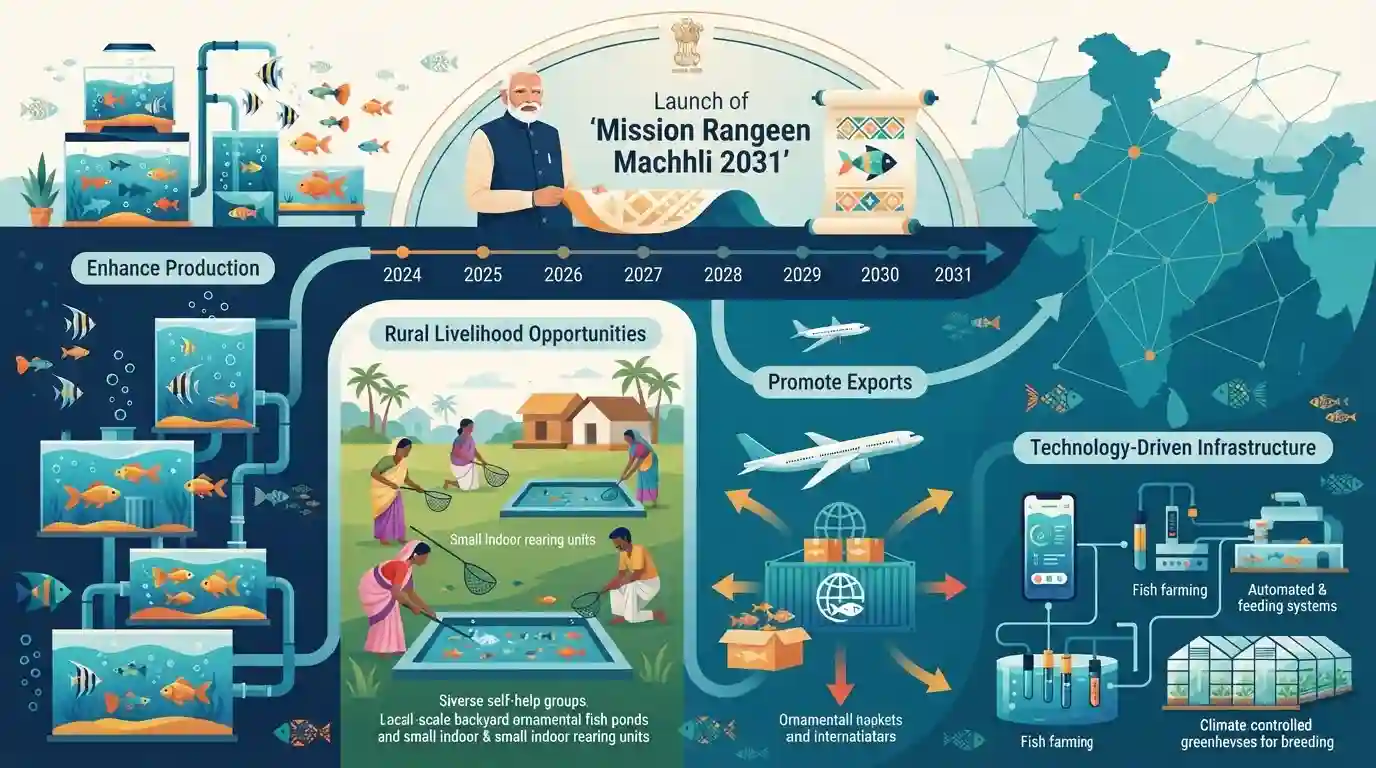
The Vice President of India is set to release 'Mission Rangeen Machhli 2031', a long-term strategic action plan aimed at transforming India's ornamental fisheries sector. Supported under the Pradhan Mantri Matsya Sampada Yojana (PMMSY), the mission seeks to enhance production, generate rural livelihood opportunities, promote exports, and strengthen technology-driven infrastructure for breeding and marketing ornamental fish.
Key Points
- Mission Rangeen Machhli 2031 is a comprehensive strategic action plan designed to drive the sustainable development and growth of the ornamental fisheries sector in India.
- The plan focuses on boosting domestic production, enhancing export earnings, and building robust market linkages for ornamental fish and aquatic plants.
- It emphasizes the generation of employment and entrepreneurship opportunities, with a strong focus on empowering rural women, youth, and small-scale farmers through allied agricultural activities.
- Key interventions include the development of modern breeding and rearing infrastructure, setting up ornamental fish parks, quality testing labs, and quarantine systems.
- The initiative promotes technological integration, including recirculating aquaculture systems (RAS), and aligns with digital tools like the 'Rangeen Machhli' mobile app developed by ICAR-CIFA to offer resource directories and guidebooks.
- Funded under the umbrella of the Pradhan Mantri Matsya Sampada Yojana (PMMSY), the mission aims to place India prominently on the global map of the multi-billion-dollar ornamental fish trade.
Important Terms
Mission Rangeen Machhli 2031

A long-term strategic action plan launched in 2026 to modernize, standardize, and scale India's ornamental fisheries sector, focusing on uniform rules for breeding, biosecurity, quality control, and trade.
UPSC context
GS Paper III (Agriculture/Allied Sectors); tests policies on rural livelihoods, technology missions, and blue economy development.
Pradhan Mantri Matsya Sampada Yojana (PMMSY)
A flagship Central scheme launched in 2020 with a ₹20,050 crore outlay to drive ecologically sustainable and responsible development of India's fisheries sector and improve fishers' welfare.
UPSC context
GS Paper III (Agriculture/Government Schemes); tests infrastructure development, allied sectors, and double farmer income initiatives.
Ministry of Fisheries, Animal Husbandry and Dairying
An Indian government ministry created in 2019 to focus on and accelerate policies, infrastructure, and growth in fisheries, animal husbandry, dairying, and allied agricultural sectors.
UPSC context
GS Paper II (Government Policies/Interventions); tests the administrative framework governing primary and allied economic sectors.
ICAR-Central Institute of Freshwater Aquaculture (ICAR-CIFA)
A premier research institute under the Indian Council of Agricultural Research, specializing in developing sustainable, economically viable technologies for freshwater aquaculture breeding, seed production, and farming.
UPSC context
GS Paper III (Science & Technology/Agriculture); tests institutional research, technological innovations, and extension services in aquaculture.
Department of Fisheries
A specialized department under the Ministry of Fisheries, Animal Husbandry and Dairying, responsible for planning, promoting, and implementing policies to sustainably develop India's marine and inland fisheries.
UPSC context
GS Paper II (Institutional Framework); tests institutional capacity and execution of national policies like PMMSY.
Prelims Trap
Recirculating Aquaculture Systems (RAS) biofilters function primarily to enrich culture water with phosphorus to stimulate the growth of ornamental aquatic plants.
RAS biofilters perform biological nitrification (converting toxic ammonia to nitrate). They do not increase phosphorus; in fact, high phosphorus causes eutrophication and must be actively removed.
Static Concepts Connected
What is Recirculating Aquaculture System (RAS) technology and how do its biofilters work?
- Water recycling: A closed-loop system that filters and recycles water, reducing overall water consumption by up to 90% compared to traditional aquaculture ponds.
- Biological nitrification: Nitrosomonas and Nitrobacter bacteria in biofilters convert toxic ammonia from fish waste into nitrite, and then into relatively harmless nitrate.
- Solids removal: Mechanical filtration physically extracts suspended organic solids, preventing biofilter clogging and maintaining high dissolved oxygen levels in the tanks.
What are the commercial and ecological roles of seaweed species promoted under PMMSY?
- Agar extraction: Gracilaria species yield agar-agar, which is widely utilized as a gelling agent in food, pharmaceuticals, and microbiological culture media.
- Carrageenan source: Kappaphycus alvarezii is cultivated to extract carrageenan, a key thickening and stabilizing agent used extensively in the food and cosmetic industries.
- Bioremediation agent: Seaweeds act as biological nutrient sinks, absorbing excess dissolved nitrogen and phosphorus to combat coastal eutrophication and ocean acidification.
Cross-Topic Patterns
Blue Economy + Coastal Security
Expanding deep-sea fishing beyond 50 nautical miles secures economic assets under PMMSY while strengthening maritime surveillance and presence in India's vast outer Exclusive Economic Zone.
Allied Agriculture + Gender Empowerment
Backyard ornamental fisheries act as high-value, low-volume livelihoods. Targeting rural women for home-based breeding units structurally bridges the gender-income gap in the primary sector.

Multi-statement questions likely to pair PMMSY's seaweed cluster geography (Lakshadweep) with the biological nitrogen cycle dynamics of RAS.
Linked PYQs · 2
Linked PYQs · 2
- 2015MainsGS3
Livestock rearing has a big potential for providing non-farm employment and income in rural areas. Discuss suggesting suitable measures to promote this sector in India.
- 2023PrelimsGS1
With reference to the role of biofilters in Recirculating Aquaculture System, consider the following statements: 1. Biofilters provide waste treatment by removing uneaten fish feed. 2. Biofilters convert ammonia present in fish waste to nitrate. 3. Biofilters increase phosphorus as nutrient for fish in water. How many of the statements given above are correct?
