India Chile CEPA Talks Advance for Critical Minerals and Trade Growth
Source:PIB ↗
हे का महत्त्वाचे आहे
The transition from a PTA to a CEPA with Chile is strategically vital for India's external sector. It not only enhances bilateral trade in high-value services and pharmaceuticals but also secures crucial critical minerals like lithium and copper, which are essential for India's clean energy transition and EV manufacturing goals. This exemplifies India's shift towards proactive bilateralism to counter global protectionist trends.
सारांश
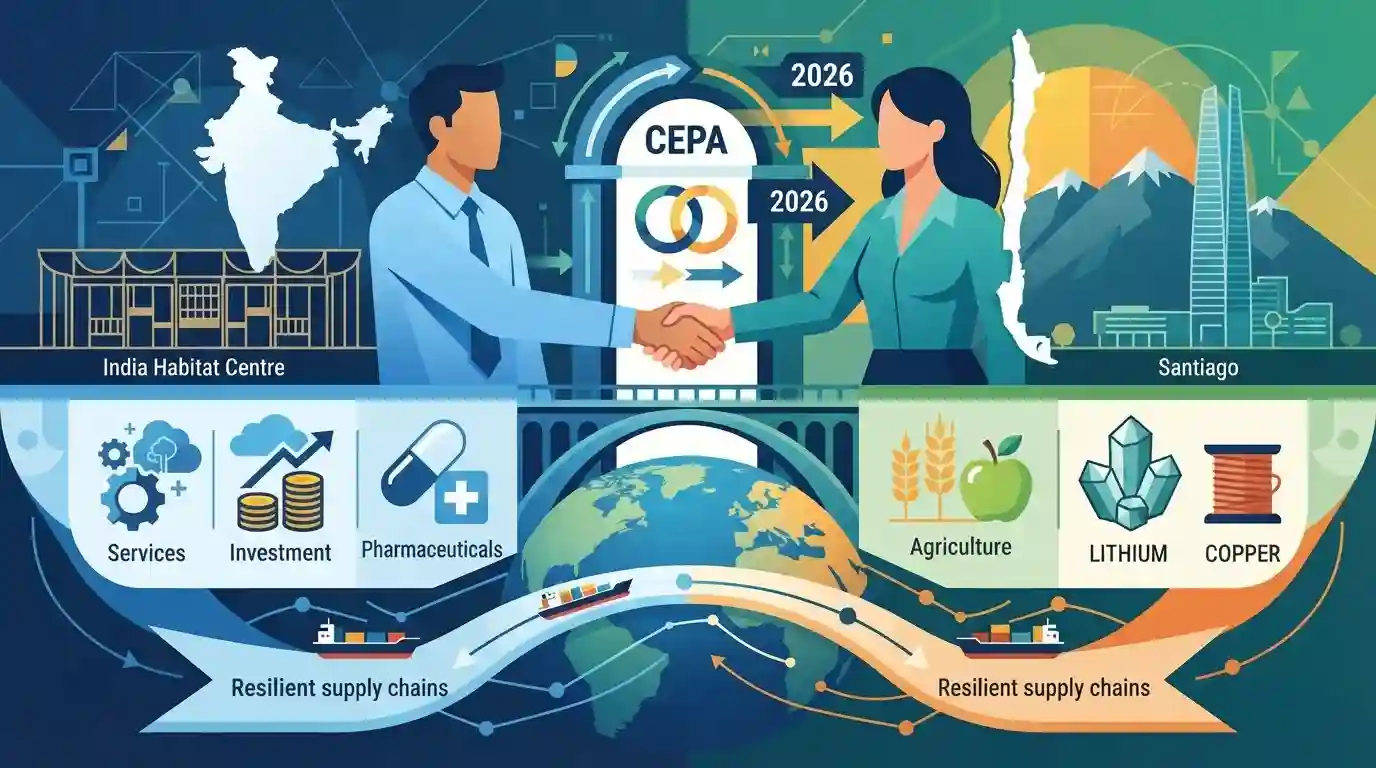
Indian Commerce Secretary Shri Rajesh Agrawal met with Chilean Vice-Minister Paula Estévez Weinstein in Santiago to accelerate negotiations for the India-Chile Comprehensive Economic Partnership Agreement (CEPA). Building on their existing Preferential Trade Agreement (PTA), both countries aim to finalize this wide-ranging agreement by the end of 2026. The CEPA will cover critical economic sectors such as services, investment, pharmaceuticals, agriculture, and strategically vital resources like critical minerals (lithium and copper), reinforcing resilient supply chains and South-South cooperation.
मुख्य मुद्दे
- The Indian Commerce Secretary, Shri Rajesh Agrawal, and the Chilean Vice-Minister of International Economic Relations, Paula Estévez Weinstein, met in Santiago, Chile, to fast-track negotiations for the India-Chile Comprehensive Economic Partnership Agreement (CEPA).
- Both nations expressed a strong commitment to concluding the CEPA negotiations by the end of 2026, marking a significant transition from their existing Preferential Trade Agreement (PTA).
- The proposed CEPA aims to expand bilateral trade beyond tariff reductions on goods (the limit of the current PTA) to encompass services, investment, intellectual property rights, and regulatory cooperation.
- Key sectors targeted for deeper cooperation include critical minerals (lithium and copper), pharmaceuticals, healthcare, agriculture, machinery, and technology.
- The partnership leverages their shared identity in the Global South, aiming to diversify trade baskets, establish resilient supply chains, and mitigate risks from global trade protectionism.
महत्त्वाच्या संज्ञा
India-Chile Comprehensive Economic Partnership Agreement (CEPA)

A proposed deep bilateral trade treaty being negotiated between India and Chile to liberalize trade, services, investments, and secure critical minerals, building on their existing preferential trade arrangement.
UPSC context
GS Paper II & III: Bilateral treaties, foreign trade policy, and energy security through resource diplomacy.
India-Chile Preferential Trade Agreement (PTA)
A bilateral trade treaty signed in 2006 (effective 2007) and significantly expanded in 2016, offering mutual tariff concessions on designated tariff lines to boost bilateral market access.
UPSC context
GS Paper II & III: Bilateral trade frameworks, preferential tariff concessions, and India's economic relations with Latin American nations.
Ministry of Commerce and Industry
The Indian government ministry responsible for formulating foreign trade policies, administering special economic zones, promoting industrial growth, and negotiating international trade agreements.
UPSC context
GS Paper II & III: Government policies, institutional frameworks for trade facilitation, and economic growth mechanisms.
Subsecretaría de Relaciones Económicas Internacionales (SUBREI)
The Chilean government's Undersecretariat of International Economic Relations under the Ministry of Foreign Affairs, responsible for executing, coordinating, and negotiating Chile’s international trade policies and trade agreements.
UPSC context
GS Paper II: Bilateral trade negotiations, international trade diplomacy, and key foreign institutional counterparts.
पूर्वपरीक्षा सापळा
A PTA is more comprehensive than a CEPA and operates on a negative list where all trade is liberalized unless specifically excluded.
Actually, a PTA is the most basic trade pact operating on a restrictive positive list, whereas a CEPA is highly comprehensive and uses negative lists.
संबंधित स्थिर संकल्पना
What is the hierarchy of bilateral trade agreements (PTA, FTA, CEPA)?
- Preferential Trade Agreement: Features a limited positive list of tariff lines with lower duties, representing the basic and least integrated form of trade agreement.
- Free Trade Agreement: Involves duty-free trade for substantially all goods using a negative list, but rarely covers services or complex investment rules.
- CECA and CEPA: Comprehensive partnerships covering trade in goods, services, investments, intellectual property, and regulatory standards, with CEPA being the most structurally integrated.
What is KABIL and its role in India's energy security?
- Joint Venture Setup: A joint venture of three public sector enterprises—NALCO, HCL, and MECL—under the Ministry of Mines, created in 2019.
- Strategic Mandate: Acquires and develops strategic critical mineral assets abroad, specifically lithium and cobalt, to secure India's green transition supply chains.
आंतर-विषय नमुने
Critical minerals & EV manufacturing
Securing lithium from Chile's Atacama directly fuels India's domestic EV schemes by reducing critical battery-input reliance on third-party processing nations.
LAC diplomacy & South-South cooperation
Expanding trade pacts in South America allows India to project Global South leadership and counter China's deep economic footprint in the Andean region.

Questions pairing the geography of the Lithium Triangle with the operational mandate of KABIL and CEPA trade dynamics are highly likely.
संबंधित PYQ · 2
संबंधित PYQ · 2
- 2025PrelimsGS1
Consider the following pairs : Country Resource-rich in I. Botswana : Diamond II. Chile : Lithium III. Indonesia : Nickel In how many of the above rows is the given information correctly matched?
- 2025MainsGS3
What are the challenges before the Indian economy when the world is moving away from free trade and multilateralism to protectionism and bilateralism? How can these challenges be met?
