Prime Minister Visit to Uzbekistan and Kyrgyz Republic Central Asia
Source:PIB ↗
हे का महत्त्वाचे आहे
This visit underscores India's strategic push to consolidate its presence in landlocked Central Asia, a region vital for energy security, counter-terrorism, and regional stability. It provides critical material for Mains answers on the 'Connect Central Asia' policy, connectivity corridors (INSTC, Chabahar, Ashgabat Agreement), and bilateral defense exercises (Dustlik, Khanjar).
सारांश
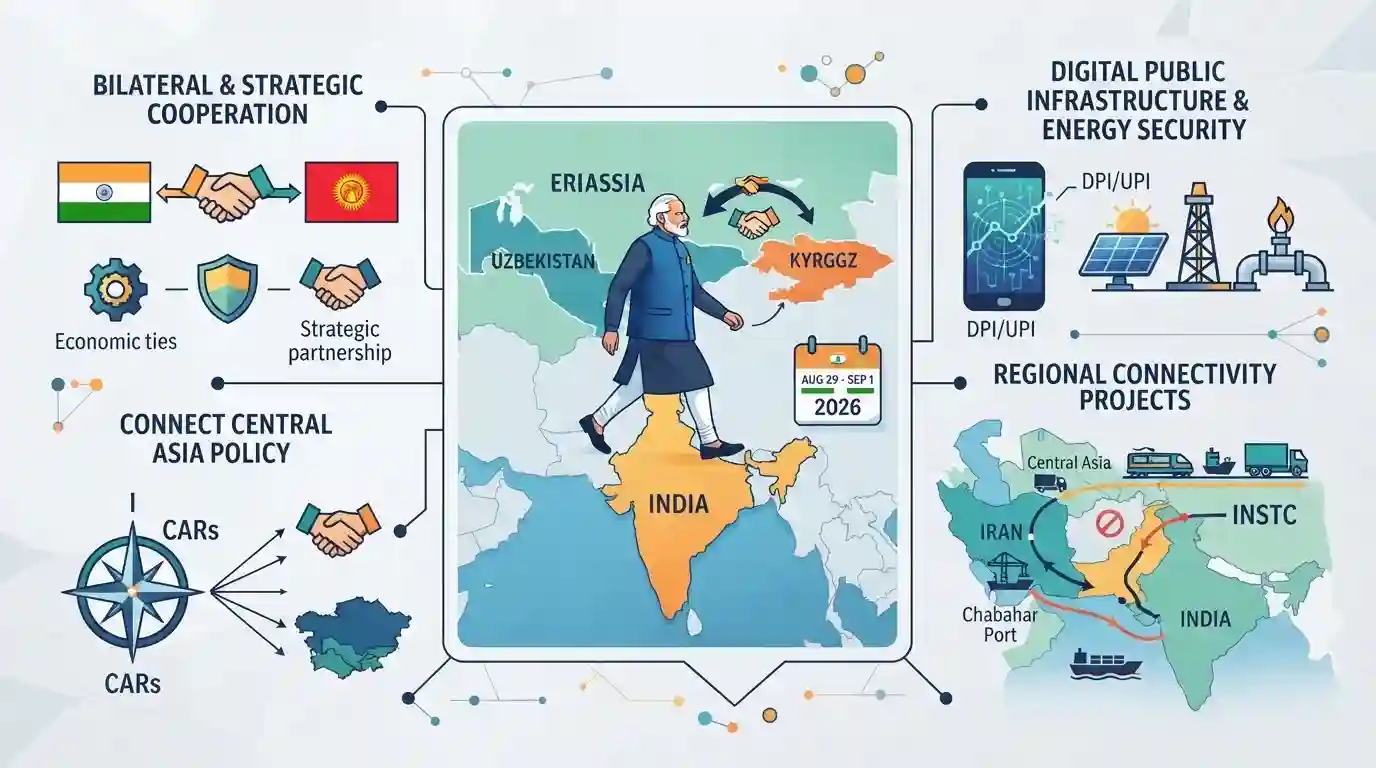
The article announces the official visit of Indian Prime Minister Narendra Modi to Uzbekistan and the Kyrgyz Republic from August 29 to September 1, 2026. The visit is aimed at strengthening bilateral diplomatic, economic, and strategic cooperation with these key Central Asian Republics (CARs) under India's 'Connect Central Asia' policy. It focuses on digital public infrastructure, energy security, defense cooperation, and enhancing regional connectivity through alternative routes like Chabahar Port and the INSTC to bypass overland transit challenges.
मुख्य मुद्दे
- Prime Minister Narendra Modi is undertaking an official visit to Uzbekistan and the Kyrgyz Republic from August 29 to September 1, 2026, to bolster India's geopolitical footprint in Central Asia under its 'Connect Central Asia' policy.
- The visit to Uzbekistan (Tashkent) involves bilateral talks with President Shavkat Mirziyoyev, focusing on diversifying economic trade, integrating digital payment systems (UPI), space technology, civil nuclear cooperation (specifically uranium supply), and defense.
- The visit to the Kyrgyz Republic (Bishkek) involves meetings with President Sadyr Japarov, focusing on Digital Public Infrastructure (DPI) sharing, telemedicine, high-altitude research, and resolving student-related issues given the significant Indian medical student population in the country.
- Defense cooperation remains a strong pillar of engagement, characterized by regular joint military exercises—Exercise Dustlik with Uzbekistan and Exercise Khanjar with the Kyrgyz Republic—alongside joint security strategies to combat terrorism and narcotics trafficking originating from Afghanistan.
- Addressing connectivity bottlenecks is a prime objective, with discussions emphasizing the optimization of the International North-South Transport Corridor (INSTC), utilization of Chabahar Port in Iran, and the Ashgabat Agreement to counter China's Belt and Road Initiative (BRI) in landlocked Central Asia.
महत्त्वाच्या संज्ञा
Connect Central Asia Policy

India's comprehensive foreign policy framework launched in 2012 to deepen political, security, economic, and cultural engagement with the five Central Asian Republics (Kazakhstan, Kyrgyzstan, Tajikistan, Turkmenistan, and Uzbekistan).
UPSC context
GS Paper II (International Relations) — India's strategic outreach, energy security objectives, and connectivity initiatives in its extended neighborhood.
International North-South Transport Corridor (INSTC)
A 7,200-km multi-mode transport network of ship, rail, and road routes connecting India, Iran, Azerbaijan, Russia, and Central Asia, designed to reduce transit time and costs compared to traditional sea routes.
UPSC context
GS Paper II & III — Regional connectivity projects, transit diplomacy, and economic corridors bypassing overland trade barriers.
Ashgabat Agreement
An international multimodal transport and transit pact signed in 2011 to establish an efficient trade corridor linking Central Asia with the Persian Gulf, which India formally joined as a member in 2018.
UPSC context
GS Paper II (International Relations) — Trade corridors, Eurasian integration, and India's Look West and Connect Central Asia alignment.
Exercise Dustlik
An annual bilateral joint military exercise conducted alternately in India and Uzbekistan, aimed at enhancing counter-terrorism capabilities, tactical interoperability, and military cooperation, first initiated in 2019.
UPSC context
GS Paper II & III — Bilateral defense agreements, security cooperation, and tactical military joint training in Central Asia.
Exercise Khanjar
An annual bilateral Special Forces exercise conducted between India and Kyrgyzstan, focusing on counter-terrorism, mountain warfare techniques, and strengthening strategic defense cooperation.
UPSC context
GS Paper II & III — Security partnerships, defense diplomacy, and military drills targeting unconventional warfare.
Shanghai Cooperation Organisation (SCO)
A permanent intergovernmental Eurasian political, economic, and security alliance founded in 2001, focusing on regional stability, counter-terrorism (via RATS), and economic partnerships among Eurasian nations.
UPSC context
GS Paper II — Regional groupings, multilateral diplomacy, and strategic engagement with China, Russia, and Central Asian states.
Indian Technical and Economic Cooperation (ITEC)
A flagship capacity-building and developmental assistance program launched in 1964 by India’s Ministry of External Affairs to share its developmental expertise, skills, and technical knowledge with partner nations.
UPSC context
GS Paper II (Bilateral & regional agreements) — Soft power diplomacy, South-South cooperation, and developmental partnership strategies.
पूर्वपरीक्षा सापळा
All five Central Asian Republics share direct land borders with Afghanistan and are classified as doubly landlocked nations.
Only Uzbekistan, Tajikistan, and Turkmenistan share borders with Afghanistan. Kyrgyzstan does not. Additionally, Uzbekistan is one of only two doubly landlocked countries in the world.
संबंधित स्थिर संकल्पना
What is the Ashgabat Agreement and its significance for India?
- Definition: A multimodal transit agreement establishing an international transport corridor facilitating transport of goods between Central Asia and the Persian Gulf.
- India's Accession: India officially acceded in February 2018 to significantly enhance its trade and strategic footprint in Central Asian markets.
- Strategic Alignment: It works in tandem with Chabahar Port and INSTC to bypass overland transit bottlenecks through Pakistan.
What are the unique geographical features of Central Asia's landlocked states?
- Doubly Landlocked: Uzbekistan is one of only two doubly landlocked nations globally (the other being Liechtenstein), surrounded entirely by other landlocked countries.
- Caspian Status: Kazakhstan and Turkmenistan border the Caspian Sea, which is landlocked itself, offering no direct natural access to the world's oceans.
आंतर-विषय नमुने
Mineral Diplomacy + Nuclear Energy
Uzbekistan's uranium supply agreements directly support India's clean energy goals, linking Central Asian bilateral diplomacy with India's domestic civil nuclear energy expansion and climate commitments.
Connectivity + Countering China
India's investments in INSTC, Chabahar, and the Ashgabat Agreement function as a strategic multimodal alternative to China's Belt and Road Initiative (BRI) in landlocked Eurasia.

Map-based questions linking CAR borders, INSTC transit nodes, and bilateral military exercises are highly probable.
संबंधित PYQ · 3
संबंधित PYQ · 3
- 2024MainsGS2
Critically analyse India's evolving diplomatic, economic and strategic relations with the Central Asian Republics (CARs) highlighting their increasing significance in regional and global geopolitics.
- 2018MainsGS2
A number of outside powers have entrenched themselves in Central Asia, which is a zone of interest to India. Discuss the implications, in this context, of India's joining the Ashgabat Agreement, 2018.
- 2022PrelimsGS1
Consider the following countries: 1. Azerbaijan 2. Kyrgyzstan 3. Tajikistan 4. Turkmenistan 5. Uzbekistan Which of the above have borders with Afghanistan ?
