Parivartan Scheme Commercial Vehicle Fleet Renewal and Incentives
Source:PIB ↗
কেন এটি গুরুত্বপূর্ণ
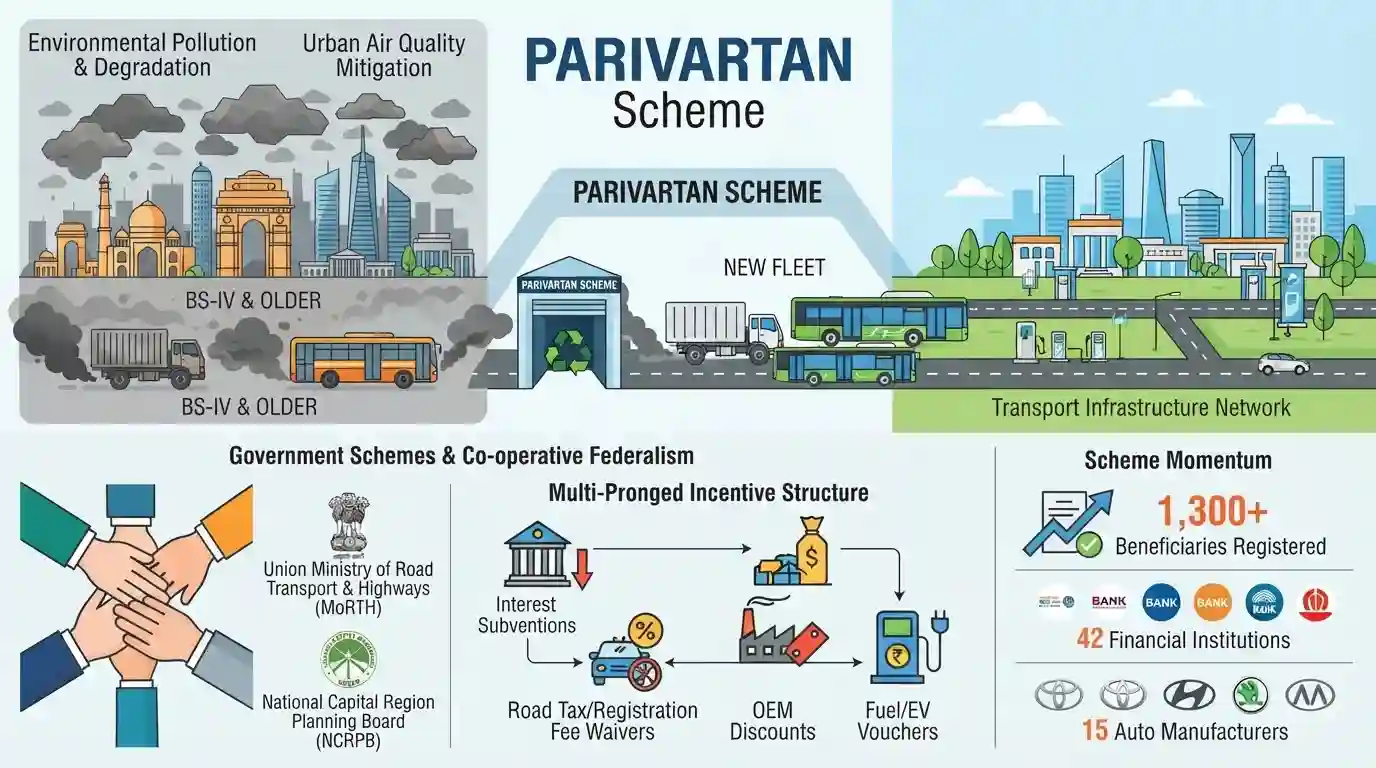
Air pollution in Delhi-NCR is a recurring environmental crisis and a high-priority topic for UPSC. The PARIVARTAN Scheme presents a concrete case study on structural and institutional interventions to eliminate heavy vehicular emissions (BS-IV or prior). It highlights how co-operative federalism (joint implementation by Centre and four states) and innovative demand-side economic incentives (interest subvention, EV vouchers, and tax waivers) are used to drive ecological transitions.
সারসংক্ষেপ
The Union Ministry of Road Transport & Highways (MoRTH) announced that the PARIVARTAN Scheme, launched in July 2026, is gaining significant momentum across the Delhi-NCR region. The scheme aims to replace over 2 lakh highly polluting BS-IV and older commercial trucks and buses with eco-friendly BS-VI or electric vehicles. Funded by the National Capital Region Planning Board (NCRPB) under MoHUA, the ₹9,585 crore program utilizes a multi-pronged incentive structure—including interest subventions, complete road tax/registration fee waivers, OEM discounts, and fuel/EV vouchers—to accelerate fleet renewal. To date, over 1,300 beneficiaries have registered, with extensive participation from 42 financial institutions and 15 auto manufacturers.
মূল বিষয়
- The PARIVARTAN Scheme was approved by the Union Cabinet on June 3, 2026, and officially launched on July 14, 2026.
- Its main objective is to replace more than 2 lakh commercial trucks and buses that conform to older Bharat Stage (BS)-IV or prior emission norms with modern BS-VI compliant or electric vehicles (EVs).
- The scheme applies specifically to vehicles registered in the National Capital Territory (NCT) of Delhi and the NCR districts of Haryana, Rajasthan, and Uttar Pradesh.
- It is funded through the National Capital Region Planning Board (NCRPB) under the Ministry of Housing and Urban Affairs (MoHUA) and implemented by the Ministry of Road Transport and Highways (MoRTH).
- The total financial outlay is ₹9,585 crore, which includes ₹5,041 crore in budgetary support from the Central Government.
- Incentives for buyers include a 5% interest saving on vehicle loans for 5 years, a 100% Road Tax Waiver for 10 years, a full waiver on registration fees, and a minimum 8% discount on the ex-showroom price from participating Original Equipment Manufacturers (OEMs).
- Additional incentives include monthly fuel vouchers (ranging from ₹1,200 to ₹4,800 for 5 years) for BS-VI diesel or CNG vehicles, or a one-time financial incentive (ranging from ₹64,000 to ₹2.56 lakh) for buying electric vehicles.
- As of late August 2026, the scheme has registered over 1,300 beneficiaries, onboarded 42 banks/NBFCs for interest subvention, and partnered with 15 auto OEMs. The first commercial vehicle owner was successfully registered in Alwar, Rajasthan, on August 19, 2026.
গুরুত্বপূর্ণ শব্দ
PARIVARTAN Scheme

A Central scheme launched in 2026 to accelerate Delhi-NCR's transition to cleaner mobility by incentivizing the replacement of over 2 lakh old commercial trucks and buses (BS-IV or older) with BS-VI or electric vehicles.
UPSC context
GS Paper III (Environment & Infrastructure); tests understanding of vehicular pollution control, green mobility, and central government schemes.
National Capital Region Planning Board (NCRPB)
A statutory body under the Ministry of Housing and Urban Affairs established in 1985 to coordinate regional planning, develop harmonized infrastructure, and prevent haphazard urban growth across Delhi-NCR.
UPSC context
GS Paper II (Statutory Bodies) & GS Paper III (Urbanization); tests knowledge of regional planning and cooperative federalism in managing urban expansion.
Bharat Stage (BS)-VI emission norms
India’s current vehicle emission standards mandated nationwide since April 2020. Equivalent to Euro 6 standards, they drastically reduce permissible sulfur, nitrogen oxides, and particulate matter levels in vehicle exhaust.
UPSC context
GS Paper III (Environment & Science/Tech); tests understanding of environmental pollution, fuel quality standards, and urban air quality mitigation.
Bharat Stage (BS)-IV emission norms
Indian vehicular emission standards implemented nationwide in 2017. They permit significantly higher levels of sulfur and harmful particulate matter than BS-VI, and are now being progressively phased out.
UPSC context
GS Paper III (Environment & Pollution); tests awareness of fuel standards evolution and strategies to phase out highly polluting older fleets.
Ministry of Road Transport & Highways (MoRTH)
The apex central ministry responsible for formulating policies, administering laws, and implementing programs for road safety, national highways, and vehicular transport standards in India.
UPSC context
GS Paper II (Government Policies) & GS Paper III (Infrastructure); tests awareness of institutional frameworks executing national transport and connectivity plans.
Ministry of Housing and Urban Affairs (MoHUA)
The apex central ministry responsible for formulating policies, administering programs, and coordinating urban development, housing, municipal governance, and regional planning, including overseeing the NCRPB.
UPSC context
GS Paper II (Government Policies) & GS Paper III (Urbanization); tests knowledge of institutional machinery managing metropolitan growth and urban infrastructure.
প্রিলিমস ফাঁদ
All targeted BS-III and BS-IV commercial vehicles under the PARIVARTAN scheme must be strictly scrapped at registered facilities.
Only BS-III and older vehicles must be strictly scrapped under PARIVARTAN. BS-IV commercial vehicles can alternatively be sold outside the NCR in non-NCAP districts.
সংযুক্ত স্থির ধারণা
What is Article 252 of the Indian Constitution and its role in regional planning?
- State Consent: Allows Parliament to legislate on State List subjects when two or more State Legislatures pass consenting resolutions.
- NCRPB Genesis: The National Capital Region Planning Board Act, 1985, was enacted under Article 252 to coordinate interstate regional development.
- Amendment Rule: An Act passed under Article 252 can only be amended or repealed by Parliament, not by the participating state legislatures.
What are the core technical differences between BS-IV and BS-VI emission norms?
- Sulfur Content: BS-VI fuel reduces sulfur content from 50 ppm (BS-IV) to 10 ppm, drastically lowering harmful particulate emissions.
- NOx Control: BS-VI introduces Selective Catalytic Reduction (SCR) and Diesel Particulate Filters (DPF) for heavy commercial diesel vehicles.
- Leapfrogging: India entirely skipped BS-V norms, leapfrogging directly from BS-IV to BS-VI in April 2020 to combat acute air pollution.
আন্তঃবিষয় প্যাটার্ন
Airshed Management & Cooperative Federalism
Addresses environmental issues like NCR air pollution through interstate statutory boards (NCRPB), shifting governance from strict administrative boundaries to geographic airsheds.
DPI-led Environmental Subsidization
Integrating VAHAN, DigiELV, and PFMS showcases how India's Digital Public Infrastructure prevents leakages and automates complex green transition incentives.

Polity questions on Article 252 and NCRPB statutory powers mixed with MoRTH's targeted commercial fleet scrappage rules.
সংযুক্ত PYQ · 3
সংযুক্ত PYQ · 3
- 2021MainsGS3
Describe the key points of the revised Global Air Quality Guidelines (AQGs) recently released by the World Health Organisation (WHO). How are these different from its last update in 2005? What changes in India's National Clean Air Programme are required to achieve these revised standards?
- 2022PrelimsGS1
In the context of WHO Air Quality Guidelines, consider the following statements: 1. The 24-hour mean of PM2.5 should not exceed 15 µg/m³ and annual mean of PM2.5 should not exceed 5 µg/m³. 2. In a year, the highest levels of ozone pollution occur during the periods of inclement weather. 3. PM10 can penetrate the lung barrier and enter the bloodstream. 4. Excessive ozone in the air can trigger asthma. Which of the statements given above are correct?
- 2021PrelimsGS1
Magnetite particles, suspected to cause neurodegenerative problems, are generated as environmental pollutants from which of the following? 1. Brakes of motor vehicles 2. Engines of motor vehicles 3. Microwave stoves within homes 4. Power plants 5. Telephone lines Select the correct answer using the code given below.
