National Framework for Malaria Elimination Progress and Strategy
Source:PIB ↗
हे का महत्त्वाचे आहे
Malaria elimination is a key priority under India's public health commitments (SDG 3.3). Understanding the institutional frameworks, surveillance mechanisms like IHIP, and grassroots interventions is essential for answering questions on health governance (GS2) as well as epidemiological challenges and disease prevention technologies (GS3/Prelims).
सारांश
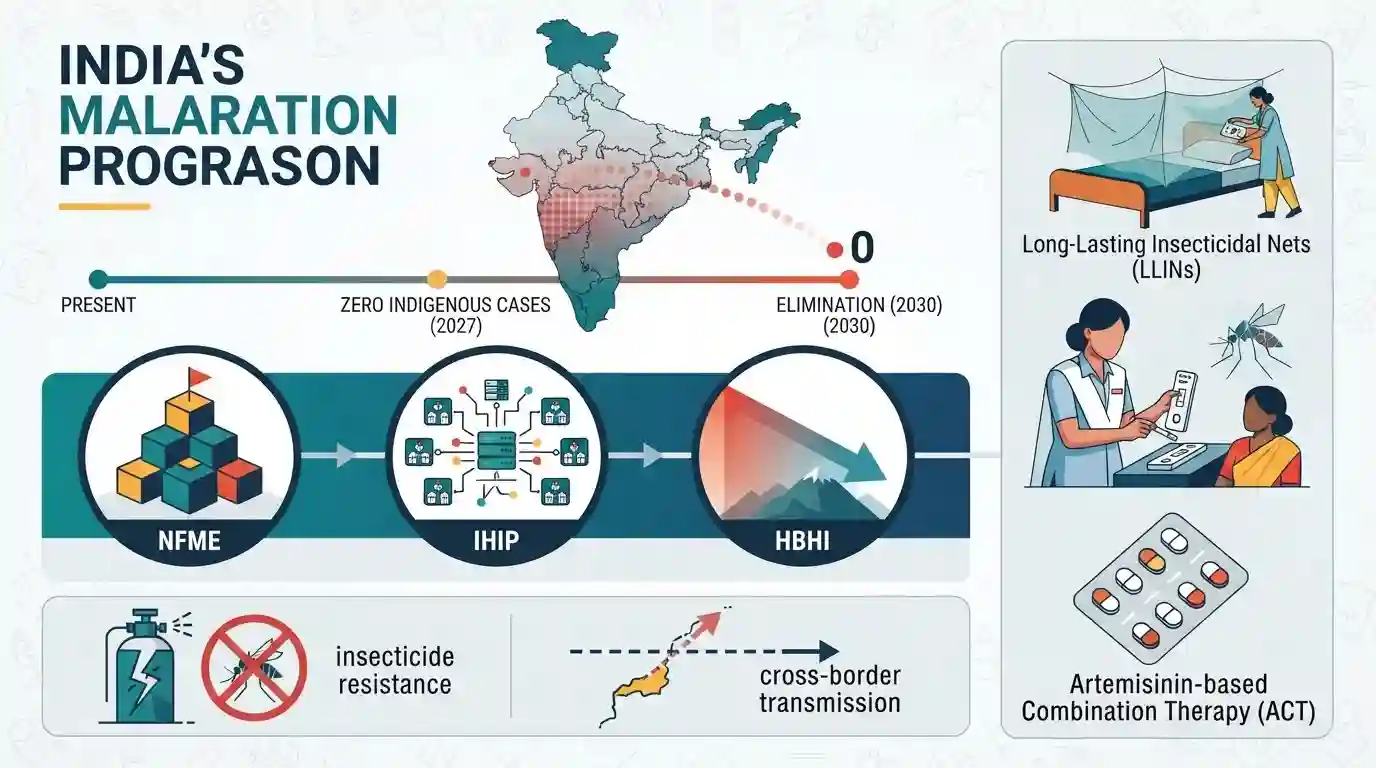
The Union Ministry of Health and Family Welfare reviewed India's progress toward achieving its goal of eliminating malaria by 2030, with an intermediate target of zero indigenous malaria cases across all states and union territories by 2027. The review focused on implementing the National Framework for Malaria Elimination (NFME), strengthening decentralized surveillance via the Integrated Health Information Platform (IHIP), and scaling up the High Burden to High Impact (HBHI) initiative. Key strategies discussed include distributing Long-Lasting Insecticidal Nets (LLINs), deploying ASHA workers for rapid diagnostics, utilizing Artemisinin-based Combination Therapy (ACT), and addressing critical challenges such as insecticide resistance and cross-border transmission.
मुख्य मुद्दे
- The Union Ministry of Health and Family Welfare reviewed the progress of the National Framework for Malaria Elimination (NFME) to ensure India achieves its target of zero indigenous malaria cases by 2027 and complete elimination by 2030.
- India's strategy aligns with the World Health Organization (WHO) Global Technical Strategy for Malaria 2016–2030, which aims to reduce malaria case incidence and mortality rates globally.
- The review emphasized a 'whole of government' and 'whole of society' approach, highlighting the necessity of multi-sectoral coordination between health, urban development, rural development, tribal affairs, and panchayati raj ministries to manage vector breeding and disease transmission.
- The High Burden to High Impact (HBHI) initiative is being intensively implemented in high-transmission states (such as Chhattisgarh, Jharkhand, Madhya Pradesh, and Odisha) to rapidly scale up prevention, diagnosis, and treatment.
- Technological and surveillance mechanisms such as the Integrated Health Information Platform (IHIP) are being leveraged for real-time tracking, case reporting, and micro-stratification of districts.
- Key intervention tools include the mass distribution of Long-Lasting Insecticidal Nets (LLINs), regular Indoor Residual Spraying (IRS), biological larviculture, and the deployment of Accredited Social Health Activists (ASHAs) for community-level diagnostics (Rapid Diagnostic Tests - RDTs) and Artemisinin-based Combination Therapy (ACT) administration.
- The ministry highlighted challenges such as drug and insecticide resistance, cross-border malaria transmission, and the need for sustained funding and community mobilization in remote, forest-fringe, and tribal areas.
महत्त्वाच्या संज्ञा
National Framework for Malaria Elimination (NFME) 2016-2030

A policy framework launched by the MoHFW in 2016 to eliminate malaria (achieve zero indigenous cases) across India by 2030 and maintain malaria-free status in interrupted transmission areas.
UPSC context
GS Paper II (Social Justice/Health); tests understanding of disease elimination strategies and national public health policies.
National Strategic Plan (NSP) for Malaria Elimination
A phased national plan designed to scale up universal diagnostics, therapeutic treatments, and preventive interventions, targeting zero indigenous malaria cases in India by 2027.
UPSC context
GS Paper II (Health/Schemes); tests knowledge of structured government roadmaps, milestones, and decentralized interventions for major vector-borne diseases.
High Burden to High Impact (HBHI) initiative
A WHO-guided, country-led approach adopted by India in 2019 to accelerate malaria reduction in four high-burden states—Chhattisgarh, Jharkhand, Madhya Pradesh, and West Bengal—focusing on political will and strategic information.
UPSC context
GS Paper II (Health) and GS Paper III (Science & Tech); tests familiarity with global health partnerships and targeted public health interventions.
Integrated Health Information Platform (IHIP)
A web-enabled, near real-time electronic surveillance platform launched by the MoHFW to capture disaggregated, geocoded health data for over 33 outbreak-prone diseases, digitalizing disease monitoring in India.
UPSC context
GS Paper II (E-Governance/Health) and GS Paper III (IT & Digital Infrastructure); tests digital health initiatives and real-time tracking systems.
National Center for Vector Borne Diseases Control (NCVBDC)
The central nodal agency under India's Ministry of Health and Family Welfare responsible for formulating policies and technical guidelines to prevent and control major vector-borne diseases.
UPSC context
GS Paper II (Health Governance & Policies); tests knowledge of institutional structures and governance in India's public health administration.
पूर्वपरीक्षा सापळा
Artemisinin-based Combination Therapy (ACT) is the universal first-line treatment for all types of malaria cases, including Plasmodium vivax, across India.
Chloroquine remains the first-line treatment for Plasmodium vivax in India; ACT is specifically mandated for Plasmodium falciparum due to species-specific chloroquine resistance.
संबंधित स्थिर संकल्पना
What biological control agents are used to manage malaria vectors in India?
- Larvivorous Fish: Introducing Gambusia affinis (mosquito fish) to feed on mosquito larvae in stagnant water bodies.
- Biolarvicides: Deploying Bacillus thuringiensis israelensis (Bti), a soil bacterium producing toxins specific to mosquito larvae.
How do Plasmodium vivax and Plasmodium falciparum differ in clinical treatment?
- Plasmodium vivax: Treated with Chloroquine; requires Primaquine to eliminate dormant liver-stage hypnozoites and prevent disease relapses.
- Plasmodium falciparum: Requires Artemisinin-based Combination Therapy (ACT) due to widespread resistance to chloroquine in this malignant species.
आंतर-विषय नमुने
Urban planning and vector-borne diseases
The rise of urban-adapted Anopheles stephensi links municipal drainage, solid waste management, and real estate building bylaws directly to public health outcomes.
Climate change and epidemiological shifts
Rising temperatures and erratic rainfall extend malaria transmission windows and push vector habitats into higher-altitude Himalayan regions previously free of the disease.

UPSC may contrast P. vivax and P. falciparum treatment protocols alongside biological vector controls like Gambusia and Bti.
संबंधित PYQ · 4
संबंधित PYQ · 4
- 2023PrelimsGS1
Consider the following statements in the context of interventions being undertaken under Anaemia Mukt Bharat Strategy: 1. It provides prophylactic calcium supplementation for pre-school children, adolescents and pregnant women. 2. It runs a campaign for delayed cord clamping at the time of child-birth. 3. It provides for periodic deworming to children and adolescents. 4. It addresses non-nutritional causes of anaemia in endemic pockets with special focus on malaria, hemoglobinopathies and fluorosis. How many of the statements given above are correct?
- 2010PrelimsGS1
Widespread resistance of malarial parasite to drugs like chloroquine has prompted attempts to develop a malarial vaccine to combat malaria. Why is it difficult to develop an effective malaria vaccine?
- 2024MainsGS2
In a crucial domain like the public healthcare system the Indian State should play a vital role to contain the adverse impact of marketisation of the system. Suggest some measures through which the State can enhance the reach of public healthcare at the grassroots level.
- 2021MainsGS2
“Besides being a moral imperative of a Welfare State, primary health structure is a necessary precondition for sustainable development.” Analyze.
