Gnani Artha Indigenous Sovereign AI Stack and Language Models
Source:PIB ↗
কেন এটি গুরুত্বপূর্ণ
This development reflects the critical intersection of technology policy, national security (data sovereignty), and democratic inclusion (multilingual AI in governance). For UPSC candidates, it highlights how indigenous software developments (like Gnani Artha) combine with national initiatives (like the India Semiconductor Mission and IndiaAI Mission) to drive economic growth and digital sovereignty toward Viksit Bharat @ 2047.
সারসংক্ষেপ
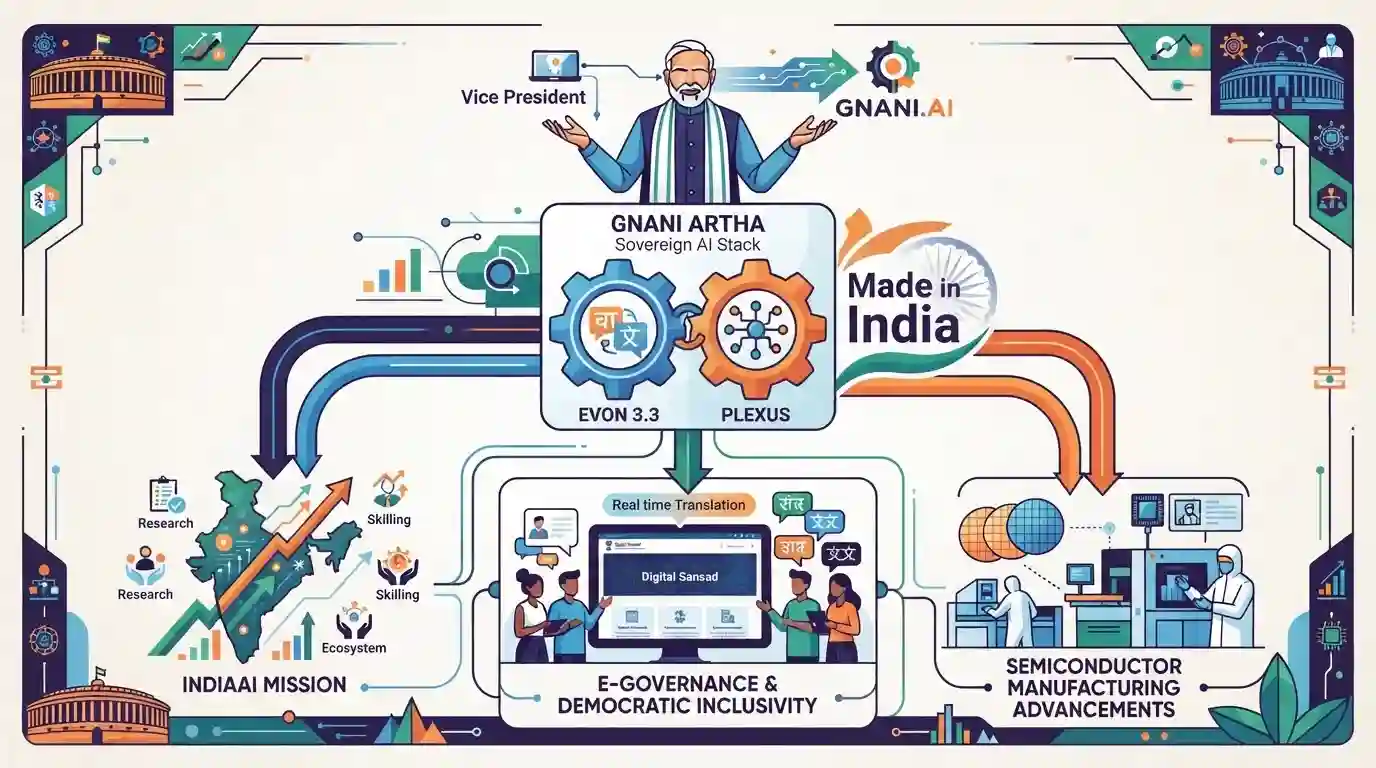
Vice President Shri C. P. Radhakrishnan launched ‘Gnani Artha’, an indigenously developed sovereign AI stack comprising ‘Evon 3.3’ (a Large Language Model tailored for Indian linguistic nuances) and ‘Plexus’ (an AI orchestration and deployment engine). Built by Indian conversational AI startup GNANI.AI, the stack highlights India's progress toward technological self-reliance, strategic autonomy, and local data protection. The Vice President situated this development within the broader context of the IndiaAI Mission, semiconductor manufacturing advancements, and the use of real-time translation AI in the Digital Sansad portal to promote democratic inclusivity.
মূল বিষয়
- Launch of 'Gnani Artha': Vice President Shri C. P. Radhakrishnan launched an indigenous sovereign AI stack to strengthen India's technological autonomy and data sovereignty.
- Two Key Pillars: The stack includes 'Evon 3.3', a state-of-the-art Large Language Model (LLM) designed for Indian languages, and 'Plexus', an orchestration platform that integrates AI models into functional, real-world workflows.
- Shift from Consumer to Creator: The Vice President stressed that India must transcend being a mere consumer of global technology to become an active creator and exporter of technology standards.
- AI in Governance (Digital Sansad): Highlighting the application of AI, the VP pointed to the Digital Sansad portal, which utilizes AI-driven simultaneous interpretation in 8 regional languages, with the goal of expanding to all 22 Scheduled Languages of the Indian Constitution.
- Synergy with National Schemes: The indigenously developed stack aligns with major national programs such as the IndiaAI Mission, Centres of Excellence (CoEs) for AI, and local hardware ecosystems boosted by the India Semiconductor Mission.
গুরুত্বপূর্ণ শব্দ
IndiaAI Mission

A ₹10,371.92 crore national initiative designed to establish India as a global AI leader, focusing on scaling GPU compute capacity, nurturing domestic startups, and building sovereign foundational models.
UPSC context
GS Paper 3 (S&T / IT); tests national technology policies, sovereign AI strategies, and digital public infrastructure.
India Semiconductor Mission
A dedicated national program under MeitY with a ₹76,000 crore outlay, aimed at building a self-reliant domestic semiconductor fabrication, chip design, assembly, and display manufacturing ecosystem.
UPSC context
GS Paper 3 (Economy / S&T); tests strategic electronic manufacturing, industrial policies, and global supply chain resilience.
Digital Sansad
An integrated digital platform and application by the Lok Sabha Secretariat that offers paperless operations, personalized dashboards, and real-time AI-based translation of parliamentary proceedings.
UPSC context
GS Paper 2 (Governance); tests digital governance, legislative transparency, and AI integration to enhance democratic inclusivity.
Viksit Bharat @ 2047
The national vision to transform India into a fully developed, self-reliant, and high-income economy with a targeted GDP of USD 30–40 trillion by its centenary of independence.
UPSC context
GS Paper 3 (Economy); tests macroeconomic growth strategies, infrastructure vision, and demographic dividend utilization.
প্রিলিমস ফাঁদ
Gnani Artha is a public-sector proprietary AI stack developed directly by MeitY under the Bhashini initiative.
Gnani Artha is developed by a private conversational AI startup (GNANI.AI), though it aligns with and supports national goals like the IndiaAI Mission.
সংযুক্ত স্থির ধারণা
What are the core pillars of Sovereign AI and its significance?
- Domestic Infrastructure: Requires local hosting on domestic clouds to ensure absolute control over data residency and computation power.
- Strategic Autonomy: Reduces critical public governance reliance on foreign-owned proprietary AI giants and closed-source models.
- Cultural Alignment: Trained on indigenous datasets to accurately capture local linguistic, cultural, and socio-economic nuances.
What constitutional provisions govern languages used in the Indian Parliament?
- Article 120: Mandates business in Parliament be in Hindi or English, but allows presiding officers to permit mother tongue usage.
- Eighth Schedule: Lists 22 languages; digital systems like Digital Sansad aim to translate proceedings into all scheduled languages.
- Article 343: Declares Hindi in Devanagari script as the official language of the Union.
আন্তঃবিষয় প্যাটার্ন
Sovereign AI + DPDP Act compliance
Localizing AI stacks prevents cross-border data transfer risks, ensuring processing complies with the strict data localization norms under the DPDP Act 2023.
AI Translation + Linguistic Federalism
Simultaneous interpretation in regional languages democratizes parliamentary debates, ensuring regional representatives participate without linguistic barriers, strengthening cooperative federalism.

IndiaAI Mission targets + Bhashini's cloud transition + data residency rules likely to merge into a single GS-3 tech-governance question.
সংযুক্ত PYQ · 3
সংযুক্ত PYQ · 3
- 2026PrelimsGS1
Which of the following statements with regard to Large Language Models (LLMs) used in machine learning is/are correct ? 1. LLMs assign probabilities to the next possible words and then pick the one with the highest probability. 2. LLMs process data through mathematical optimization to minimise prediction errors. 3. LLMs produce unbiased outputs. Select the answer using the code given below :
- 2025MainsGS3
India aims to become a semiconductor manufacturing hub. What are the challenges faced by the semiconductor industry in India? Mention the salient features of the India Semiconductor Mission.
- 2025MainsGS2
e-governance projects have a built-in bias towards technology and back-end integration than user-centric designs. Examine.
