Pradhan Mantri Jan Dhan Yojana and Women Economic Empowerment
Source:PIB ↗
हे का महत्त्वाचे आहे
Financial inclusion is a foundational theme in the UPSC syllabus, straddling GS Paper 3 (Economy & Inclusive Growth) and GS Paper 2 (Welfare Schemes & Gender Empowerment). This milestone assessment highlights how basic banking services can be scaled to create a robust social security and micro-credit architecture, presenting crucial fodder for analytical Mains answers and concrete factual details for Prelims.
सारांश
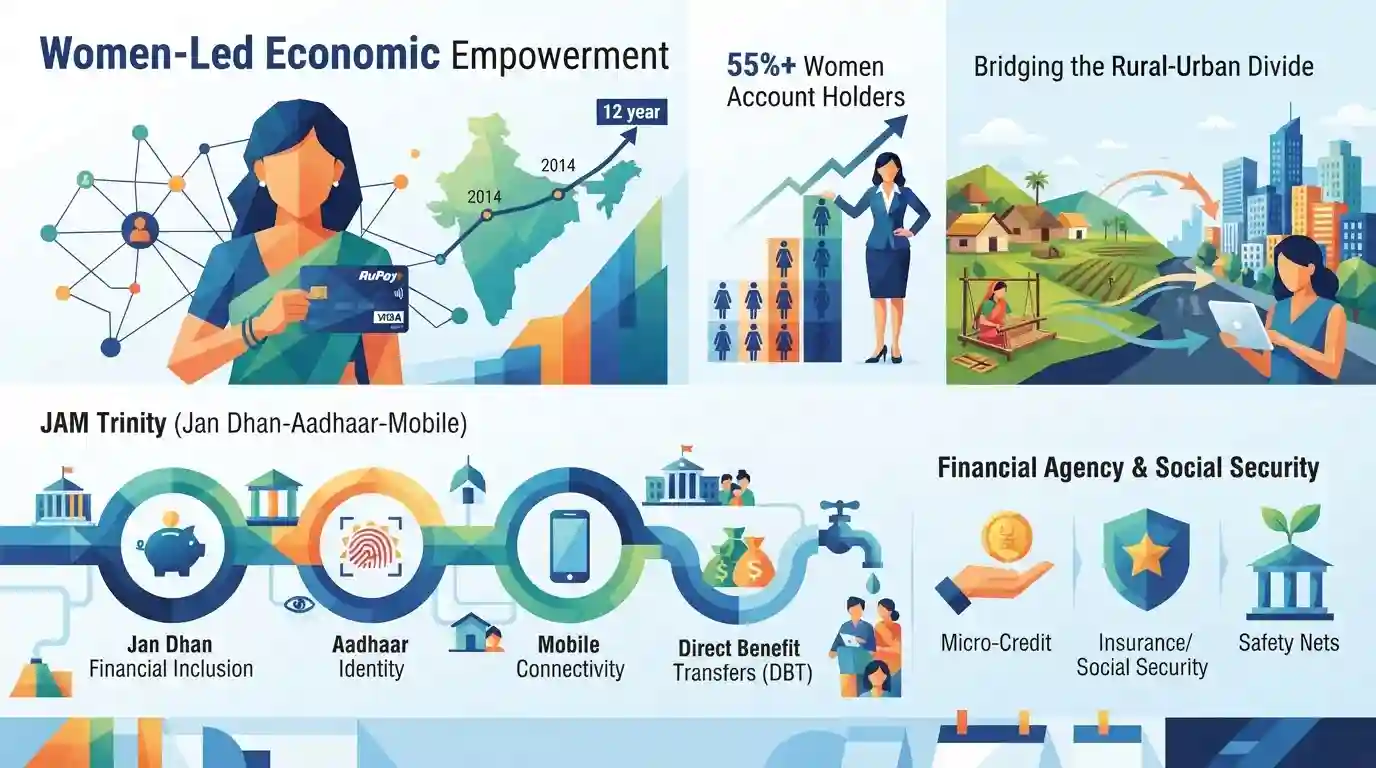
Union Minister for Women and Child Development, Smt. Annpurna Devi, hailed the 12-year milestone of the Pradhan Mantri Jan-Dhan Yojana (PMJDY), highlighting its success in driving women-led economic empowerment. Launched on August 28, 2014, the scheme has moved beyond mere financial inclusion to actively empowering women, who now hold over 55% of the accounts. By bridging the rural-urban divide (with two-thirds of accounts in rural/semi-urban areas) and leveraging the JAM (Jan Dhan-Aadhaar-Mobile) Trinity for seamless, leakproof Direct Benefit Transfers (DBT), PMJDY has institutionalized financial agency for the country's most vulnerable, acting as a portal for safety nets, micro-credit, and social security.
मुख्य मुद्दे
- Pradhan Mantri Jan-Dhan Yojana (PMJDY) completed 12 years of implementation on August 28, 2026, marking a transition from basic financial inclusion to substantive women-led economic empowerment.
- Over 55% of total Jan Dhan accounts are held by women, granting them direct access and control over household financial resources, thus boosting their economic agency.
- Approximately 66-67% of PMJDY accounts are located in rural and semi-urban areas, narrowing the spatial disparity in formal banking infrastructure.
- Integrated with Aadhaar and mobile phones (the JAM Trinity), PMJDY has enabled transparent, leakproof Direct Benefit Transfers (DBT) directly into the hands of the targeted beneficiaries, particularly women.
- PMJDY accounts are Basic Savings Bank Deposit (BSBD) accounts with zero-balance requirements, providing a RuPay Debit Card with an inbuilt accident insurance cover of ₹2 lakh (for accounts opened after August 28, 2018).
- The scheme provides an overdraft (OD) facility of up to ₹10,000, with priority given to the female head of the household, which acts as a micro-credit cushion.
- PMJDY serves as a critical gateway to broader social security programs including PMJJBY (life insurance), PMSBY (accident insurance), and Atal Pension Yojana (pension).
- The deployment of 'BC Sakhis' (Women Business Correspondents) has revolutionized rural banking delivery, offering doorstep services and promoting local micro-entrepreneurship among women.
महत्त्वाच्या संज्ञा
Pradhan Mantri Jan-Dhan Yojana

India's national financial inclusion mission launched in 2014, providing unbanked adults with zero-balance basic savings accounts, RuPay debit cards with ₹2 lakh accident insurance, overdrafts up to ₹10,000, and direct linkage to social security.
UPSC context
GS Paper III (Inclusive Growth/Financial Inclusion). Tests understanding of digital financial infrastructure, gender-inclusive development, and direct welfare delivery models.
Pradhan Mantri Jeevan Jyoti Bima Yojana
A government-backed, renewable one-year term life insurance scheme launched in 2015, offering ₹2 lakh cover for death due to any cause at an annual premium of ₹436, available to bank account holders aged 18–50.
UPSC context
GS Paper II (Social Justice/Welfare Schemes). Tests knowledge of financial security systems and low-cost life insurance penetration for the informal workforce.
Pradhan Mantri Suraksha Bima Yojana
A government-backed, renewable one-year personal accident insurance scheme launched in 2015, providing ₹2 lakh cover for accidental death/total disability and ₹1 lakh for partial disability at a minimal ₹20 annual premium.
UPSC context
GS Paper II (Social Justice/Welfare Schemes). Tests risk mitigation structures and affordable social security safety nets for unorganised sector workers.
Atal Pension Yojana
A government-backed pension scheme launched in 2015, regulated by PFRDA, providing unorganised sector workers aged 18–40 with a guaranteed monthly pension of ₹1,000–₹5,000 after attaining age 60.
UPSC context
GS Paper II (Social Justice/Welfare Schemes). Tests old-age pension architectures, financial planning, and retirement security in the unorganised sector.
Pradhan Mantri Matru Vandana Yojana
A centrally sponsored conditional cash transfer scheme launched in 2017, providing cash incentives of ₹5,000 to pregnant and lactating mothers for their first child to partially compensate for wage loss and promote nutrition.
UPSC context
GS Paper II (Health/Welfare Schemes). Tests maternal health interventions, direct benefit transfer efficacy, and nutritional policies under NFSA 2013.
Ministry of Women and Child Development
The premier Ministry of the Government of India responsible for designing policies, administering legislations, and coordinating gender-budgeting and child welfare programmes across the nation.
UPSC context
GS Paper II (Governance/Welfare). Tests institutional frameworks, policy coordination, and gender-inclusive schemes designed for women and children.
पूर्वपरीक्षा सापळा
All Jan Dhan accounts carry a flat, unconditional ₹2 lakh accidental insurance cover upon opening.
The ₹2 lakh cover applies only to accounts opened after August 28, 2018, and requires a successful transaction within 90 days prior to the accident.
संबंधित स्थिर संकल्पना
What are the core features of a Basic Savings Bank Deposit (BSBD) account?
- Zero Balance: No minimum balance is required to open or maintain the account.
- Withdrawal Cap: Account holders are permitted a maximum of four cash withdrawals in a month.
- No Charges: Banks cannot charge for non-operation or activation of inoperative BSBD accounts.
How does the Business Correspondent (BC) model operate in India?
- Definition: BCs are bank-authorized retail agents providing basic banking services in unbanked or underbanked rural pockets.
- Allowed Services: They facilitate deposits, cash withdrawals, remittance transfers, and process micro-credit applications.
- Key Actors: NGOs, microfinance institutions, and individual self-help group members (like Bank Sakhis) can act as BCs.
आंतर-विषय नमुने
JAM Trinity & Fiscal Consolidation
Using Aadhaar-linked Jan Dhan accounts for direct benefit transfers minimizes intermediaries, significantly reducing administrative leakages and helping streamline the government's fiscal deficit.
Financial Inclusion & Gender Agency
Over 55% female account ownership under PMJDY directly feeds into GS-1 and GS-2 debates on institutionalizing women's financial independence and shifting intra-household decision-making dynamics.

Multi-statement questions may test specific conditions of PMJDY (overdraft limits, age criteria) alongside its structural shift post-2018.
संबंधित PYQ · 4
संबंधित PYQ · 4
- 2016MainsGS3
Pradhan Mantri Jan-Dhan Yojana (PMJDY) is necessary for bringing unbanked to the institutional finance fold. Do you agree with this for financial inclusion of the poorer section of the Indian society? Give arguments to justify your opinion.
- 2024PrelimsGS1
With reference to the Pradhan Mantri Jan Dhan Yojana (PMJDY), which of the following statements is/are correct? 1. The scheme aims to open bank accounts for unbanked households. 2. There is a minimum balance requirement for accounts opened under this scheme. 3. Beneficiaries get a Rupay Debit Card with an inbuilt accident insurance cover. Select the correct answer using the code given below.
- 2015PrelimsGS1
'Pradhan Mantri Jan-Dhan Yojana' has been launched for
- 2022MainsGS3
Is inclusive growth possible under market economy ? State the significance of financial inclusion in achieving economic growth in India.
