Jal Jeevan Mission Student Participation and Academic Outreach
Source:PIB ↗
हे का महत्त्वाचे आहे
This initiative represents an innovative integration of educational outreach, academic research, and grassroots governance. By tasking local universities and schools with monitoring and documenting water supply systems, the government is shifting welfare delivery from a top-down bureaucratic exercise to a community-owned, science-backed endeavor. It highlights how modern technologies like SCADA and IoT can be popularized at the school level to build climate and water resilience in rural India.
सारांश
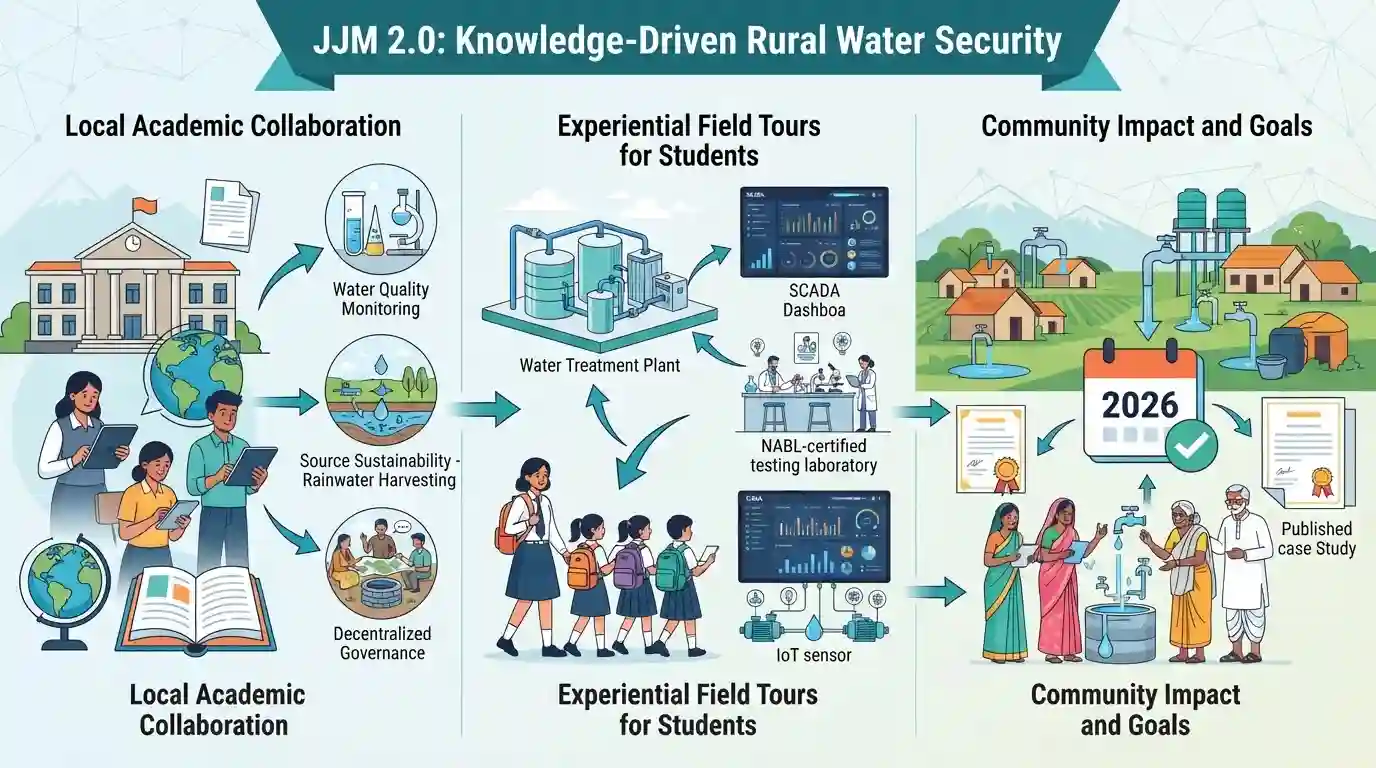
The Department of Drinking Water & Sanitation (DDWS), Ministry of Jal Shakti, has directed States and Union Territories to foster collaboration with local academic institutions, colleges, and universities under Jal Jeevan Mission (JJM) 2.0. The initiative aims to build a robust database of local knowledge, innovations, and best practices in rural water supply management. Academic partners will study and document key components of JJM 2.0—such as water quality monitoring, source sustainability, and decentralized governance—and disseminate findings through research publications. Additionally, states are instructed to conduct experiential field tours for secondary school students to advanced facilities like Water Treatment Plants, NABL-certified labs, and SCADA/IoT-enabled water systems. By the end of September 2026, every district is expected to have facilitated at least one student tour and published one collaborative case study, driving community-led rural water security.
मुख्य मुद्दे
- The Department of Drinking Water & Sanitation (DDWS) under the Ministry of Jal Shakti has urged all States and Union Territories to actively involve local academic institutions, colleges, and universities in the activities of the Jal Jeevan Mission (JJM) 2.0.
- The primary objective of this initiative is to leverage citizen science and local academia to document and publish best practices, cultivate a field-based learning culture, promote indigenous innovations, and enhance the visibility of rural water security measures.
- Key areas highlighted for documentation by academic bodies include community participation, source sustainability, water quality management, operation and maintenance (O&M), technology adoption, and decentralized governance.
- States/UTs are directed to organize educational tours for Higher Secondary/Senior Secondary students to vital water infrastructure, including Multi Village Schemes (MVS), Water Treatment Plants (WTPs), Intake Wells, NABL-accredited water testing laboratories, and sites using modern systems like SCADA (Supervisory Control and Data Acquisition) and IoT (Internet of Things).
- A strict timeline has been set, expecting every district across India to complete at least one student field tour and publish at least one collaborative case study/best practice with local academic institutions by the end of September 2026.
- The program emphasizes decentralized governance by requiring active coordination among local educational bodies, school networks, District Water and Sanitation Missions (DWSMs), and Gram Panchayats.
महत्त्वाच्या संज्ञा
Jal Jeevan Mission (JJM) 2.0

The revamped phase of India's flagship rural water scheme, extended to 2028, focusing on long-term source sustainability, water quality monitoring, greywater management, and community-led operations.
UPSC context
GS Paper II: Government Policies; tests knowledge of rural infrastructure, decentralized water governance, and drinking water security.
Department of Drinking Water & Sanitation (DDWS)
A department under the Ministry of Jal Shakti responsible for formulating policies, providing financial assistance, and monitoring national rural sanitation and drinking water programmes.
UPSC context
GS Paper II: Executive Organs; tests familiarity with institutional machinery executing flagship welfare schemes.
Ministry of Jal Shakti
An integrated Union Ministry created in 2019 to handle water-related issues holistically, consolidating water resources, Ganga rejuvenation, and drinking water departments.
UPSC context
GS Paper II: Governance; tests administrative structures and holistic resource management in government policies.
District Water and Sanitation Missions (DWSMs)
District-level institutional bodies responsible for planning, executing, and monitoring decentralized water supply and sanitation projects under national guidelines.
UPSC context
GS Paper II: Local Governance; tests understanding of the administrative link between State ministries and grassroot institutions.
Gram Panchayats
Constitutionally mandated local self-governing bodies at the village level, responsible for planning socio-economic development and managing basic public services.
UPSC context
GS Paper II: Panchayati Raj; tests decentralized governance and community-level scheme execution.
National Accreditation Board for Testing and Calibration Laboratories (NABL)
A constituent board of the Quality Council of India that grants formal recognition and accreditation to testing and calibration laboratories under international standards.
UPSC context
GS Paper II & III: Statutory/Regulatory Bodies; tests mechanisms of quality control and standardisation.
पूर्वपरीक्षा सापळा
Under the Jal Arpan initiative of JJM 2.0, Gram Panchayats are delegated the management of capital-intensive bulk water transmission infrastructure.
UPSC often reverses responsibilities between local and state-level bodies. Under the Jal Arpan framework, Gram Panchayats manage in-village infrastructure, while bulk infrastructure remains under state-level bodies.
संबंधित स्थिर संकल्पना
Which entries in the 11th Schedule of the Constitution empower Panchayats regarding water?
- Entry 11: Specifically covers 'Drinking water' management and provision at the rural local body level.
- Entry 3: Covers 'Minor irrigation, water management, and watershed development', providing the broader agricultural water resource framework.
- Entry 29: Covers 'Maintenance of community assets', which directly applies to rural water distribution systems.
How do SCADA and IoT technologies optimize rural water supply grids?
- SCADA Utility: Supervisory Control and Data Acquisition systems enable centralized control, monitoring flow rates, pump status, and valve actions remotely.
- IoT Edge Sensing: Internet of Things sensors collect real-time decentralized data like pH, turbidity, and local pipe pressure to transmit to central servers.
- System Integration: Integrating both minimizes Non-Revenue Water (NRW) due to leakages and ensures real-time water quality monitoring under JJM.
आंतर-विषय नमुने
Citizen Science & Decentralized Governance
Engaging local academic bodies and schools under JJM 2.0 leverages citizen science to operationalize democratic decentralization, converting Gram Panchayats into active knowledge-driven local utility providers.
Social Security + Water Asset Convergence
Converging JJM 2.0 with the VB-G RAM G Act, 2025 reflects a structural shift from disjointed scheme-based construction to statutory, labor-linked lifecycle asset management in rural India.

The asset management divide under 'Jal Arpan' (GPs vs. States) and statutory convergence under VB-G RAM G is ripe for statement-based MCQs.
संबंधित PYQ · 3
संबंधित PYQ · 3
- 2020MainsGS3
What are the salient features of the Jal Shakti Abhiyan launched by the Government of India for water conservation and water security?
- 2024MainsGS3
The world is facing an acute shortage of clean and safe freshwater. What are the alternative technologies which can solve this crisis? Briefly discuss any three such technologies citing their key merits and demerits.
- 2022MainsGS2
To what extent, in your opinion, has the decentralisation of power in India changed the governance landscape at the grassroots?
