India Kuwait Joint Defense Committee Bilateral Maritime Security
Source:PIB ↗
हे का महत्त्वाचे आहे
This article illustrates India's strategic shift in West Asia from a traditional energy-and-diaspora-centric relationship to a comprehensive security and defense partnership. Understanding these bilateral defense committees helps aspirants analyze India's growing role as a net security provider in the Indian Ocean Region and its efforts to position itself as a global defense manufacturing hub, which is highly relevant for both GS Paper 2 (International Relations) and GS Paper 3 (Security/Defense).
सारांश
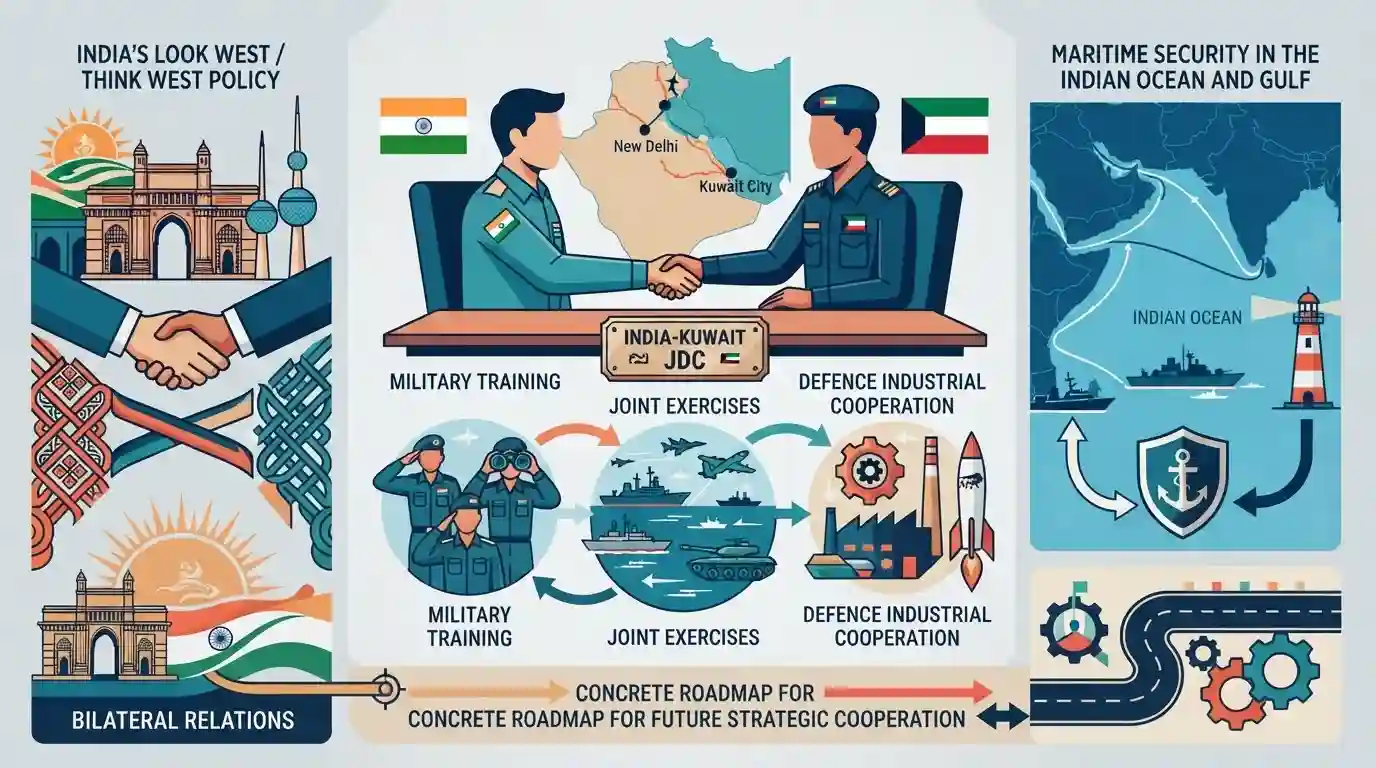
The inaugural India-Kuwait Joint Defence Committee (JDC) meeting was held in New Delhi to institutionalize and elevate bilateral defense ties. Co-chaired by defense representatives from both nations, the JDC focused on broadening military-to-military training, joint exercises, and defense industrial cooperation under India's 'Make in India' framework. Both sides underscored the importance of maritime security in the Indian Ocean Region and the Persian Gulf, and laid out a concrete roadmap for future strategic cooperation.
मुख्य मुद्दे
- The Inaugural India-Kuwait Joint Defence Committee (JDC) meeting was held in New Delhi, marking a milestone in upgrading bilateral relations to a strategic defense partnership.
- The meeting was co-chaired by Shri Amitabh Prasad, Joint Secretary (Armed Forces), Ministry of Defence, India, and Brigadier General Fawaz Al-Harbi, Chief of Military Education Department, Kuwait Armed Forces.
- Both nations agreed to boost cooperation in military-to-military training, exchange of subject matter experts, joint military exercises, and academic engagements.
- The Indian side highlighted the capabilities of its domestic defense manufacturing industry under 'Make in India' and 'Aatmanirbhar Bharat' initiatives, prompting the Kuwaiti side to show keen interest in defense procurement, maintenance services, and co-development.
- Both delegations discussed key regional security challenges, specifically focusing on safeguarding sea lanes of communication (SLOCs) and ensuring maritime security in the Western Indian Ocean and Persian Gulf.
- A structured roadmap was formulated to guide future defense engagements, with the next meeting scheduled to be hosted in Kuwait.
महत्त्वाच्या संज्ञा
Gulf Cooperation Council (GCC)

A political and economic alliance of six Middle Eastern nations—Bahrain, Kuwait, Oman, Qatar, Saudi Arabia, and the United Arab Emirates—established in 1981 to promote regional stability, economic integration, and collective security.
UPSC context
GS Paper II (International Relations) — crucial for studying India's 'Look West/Think West' policy, regional security, and trade in West Asia.
Aatmanirbhar Bharat
A national vision launched in 2020 aiming to make India self-reliant across key sectors, heavily focusing on domestic manufacturing, indigenisation, R&D, and reducing import dependencies in defense and technology.
UPSC context
GS Paper III (Indian Economy, Security) — tested for policies on defense indigenisation, strategic autonomy, and domestic industrial growth.
Make in India
A flagship initiative launched in 2014 to transform India into a global design and manufacturing hub, encouraging domestic and foreign investments across key sectors including defense production.
UPSC context
GS Paper III (Economy, Manufacturing) — tested for economic growth, ease of doing business, and transforming India from an importer to an exporter.
India-Kuwait Defence Cooperation MoU
A strategic bilateral agreement signed in December 2024 to institutionalize and elevate defense relations through training, joint military exercises, defense industrial cooperation, R&D, and medical services.
UPSC context
GS Paper II (Bilateral Relations) — tests India’s strategic partnership, maritime diplomacy in the Persian Gulf, and security ties with key West Asian partners.
पूर्वपरीक्षा सापळा
The standard domestic Indian Rupee served as the official legal tender in Kuwait up until 1961.
While Indian currency circulated, the RBI introduced a distinct 'Gulf Rupee' in 1959 to prevent gold smuggling; the domestic rupee was restricted.
संबंधित स्थिर संकल्पना
What was the Gulf Rupee and why was it issued?
- Issuing Authority: Introduced by the Reserve Bank of India in 1959 as a parallel currency for circulation in the Persian Gulf region.
- Primary Objective: Specifically created to curb the smuggling of gold into India, which was draining India's foreign exchange reserves.
- Demise: Phased out as Gulf nations gained independence, with Kuwait replacing it with the Kuwaiti Dinar in 1961.
What are the core objectives of India's 'Think West' Policy?
- Strategic Shift: Transitioning West Asian relations from transactional energy imports to comprehensive defense, counter-terrorism, and maritime security partnerships.
- De-hyphenation: Maintaining independent, robust bilateral ties with regional rivals like Iran, Saudi Arabia, Israel, and GCC members simultaneously.
- Diaspora Welfare: Securing the economic interests, legal protection, and seamless remittance channels for over 8.5 million Indian nationals in the region.
आंतर-विषय नमुने
Energy Security and Chokepoint Vulnerability
India's reliance on Kuwaiti oil and gas ties its economic stability to maritime choke points like the Strait of Hormuz, driving joint naval cooperation and security pacts.
Diaspora Remittances and Balance of Payments
The million-strong Kuwaiti diaspora acts as a stable source of non-debt foreign capital, cushioning India's current account deficit against sudden global oil price shocks.

Focus on 'Think West' defense diplomacy likely to yield multi-statement questions comparing India's security pacts with Oman vs. Kuwait.
संबंधित PYQ · 3
संबंधित PYQ · 3
- 2025MainsGS2
"Energy security constitutes the dominant kingpin of India's foreign policy, and is linked with India's overarching influence in Middle Eastern countries.” How would you integrate energy security with India's foreign policy trajectories in the coming years?
- 2017MainsGS2
The question of India's Energy Security constitutes the most important part of India's economic progress. Analyze India's energy policy cooperation with West Asian countries.
- 2016PrelimsGS1
Which of the following is not a member of 'Gulf Cooperation Council'?
