Government initiates onion buffer stock release to curb inflation
Source:PIB ↗
ఇది ఎందుకు ముఖ్యం
Food inflation directly impacts consumer welfare and macroeconomic stability. Understanding government interventions like buffer stock releases, specialized logistics initiatives (Kanda Express), and the roles of agencies like NAFED, NCCF, and CWC is essential for addressing GS3 topics related to food security, supply chain management, and inflation control mechanisms.
సారాంశం
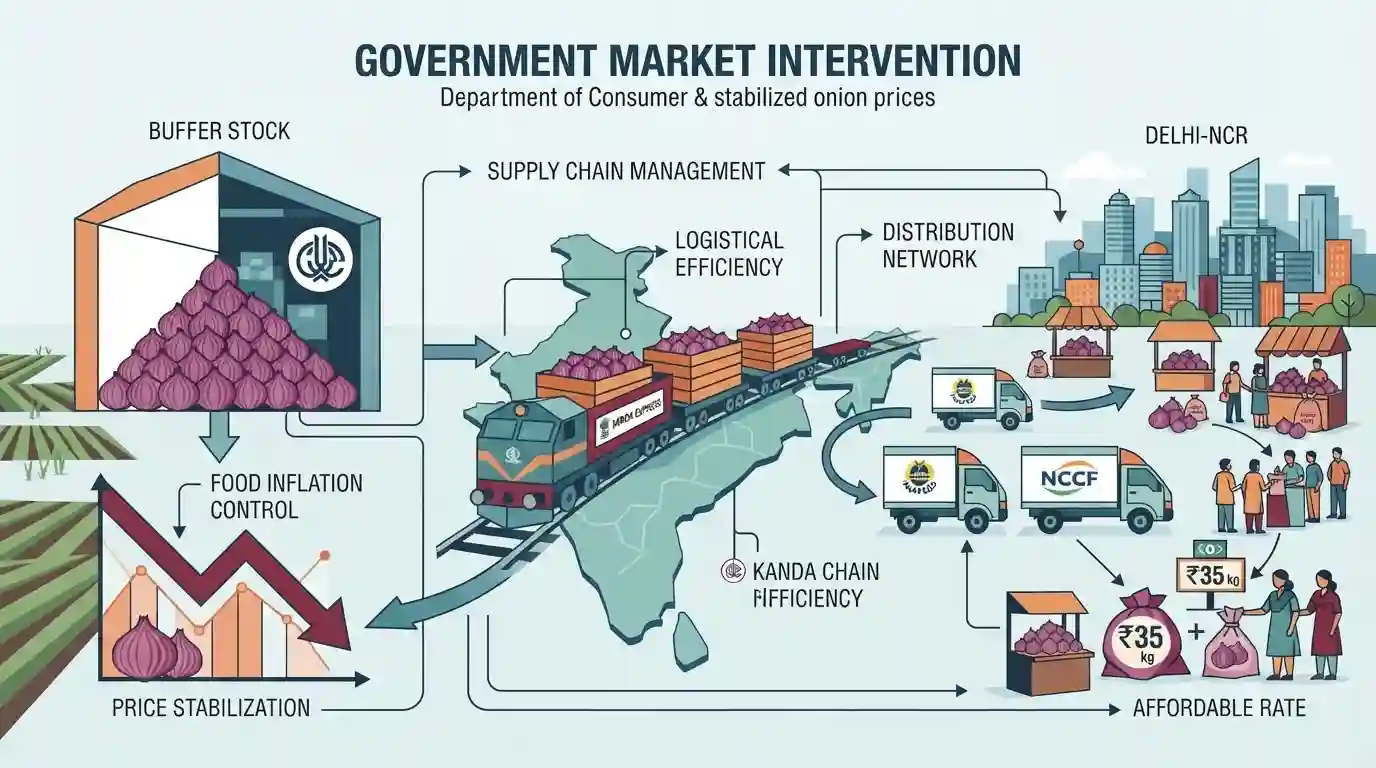
The Government of India has initiated a calibrated market intervention to stabilize onion prices by releasing buffer stocks at an affordable rate of ₹35 per kg in the Delhi-NCR region. The Department of Consumer Affairs (DoCA) partnered with cooperative agencies NAFED and NCCF for retail distribution through mobile vans. To address supply chain bottlenecks and enhance logistical efficiency, the "Kanda Express" initiative leveraged railway rakes for bulk transportation from production centers to consumption hubs, scaling up to 88,000 MT of onions moved across 16 cities. Additionally, the Central Warehousing Corporation (CWC) has been engaged to facilitate scientific storage and distribution. This strategic intervention aims to moderate food inflation, ensure adequate market supply, and protect consumers from sudden price spikes.
ముఖ్య అంశాలు
- The government initiated a market intervention to ensure affordable onion availability, retailing buffer stocks at ₹35 per kg in Delhi-NCR via mobile vans operated by NAFED and NCCF.
- The 'Kanda Express' initiative has significantly bolstered logistics by using railway rakes to move large quantities of onions from producing regions to consumption centers, transporting 88,000 MT to 16 cities in 2025-26.
- The Central Warehousing Corporation (CWC) was incorporated into the intervention mechanism to provide scientific storage and efficient distribution of the buffer stocks.
- This intervention aims to moderate inflationary pressures on essential food items and stabilize market prices by maintaining a robust supply chain.
ముఖ్యమైన పదాలు
Kanda Express

A logistics initiative leveraging dedicated railway rakes to transport bulk buffer onions from production centers to high-demand hubs. By scaling up bulk transportation, it curbs food inflation, prevents price spikes, and ensures supply availability.
UPSC context
Highly relevant for GS Paper 3 (Supply Chain Management, Logistics) evaluating state interventions to control food inflation.
Price Stabilization Fund (PSF)
Established in 2014-15, this central fund regulates extreme price volatility of essential commodities like onions, potatoes, and pulses. It provides working capital for procuring and distributing strategic buffer stocks to protect consumers and farmers.
UPSC context
Crucial for GS Paper 3 (Indian Economy, Inflation). Tests knowledge of government market interventions and food security mechanisms.
NAFED
The National Agricultural Cooperative Marketing Federation of India (est. 1958) is the apex body for agricultural marketing cooperatives. It procures produce, supports Minimum Support Price (MSP) operations, and manages buffer stocks to stabilize market prices.
UPSC context
Essential for GS Paper 3 (Agricultural Marketing, Minimum Support Price). Tests knowledge of procurement and agricultural cooperatives.
NCCF
The National Cooperative Consumers' Federation of India (est. 1965) is the apex body for consumer cooperatives. It operates under the Ministry of Consumer Affairs to distribute essential commodities at subsidized rates during market shortages.
UPSC context
Important for GS Paper 2 & 3 (Food Security, PDS). Tests understanding of retail market interventions and consumer protection.
Central Warehousing Corporation (CWC)
A premier warehousing agency providing scientific storage and logistics support for agricultural commodities. It prevents post-harvest losses, preserves buffer stocks like onions, and ensures efficient distribution during market shortages.
UPSC context
Relevant to GS Paper 3 (Storage, Transport, and Marketing of Agricultural Produce). Tests infrastructure and post-harvest management.
ప్రిలిమ్స్ ఉచ్చు
The Price Stabilization Fund (PSF) for managing agri-commodity volatility is administered by the Ministry of Agriculture and Farmers Welfare.
The PSF was transferred to the Department of Consumer Affairs under the Ministry of Consumer Affairs, Food & Public Distribution in April 2016.
అనుసంధానమైన స్థిర భావనలు
What is the Price Stabilization Fund (PSF) and how does it operate?
- Objective: Established in 2014-15 to mitigate extreme price volatility of select agri-horticultural commodities like pulses, onions, and potatoes.
- Administration: Managed by the Department of Consumer Affairs; operates via a revolving corpus to provide interest-free advances to central/state procurement agencies.
- Buffer Mechanism: Maintains strategic buffer stocks by procuring directly from farmers or mandis, releasing them during lean seasons to stabilize retail prices.
What is the Central Warehousing Corporation (CWC)?
- Status and Mandate: A statutory public sector enterprise established under the Warehousing Corporations Act, 1962, operating under the Ministry of Consumer Affairs.
- Key Function: Provides scientific storage and warehousing services for agricultural produce and other notified commodities to prevent post-harvest decay.
అంతర-అంశ నమూనాలు
Agri-Logistics + Infrastructure Integration
Leveraging dedicated railway initiatives like Kanda Express aligns with PM Gati Shakti, reducing post-harvest transit losses and lowering national logistics costs in the perishable agri-sector.
Food Inflation + Monetary Policy Limits
Persistent supply-side volatility in perishables drives CPI headline inflation, highlighting the limitations of RBI's monetary tools and the necessity of direct government supply-chain interventions.

UPSC may test the institutional mechanisms of agri-inflation control, contrasting PSF’s ministerial shift with CWC's statutory mandate.
అనుసంధాన PYQలు · 4
అనుసంధాన PYQలు · 4
- 2022PrelimsGS1
In India, which one of the following is responsible for maintaining price stability by controlling inflation?
- 2024MainsGS3
Elucidate the importance of buffer stocks for stabilizing agricultural prices in India. What are the challenges associated with the storage of buffer stock? Discuss.
- 2024MainsGS3
What are the causes of persistent high food inflation in India? Comment on the effectiveness of the monetary policy of the RBI to control this type of inflation.
- 2014MainsGS3
There is also a point of view that Agricultural Produce Market Committees (APMCs) set up under the State Acts have not only impeded the development of agriculture but also have been the cause of food inflation in India. Critically examine.
