Indian Navy receives Samarthak to boost maritime indigenisation
Source:PIB ↗
কেন এটি গুরুত্বপূর্ণ
The delivery of indigenous defence platforms like 'Samarthak' is crucial for UPSC aspirants studying GS-3, as it provides concrete examples for answers on defense indigenisation, maritime security, and the success of the 'Aatmanirbhar Bharat' initiative in reducing import dependency.
সারসংক্ষেপ
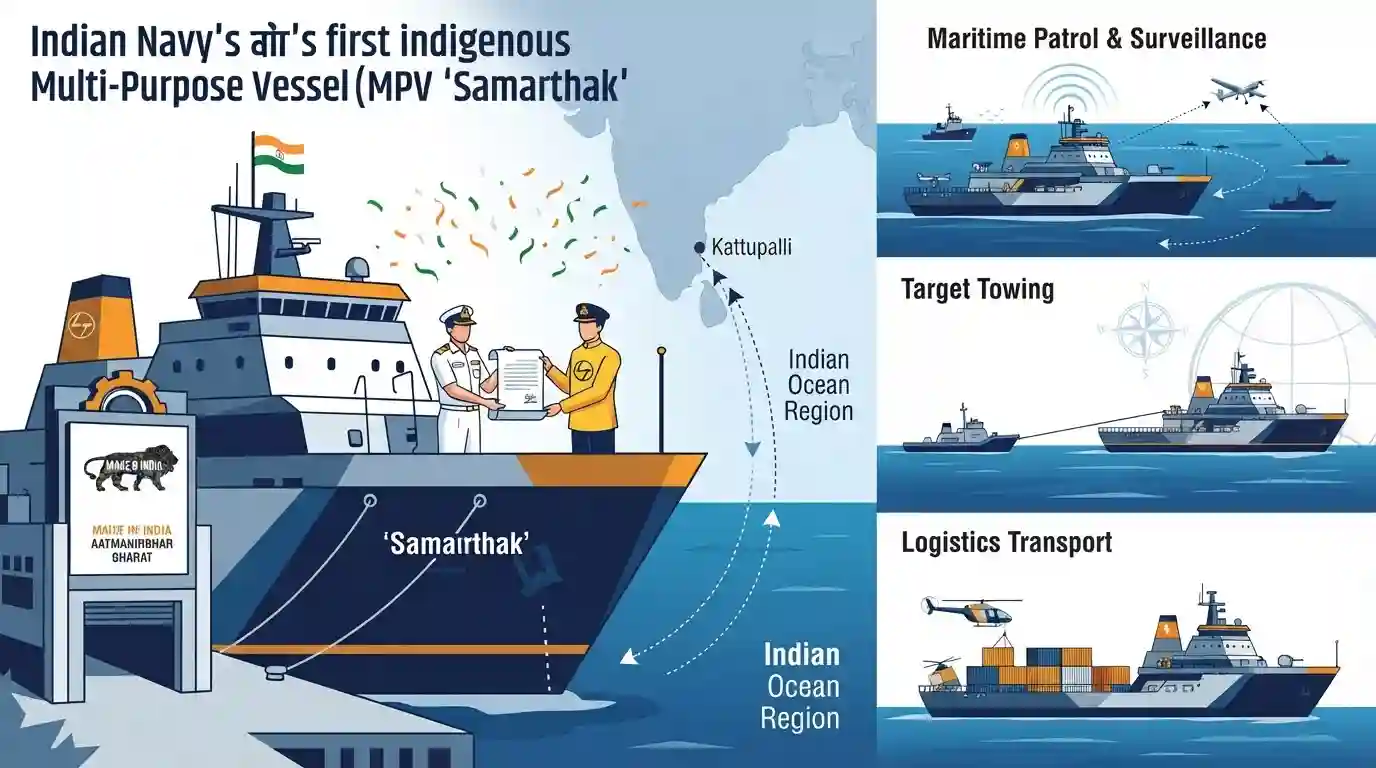
The Indian Navy has successfully taken delivery of 'Samarthak', its first indigenous Multi-Purpose Vessel (MPV), built by Larsen & Toubro (L&T) at Kattupalli. As a major milestone for 'Aatmanirbhar Bharat' and 'Make in India' in the defense sector, the vessel represents India's growing self-reliance in advanced shipbuilding. Designed to undertake varied roles ranging from maritime patrol to target towing and logistics transport, 'Samarthak' will bolster the Indian Navy's operational capabilities and readiness in the Indian Ocean Region.
মূল বিষয়
- 'Samarthak' is the first of two indigenous Multi-Purpose Vessels (MPVs) built by Larsen & Toubro (L&T) for the Indian Navy.
- The vessel's delivery underscores the success of the 'Aatmanirbhar Bharat' and 'Make in India' initiatives in enhancing domestic defense manufacturing and shipbuilding capabilities.
- These MPVs are versatile platforms designed for diverse roles, including towing targets for weapon-firing exercises, launching and recovering torpedoes, and maritime patrolling.
- The addition of these vessels will significantly boost the logistical support, operational flexibility, and maritime security capabilities of the Indian Navy.
গুরুত্বপূর্ণ শব্দ
Samarthak (Multi-Purpose Vessel)

The Indian Navy’s first indigenously built Multi-Purpose Vessel (MPV), constructed by L&T. It supports maritime surveillance, uncrewed autonomous vehicle operations, target towing, and serves as a trial platform for testing new indigenous weapons and sensors.
UPSC context
Important for GS Paper 3 (Defence). Demonstrates India's evolving capabilities in private-sector naval shipbuilding and maritime security.
Aatmanirbhar Bharat
A national vision for self-reliance prioritizing domestic design, development, and manufacturing. In defense, it aims to reduce import dependency by reserving capital procurement budgets for local industries and boosting international defense exports.
UPSC context
Crucial for GS Paper 3 (Indigenisation of Technology). Tests understanding of India's strategic autonomy and defense industrial base expansion.
Make in India
A flagship government initiative fostering innovation and building best-in-class manufacturing infrastructure. It directly supports projects like the Samarthak vessel by integrating domestic private enterprises into advanced defense production to reduce foreign dependency.
UPSC context
Relevant for GS Paper 3 (Economy/Defence). Often tested on its effectiveness in boosting manufacturing and reducing import dependence.
Larsen & Toubro (L&T)
An Indian multinational conglomerate and key private-sector defense partner. Operating the Kattupalli Shipyard, it spearheads indigenous shipbuilding projects like the Samarthak MPV, showcasing the private sector's role in advancing national defense capabilities.
UPSC context
Important for GS Paper 3 (Defence/Indigenisation). Highlights the growing necessity of public-private partnerships (PPP) in achieving defense self-reliance.
Indian Navy
The maritime branch of the Indian Armed Forces. Beyond ensuring regional security, it actively champions indigenization by committing to domestic shipbuilding programs, partnering with private shipyards, and deploying native weapons and sensors.
UPSC context
Key for GS Paper 3 (Security). Tests knowledge of maritime security strategies and India's capacity building in the Indian Ocean Region.
প্রিলিমস ফাঁদ
"INS Samarthak is an indigenous Multi-Purpose Vessel built by a Defence Public Sector Undertaking (DPSU)."
UPSC frequently swaps private defense contractors (like L&T) with DPSUs to test candidates' awareness of India's growing public-private partnership (PPP) and private sector maturity in strategic manufacturing.
সংযুক্ত স্থির ধারণা
What is the 'Buy (Indian-IDDM)' category under DAP 2020?
- Highest Priority: It stands for Indigenously Designed, Developed and Manufactured, serving as the most preferred procurement category under the Defence Acquisition Procedure (DAP).
- Criteria: It mandates that the defence equipment must have an indigenous design and a minimum of 50% Indigenous Content (IC) on cost basis.
What is a Master Shipyard Repair Agreement (MSRA)?
- Definition: A bilateral logistics agreement allowing a foreign navy (like the US) to regularly service, maintain, and repair its ships at designated partner nation shipyards.
- Strategic Value: It transforms Indian shipyards into regional logistical hubs, acting as a practical extension of foundational agreements like LEMOA to boost interoperability.
আন্তঃবিষয় প্যাটার্ন
Defence PSUs vs. Private Sector Indigenisation
The shift from relying solely on Defence PSUs (like MDL or GRSE) to private shipyards (L&T) reflects structural reforms in defence procurement and the maturation of India's private defence manufacturing.
India as an Indo-Pacific ship repair hub
Kattupalli’s dual role in delivering Indian naval vessels and repairing US Navy ships (under MSRA) directly connects 'Aatmanirbhar Bharat' to India's strategic positioning in the broader Indo-Pacific.

Expect a multi-statement question linking INS Samarthak's private-sector origins (L&T) with India's broader push for US Navy MSRA tie-ups.
সংযুক্ত PYQ · 2
সংযুক্ত PYQ · 2
- 2022MainsGS3
What are the maritime security challenges in India ? Discuss the organisational, technical and procedural initiatives taken to improve the maritime security.
- 2026PrelimsGS1
Which of the following items of defence hardware is/are manufactured in India ? 1. Su-30 MKI Fighter Jets 2. T-90 MK-III Tanks 3. Akula Class Submarine Select the answer using the code given below :
