Judicial Appointments to Himachal Pradesh High Court Collegium System
Source:PIB ↗
हे का महत्त्वाचे आहे
Understanding the appointment process of High Court judges is crucial for the UPSC syllabus, particularly regarding the role of the Collegium system, constitutional provisions (Articles 217 and 224), and the broader debate on judicial independence versus accountability.
सारांश
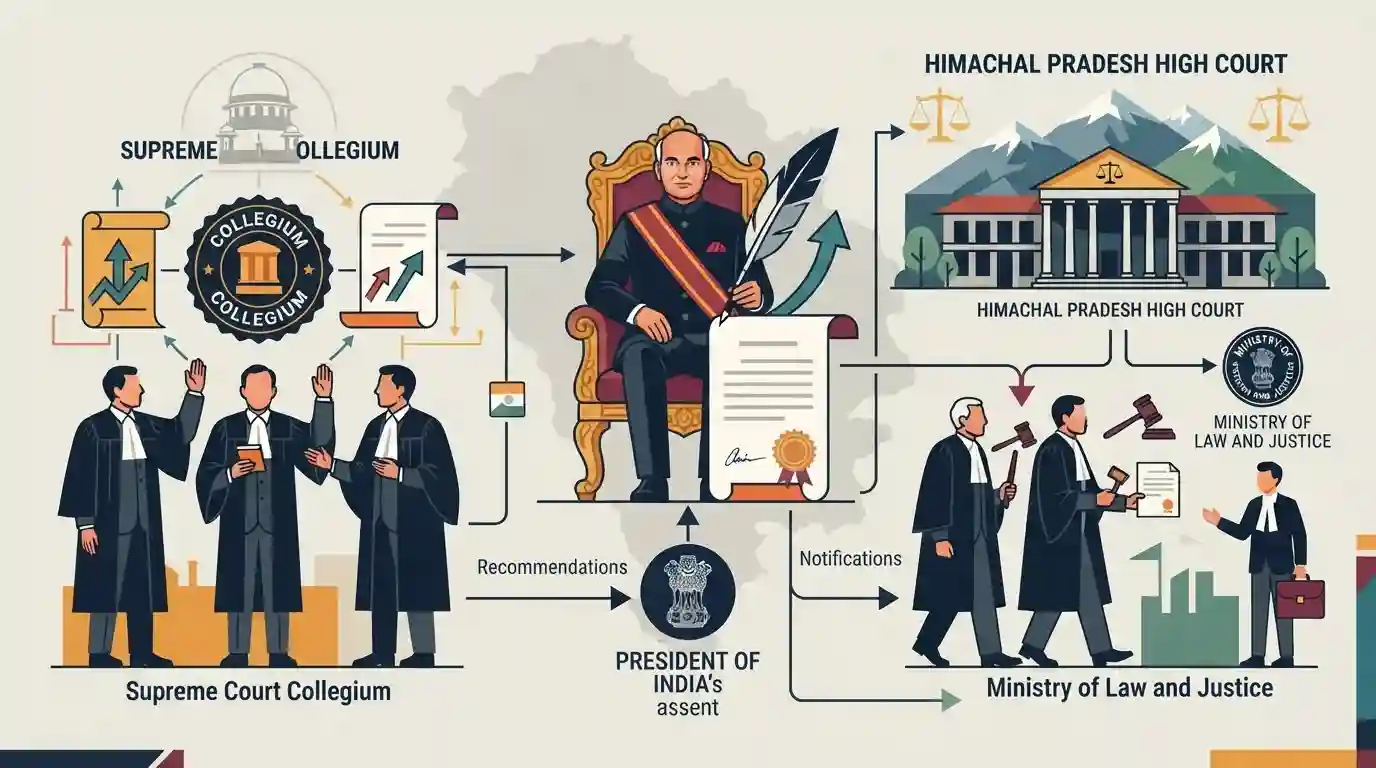
The Ministry of Law and Justice has announced the appointment of judicial officers as Judges and Additional Judges to the Himachal Pradesh High Court. This administrative step follows the constitutional framework where the President of India makes higher judicial appointments based on recommendations from the Supreme Court Collegium. The appointments, guided by Articles 217 and 224 of the Constitution, underscore the continuous process of filling judicial vacancies to address case pendency and ensure the effective functioning of the constitutional courts.
मुख्य मुद्दे
- The Ministry of Law and Justice has officially notified the appointment of judicial officers as Judges/Additional Judges to the Himachal Pradesh High Court.
- Such appointments are made by the President of India under the provisions of Article 217 and Article 224 of the Constitution of India.
- The procedure involves the recommendation of names by the Supreme Court Collegium, maintaining the balance of executive and judicial involvement in higher judiciary appointments.
- Additional judges are generally appointed for a period of up to two years to clear pending cases, after which their tenure may be made permanent based on performance evaluations.
महत्त्वाच्या संज्ञा
Supreme Court Collegium

A panel comprising the Chief Justice of India and senior-most judges that recommends higher judiciary appointments and transfers. Evolving through Supreme Court judgments, it replaced the original consultative process to ensure judicial primacy.
UPSC context
GS Paper II (Polity). Central to debates on judicial independence, transparency, and executive-judiciary relations in India.
Article 217 of the Constitution
A constitutional provision outlining the appointment of High Court judges. It mandates that the President appoints judges by warrant, conventionally requiring consultation with the Chief Justice of India, the state Governor, and the High Court Chief Justice.
UPSC context
GS Paper II (Polity). Frequently tested on the constitutional mechanisms of judicial appointments, qualifications, and the retirement age of High Court judges.
Additional Judges (Article 224)
Temporary High Court judges appointed by the President for up to two years to manage increased workloads or clear case pendency. They hold the same powers as permanent judges but must retire at age 62.
UPSC context
GS Paper II (Judiciary). Relevant for topics surrounding judicial backlog, speedy justice delivery, and structural provisions of the Indian judiciary.
Department of Justice (Ministry of Law and Justice)
A department under the Ministry of Law and Justice responsible for the administrative process of appointing, resigning, and removing judges of the higher judiciary. It issues formal appointment notifications based on Collegium recommendations.
UPSC context
GS Paper II (Governance). Highlights the executive branch's administrative role in processing and finalizing judicial appointments and managing court infrastructure.
Himachal Pradesh High Court
The highest constitutional court in Himachal Pradesh. Like other state High Courts, its judges are appointed by the President following recommendations from the Supreme Court Collegium, underscoring the integrated nature of India's judicial system.
UPSC context
GS Paper II (Polity - State Judiciary). Represents the state-level manifestation of constitutional courts and their ongoing operational challenges with pendency.
पूर्वपरीक्षा सापळा
"A distinguished jurist can be appointed as a judge of a High Court by the President."
Under Article 217, only individuals with 10 years of judicial office or high court advocacy qualify. The 'distinguished jurist' category solely applies to Supreme Court appointments (Article 124).
संबंधित स्थिर संकल्पना
How does the Supreme Court Collegium composition differ for varying judicial appointments?
- Supreme Court Appointments: Recommendations require a Collegium comprising the Chief Justice of India (CJI) and the four senior-most judges of the Supreme Court.
- High Court Appointments: Recommendations are made by a smaller Collegium comprising the CJI and only the two senior-most judges of the Supreme Court.
What are the constitutional conditions for appointing Additional Judges to High Courts?
- Article 224(1): Empowers the President to appoint qualified individuals to manage temporary workload surges or clear case backlogs in High Courts.
- Maximum Tenure: They are appointed for a temporary period not exceeding two years.
- Retirement Age: Regardless of the two-year tenure allowance, an additional judge cannot hold office after attaining the age of 62 years.
आंतर-विषय नमुने
NJAC and the Basic Structure Doctrine
Judicial appointments link directly to the 99th Amendment's strike-down. The Supreme Court rejected the NJAC to preserve judicial independence, firmly embedding the Collegium system in constitutional jurisprudence.
MoP friction and judicial pendency
Delays by the executive in clearing High Court Collegium recommendations highlight ongoing friction over the Memorandum of Procedure (MoP), which directly exacerbates India's high judicial pendency rates.

Expect multi-statement Qs contrasting HC/SC judge qualifications (like the 'distinguished jurist' clause) and differing Collegium sizes.
संबंधित PYQ · 3
संबंधित PYQ · 3
- 2025MainsGS2
Discuss the evolution of collegium system in India. Critically examine the advantages and disadvantages of the system of appointment of the Judges of the Supreme Court of India and that of the USA.
- 2017MainsGS2
Critically examine the Supreme Court's judgement on 'National Judicial Appointments Commission Act, 2014' with reference to appointment of judges of higher judiciary in India.
- 2021PrelimsGS1
With reference to Indian judiciary, consider the following statements : 1. Any retired judge of the Supreme Court of India can be called back to sit and act as a Supreme Court judge by the Chief Justice of India with prior permission of the President of India. 2. A High Court in India has the power to review its own judgement as the Supreme Court does. Which of the statements given above is/are correct?
