Convergence of Jal Jeevan Mission and Swachh Bharat Mission Grameen
Source:PIB ↗
কেন এটি গুরুত্বপূর্ণ
Understanding the convergence of government schemes is critical for UPSC aspirants, as it highlights administrative efficiency, cooperative federalism, and the pivotal role of local self-government (Panchayats) in sustainable rural development. It addresses overlapping issues in GS Paper 2 (Governance & Schemes) and GS Paper 3 (Water Resources).
সারসংক্ষেপ
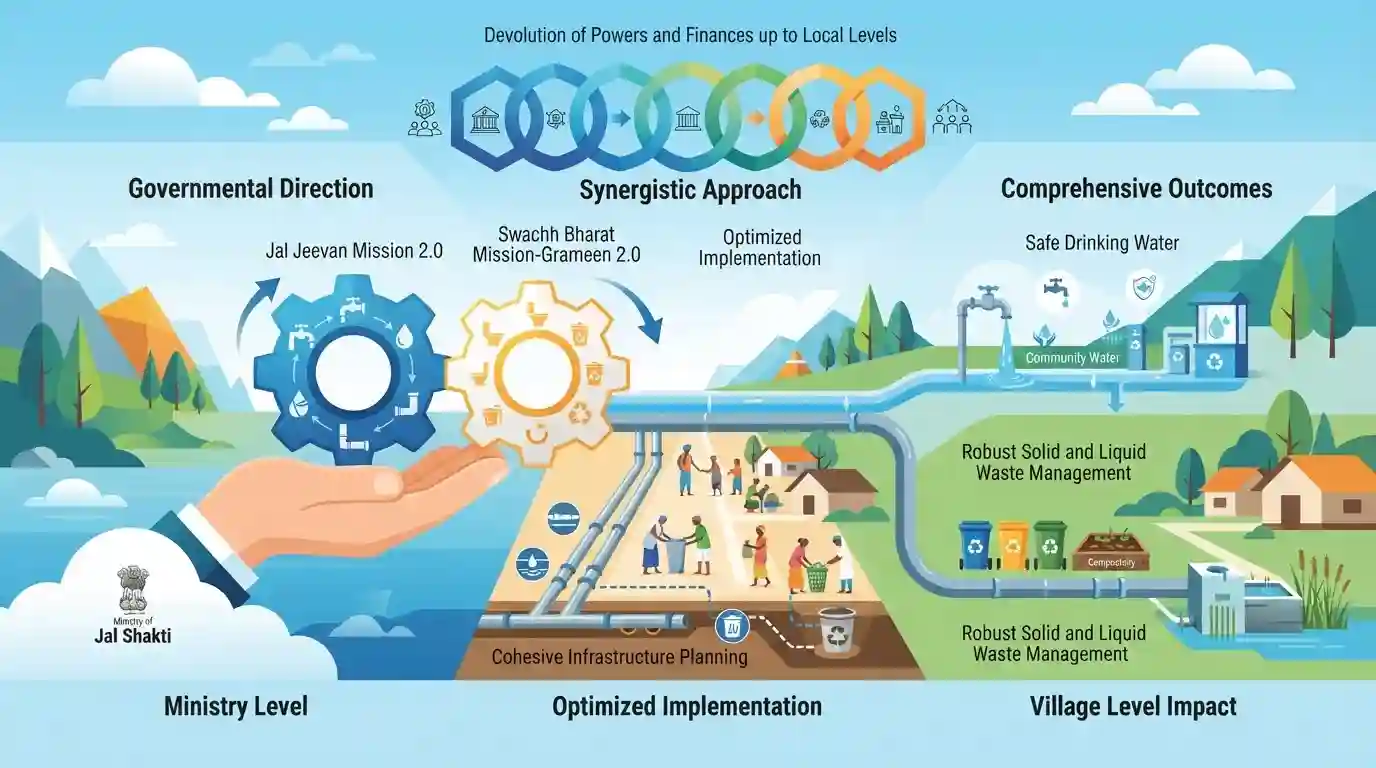
The Department of Drinking Water and Sanitation (DDWS), under the Ministry of Jal Shakti, has directed States and Union Territories to promote the convergence of Jal Jeevan Mission 2.0 and Swachh Bharat Mission-Grameen 2.0. By integrating these flagship water and sanitation programs, the government aims to achieve comprehensive rural development through optimized funding, cohesive infrastructure planning, and enhanced participation of local self-government institutions. This synergistic approach will focus on securing safe drinking water alongside robust solid and liquid waste management at the village level.
মূল বিষয়
- The Department of Drinking Water and Sanitation (DDWS) has called on States and UTs to integrate the activities of Jal Jeevan Mission 2.0 and Swachh Bharat Mission-Grameen 2.0.
- The convergence aims to optimize resources, avoid duplication, and ensure holistic development encompassing both clean drinking water and effective sanitation/waste management in rural areas.
- Local bodies, such as Gram Panchayats, are envisioned to be central to the planning, execution, and operation of these combined initiatives, enhancing decentralized governance.
- Integrated implementation is expected to result in better greywater management, solid waste disposal, and sustainable water supply, significantly improving rural health and living standards.
গুরুত্বপূর্ণ শব্দ
VB-G RAM G Act

The Viksit Bharat–Guarantee for Rozgar and Ajeevika Mission (Gramin) Act, 2025, replaced MGNREGA. It guarantees 125 days of rural wage employment annually, shifting focus toward durable infrastructure, asset creation, and water security.
UPSC context
GS Paper 2 & 3 (Social Justice, Economy). A massive statutory overhaul of India's rural employment framework, critical for exam prep.
Jal Jeevan Mission 2.0 (JJM 2.0)
Approved in March 2026, this upgraded scheme prioritises drinking water source sustainability, groundwater recharge, and greywater management to ensure reliable and climate-resilient rural drinking water services.
UPSC context
GS Paper 2 & 3 (Welfare Schemes). Tests knowledge of rural water security policies and sustainable infrastructure development.
Swachh Bharat Mission-Grameen 2.0 (SBM-G 2.0)
The second phase of India's rural sanitation program, focusing on the scientific management of solid and liquid waste (SLWM) to sustain Open Defecation Free (ODF) status and improve environmental health.
UPSC context
GS Paper 2 (Health & Sanitation, Governance). Essential for questions on rural sanitation interventions and public health.
Department of Drinking Water and Sanitation (DDWS)
A department under the Ministry of Jal Shakti responsible for implementing national water and sanitation programs, including the convergence of JJM 2.0 and SBM-G 2.0 for rural infrastructure development.
UPSC context
GS Paper 2 (Governance). Prelims frequently test nodal ministries and departments overseeing major flagship welfare missions.
Gram Panchayats
The grassroots tier of India's local self-government system. They play a central role in decentralised planning by integrating water and sanitation schemes into local Viksit Gram Panchayat Plans (VGPPs).
UPSC context
GS Paper 2 (Local Self-Government). Tests the devolution of powers, local governance, and participatory planning in rural development.
প্রিলিমস ফাঁদ
"The VB-G RAM G operates on a demand-driven funding model."
The new VB-G RAM G Act completely abandons the open-ended, purely demand-driven framework of MGNREGA for a 'normative allocation model' (typically 60:40).
সংযুক্ত স্থির ধারণা
What is the constitutional mandate for Gram Panchayat planning?
- Article 243G: Empowers Gram Panchayats to prepare plans for economic development and social justice.
- 11th Schedule: Lists 29 subjects, including drinking water, rural housing, and sanitation, falling under GP purview.
- Gram Sabha Role: Mandates that the Gram Sabha must approve village-level development plans and audit resource utilization.
How does the CGWB categorize groundwater assessment blocks?
- Safe: Extraction is less than 70% of the total annual extractable recharge.
- Semi-critical: Extraction is between 70% and 90%, accompanied by a long-term decline in water levels.
- Critical & Over-exploited: Extraction exceeds 90% (Critical) and 100% (Over-exploited), both showing significant long-term water depletion trends.
আন্তঃবিষয় প্যাটার্ন
Scheme Convergence & Fiscal Federalism
The shift from demand-driven MGNREGA to normative CSS funding for VB-G RAM G alters state fiscal liabilities, making inter-departmental convergence (VGPP + JJM + SBM) crucial for resource optimization.
Climate Resilience in Wage Guarantees
Mandating up to 65% VB-G RAM G expenditure in over-exploited blocks directly links rural employment schemes with India's climate adaptation and groundwater restoration goals.

Expect multi-statement questions contrasting MGNREGA with VB-G RAM G, focusing on the 125-day guarantee and the shift to normative funding.
সংযুক্ত PYQ · 3
সংযুক্ত PYQ · 3
- 2015MainsGS2
In absence of a well-educated and organized local level government system, 'Panchayats' and 'Samitis' have remained mainly political institutions and not effective instruments of governance. Critically discuss.
- 2024MainsGS3
The world is facing an acute shortage of clean and safe freshwater. What are the alternative technologies which can solve this crisis? Briefly discuss any three such technologies citing their key merits and demerits.
- 2024PrelimsGS1
Consider the following statements regarding World Toilet Organization : 1. It is one of the agencies of the United Nations. 2. World Toilet Summit, World Toilet Day and World Toilet College are the initiatives of this organization, to inspire action to tackle the global sanitation crisis. 3. The main focus of its function is to grant funds to the least developed countries and developing countries to achieve the end of open defecation. Which of the statements given above is/are correct?
