Centre Monitors Transboundary Flash Floods and Nepal River Swells
Source:PIB ↗
આ શા માટે મહત્વનું છે
Transboundary flooding is an annual recurring disaster in states like Bihar. For UPSC aspirants, it is essential to understand the institutional response framework (CWC, NDMA, NDRF) and the significance of India-Nepal bilateral coordination in shifting disaster management from a reactive to a proactive paradigm.
સારાંશ
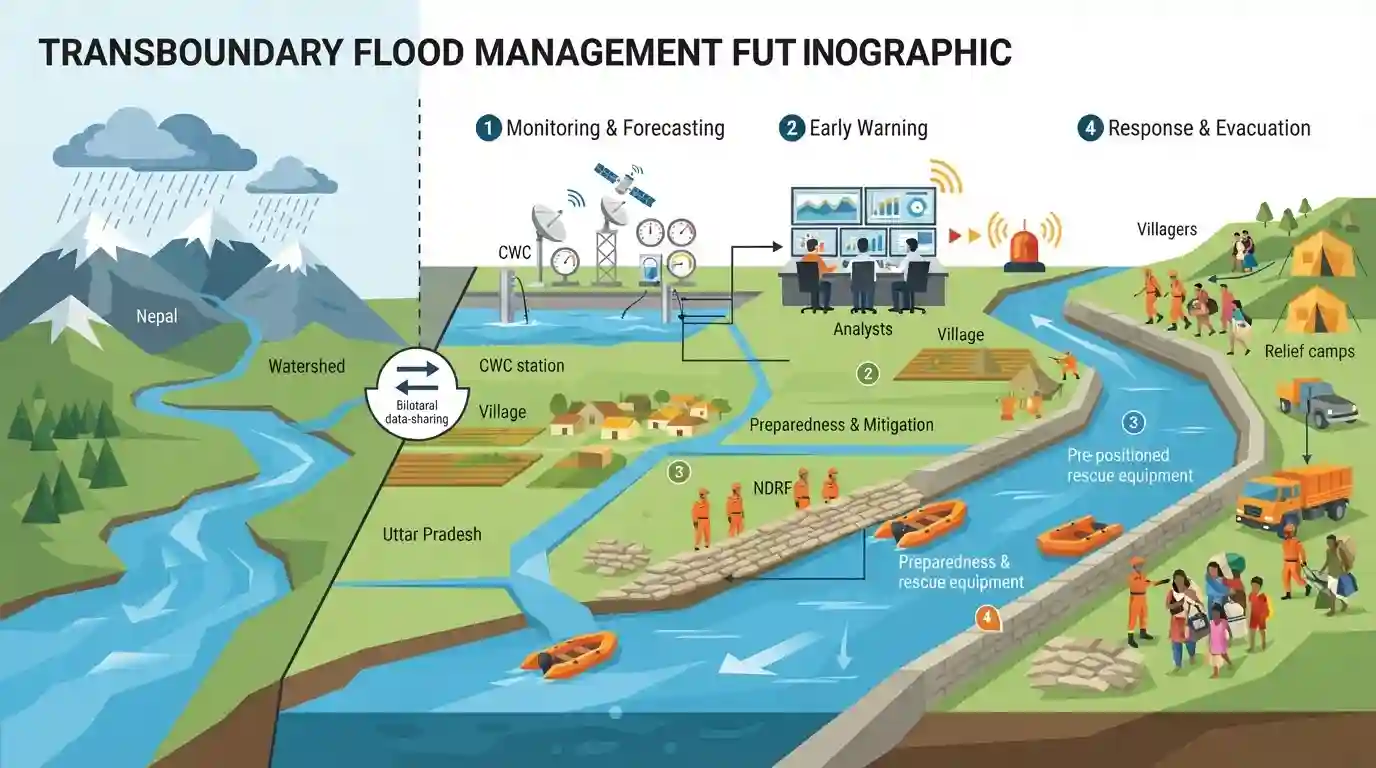
The Central Government is closely monitoring flash flood situations in Nepal, which directly elevate the risk of downstream flooding in Indian states like Bihar and Uttar Pradesh. The Central Water Commission (CWC), along with the National Disaster Management Authority (NDMA) and the National Disaster Response Force (NDRF), is engaged in real-time tracking, hydro-meteorological forecasting, and early warning dissemination. This event underscores the recurring vulnerability of India's northern plains to transboundary river swells and highlights the imperative of proactive disaster management, robust bilateral data-sharing mechanisms with Nepal, and inter-agency coordination for effective mitigation.
મુખ્ય મુદ્દા
- Heavy rainfall and flash floods in Nepal inevitably cause a surge in transboundary rivers like Kosi, Gandak, and Bagmati, leading to severe downstream flooding in Indian states like Bihar and Uttar Pradesh.
- The Central Water Commission (CWC) is tasked with real-time monitoring of river discharge and forecasting water levels to issue early warnings to affected states.
- Institutions like the NDMA and NDRF operate proactively in a coordinated framework alongside state agencies, shifting the focus from post-disaster response to pre-disaster preparedness and early evacuation.
- Effective management of transboundary floods requires strong bilateral hydro-diplomacy, real-time hydrological data-sharing, and joint infrastructure maintenance with Nepal.
મહત્વપૂર્ણ શબ્દો
Central Water Commission (CWC)

India's premier technical organization under the Ministry of Jal Shakti, tasked with coordinating, conserving, and managing water resources, including flood forecasting, irrigation, dam safety, and river basin planning nationwide.
UPSC context
GS Paper III: Disaster Management and Water Resources. Tests institutional frameworks, flood mitigation strategies, and interstate water governance.
National Disaster Management Authority (NDMA)
The apex statutory body for disaster management in India, established under the Disaster Management Act, 2005. It is chaired by the Prime Minister and mandates policies, plans, and guidelines for timely and effective disaster response.
UPSC context
GS Paper III: Disaster Management. Tests statutory bodies, disaster policy frameworks, prevention, preparedness, and inter-agency coordination.
National Disaster Response Force (NDRF)
A specialized multi-disciplinary force in India established under the Disaster Management Act, 2005. Operating under the Ministry of Home Affairs, it is tasked with rapid, specialist response to threatening disaster situations or actual disasters.
UPSC context
GS Paper III: Disaster Management. Tests operational response mechanisms, rescue capabilities, and emergency management during natural and man-made crises.
Disaster Management Act, 2005
A landmark legislative act enacted by the Parliament of India that provides a three-tiered institutional framework (national, state, district) for effective disaster prevention, mitigation, capacity-building, and emergency response across India.
UPSC context
GS Paper III: Disaster Management legislation. Tests statutory governance frameworks, legal mandates, and responsibilities of central, state, and district authorities.
પ્રિલિમ્સ ટ્રેપ
India and Nepal coordinate transboundary flood data under the framework of the UN Convention on the Non-Navigational Uses of International Watercourses.
Neither India nor Nepal is a party to the UN Watercourses Convention (UNWC) 1997 or the UNECE Water Convention. Their water cooperation is purely bilateral.
સંલગ્ન સ્થિર ખ્યાલો
What is the institutional architecture of India-Nepal bilateral water resource management?
- Three-Tier Architecture: Organized into three tiers: Joint Ministerial Level Commission (JMCWR), Joint Committee on Water Resources (JCWR), and Joint Standing Technical Committee (JSTC).
- JCIFM Focus: A specialized joint body that specifically addresses inundation, river training, and flood management works on shared border rivers.
- Bilateral Treaties: Governed by the Kosi Agreement (1954, amended 1966), Gandak Agreement (1959, amended 1964), and Mahakali Treaty (1996).
What are the core customary international law principles for transboundary waters?
- No Significant Harm: Obligates upstream states to prevent projects from causing significant environmental or physical harm downstream (reaffirmed in the ICJ Pulp Mills case, 2010).
- Equitable Utilization: Requires basin states to share water resources reasonably, balancing geographical, ecological, and socio-economic needs of all riparian states.
- Prior Notification: Upstream riparians must notify and consult downstream neighbors prior to implementing projects that may cause significant transboundary impact.
આંતર-વિષય પેટર્ન
Hydro-diplomacy + Neighborhood First Policy
Transboundary water cooperation serves as a critical, non-military pillar of India's "Neighborhood First" policy, balancing domestic disaster mitigation with geopolitical goodwill in Nepal.
Disaster Risk Reduction + Cooperative Federalism
Effective mitigation of Bihar's transboundary floods tests cooperative federalism, requiring tight coordination between Central agencies (CWC, NDMA) and State disaster machinery.

Expect questions testing the specific bilateral treaties with Nepal (Kosi, Gandak, Mahakali) versus non-signed global UN conventions.
સંલગ્ન PYQ · 3
સંલગ્ન PYQ · 3
- 2024MainsGS3
Flooding in urban areas is an emerging climate-induced disaster. Discuss the causes of this disaster. Mention the features of two such major floods in the last two decades in India. Describe the policies and frameworks in India that aim at tackling such floods.
- 2020MainsGS3
Discuss the recent measures initiated in disaster management by the Government of India departing from the earlier reactive approach.
- 2023MainsGS3
Dam failures are always catastrophic, especially on the downstream side, resulting in a colossal loss of life and property. Analyze the various causes of dam failures. Give two examples of large dam failures.
