Government regulates buffer stocks to stabilize food prices
Source:PIB ↗
কেন এটি গুরুত্বপূর্ণ
Food inflation significantly impacts macroeconomic stability and consumer welfare. The effective management of agricultural buffer stocks via mechanisms like the Price Stabilization Fund highlights the government's role in ensuring food security, stabilizing markets, and addressing supply chain bottlenecks in the agriculture sector.
সারসংক্ষেপ
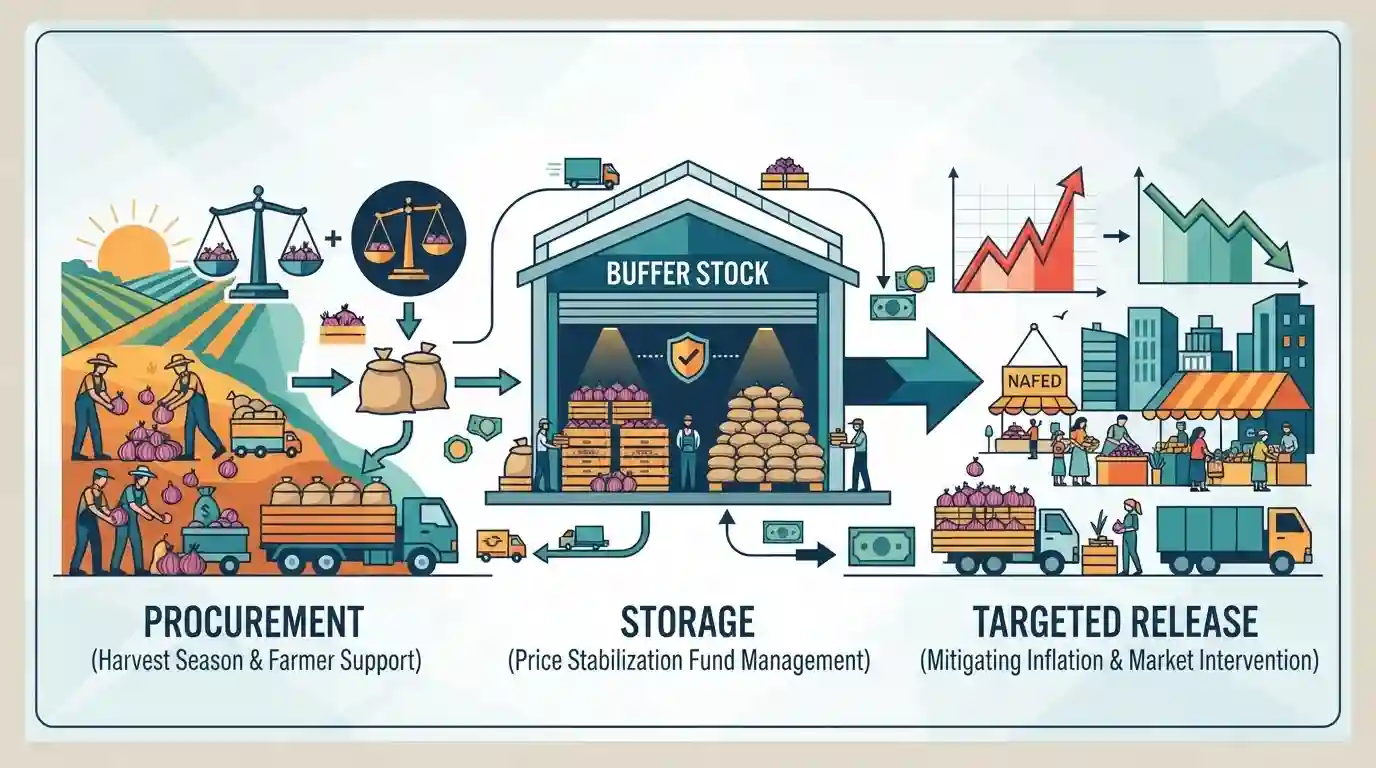
To mitigate seasonal price surges of essential commodities, the Government of India employs a calibrated and targeted release of onion buffer stocks. Managed under the Price Stabilization Fund (PSF), these market interventions are executed through central nodal agencies like NAFED and NCCF. The strategy focuses on procuring surplus crops during harvest seasons to guarantee remunerative prices for farmers, and subsequently offloading them in specific markets experiencing high inflation. This dual approach ensures supply chain stability and balances consumer affordability with farmer income security.
মূল বিষয়
- The Government of India manages buffer stocks of essential commodities like onions to moderate seasonal price volatility and protect consumers from sudden spikes.
- Calibrated and targeted market interventions are executed by offloading buffer stocks in regions experiencing significant price pressures.
- The Price Stabilization Fund (PSF) is the primary financial vehicle utilized by the Department of Consumer Affairs to support these market interventions.
- Central nodal agencies, such as NAFED and NCCF, execute the procurement of crops during peak harvest and facilitate their targeted release during lean seasons.
গুরুত্বপূর্ণ শব্দ
Price Stabilization Fund (PSF)

A government fund established to regulate the price volatility of essential agricultural commodities, such as onions and pulses, by maintaining strategic buffer stocks and intervening during supply shortages.
UPSC context
GS Paper 3 (Economy/Agriculture). Tests understanding of inflation management, buffer stock operations, and government market interventions.
NAFED
The National Agricultural Cooperative Marketing Federation of India is an apex cooperative organization. It serves as a central nodal agency for procuring agricultural commodities to support farmers and manage national buffer stocks.
UPSC context
GS Paper 3 (Agriculture). Tests knowledge of cooperative marketing, Minimum Support Price (MSP) procurement, and agencies executing food security interventions.
NCCF
The National Cooperative Consumers' Federation of India is the apex body of consumer cooperatives. It procures and distributes essential commodities, executing market interventions alongside NAFED to stabilize retail prices.
UPSC context
GS Paper 3 (Economy). Tests knowledge of inflation control mechanisms, cooperative societies, and government distribution networks for essential commodities.
Department of Consumer Affairs
A nodal department that monitors essential commodity prices, manages the Price Stabilization Fund, and executes policies to prevent hoarding, ensuring consumer goods remain affordable during supply crunches.
UPSC context
GS Paper 2/3 (Governance/Economy). Tests institutional frameworks for inflation control, consumer protection, and the regulation of essential commodities.
প্রিলিমস ফাঁদ
The Price Stabilization Fund is administered by the Ministry of Agriculture and primarily stocks Kharif onions for winter shortages.
The PSF was transferred to the Ministry of Consumer Affairs in 2016. Additionally, buffers use Rabi onions (not Kharif) due to their low moisture and longer shelf-life.
সংযুক্ত স্থির ধারণা
What is the Price Stabilization Fund (PSF) and how is it structured?
- Administrative Control: Managed by the Department of Consumer Affairs (Ministry of Consumer Affairs, Food & Public Distribution) since April 2016.
- Core Objective: Established in 2014-15 to regulate extreme price volatility of key agri-horticultural commodities like onions, potatoes, and pulses.
- Funding & Corpus: Maintained by the Small Farmers Agribusiness Consortium (SFAC), with State-level corpuses funded on a 50:50 (75:25 for NE) sharing pattern.
What is PM-AASHA and how does it integrate with buffer stocking?
- Umbrella Scheme: An umbrella scheme aimed at ensuring remunerative prices to farmers, integrating the Price Support Scheme (PSS) and Price Deficit Payment Scheme (PDPS).
- Buffer Integration: Integrates PSF with PSS to allow crops procured under price-support operations to be seamlessly transferred into the strategic consumer buffer.
আন্তঃবিষয় প্যাটার্ন
Nuclear technology in agri-logistics
Connecting nuclear science (BARC's Cobalt-60 gamma irradiation) to agricultural logistics illustrates how high-tech solutions mitigate food waste and post-harvest storage decay in critical crops.
Fiscal federalism in inflation management
The 50:50 central-state PSF funding framework showcases cooperative federalism deployed as an economic shock absorber to handle regionalized food price spikes.

Multi-statement questions likely to pair PSF's administrative history with Rabi storage advantages and nuclear-based preservation tech.
সংযুক্ত PYQ · 4
সংযুক্ত PYQ · 4
- 2024MainsGS3
Elucidate the importance of buffer stocks for stabilizing agricultural prices in India. What are the challenges associated with the storage of buffer stock? Discuss.
- 2025MainsGS3
Elaborate the scope and significance of supply chain management of agricultural commodities in India.
- 2024MainsGS3
What are the causes of persistent high food inflation in India? Comment on the effectiveness of the monetary policy of the RBI to control this type of inflation.
- 2022PrelimsGS1
In India, which one of the following is responsible for maintaining price stability by controlling inflation?
