Air quality commission seals defaulting units in Ghaziabad
Source:PIB ↗
Why It Matters
Air pollution in Delhi-NCR is a recurring environmental and public health crisis. Understanding the role, mandate, and enforcement powers of the Commission for Air Quality Management (CAQM) is critical for answering questions related to environmental governance, regulatory bodies, and pollution control strategies in India.
Summary
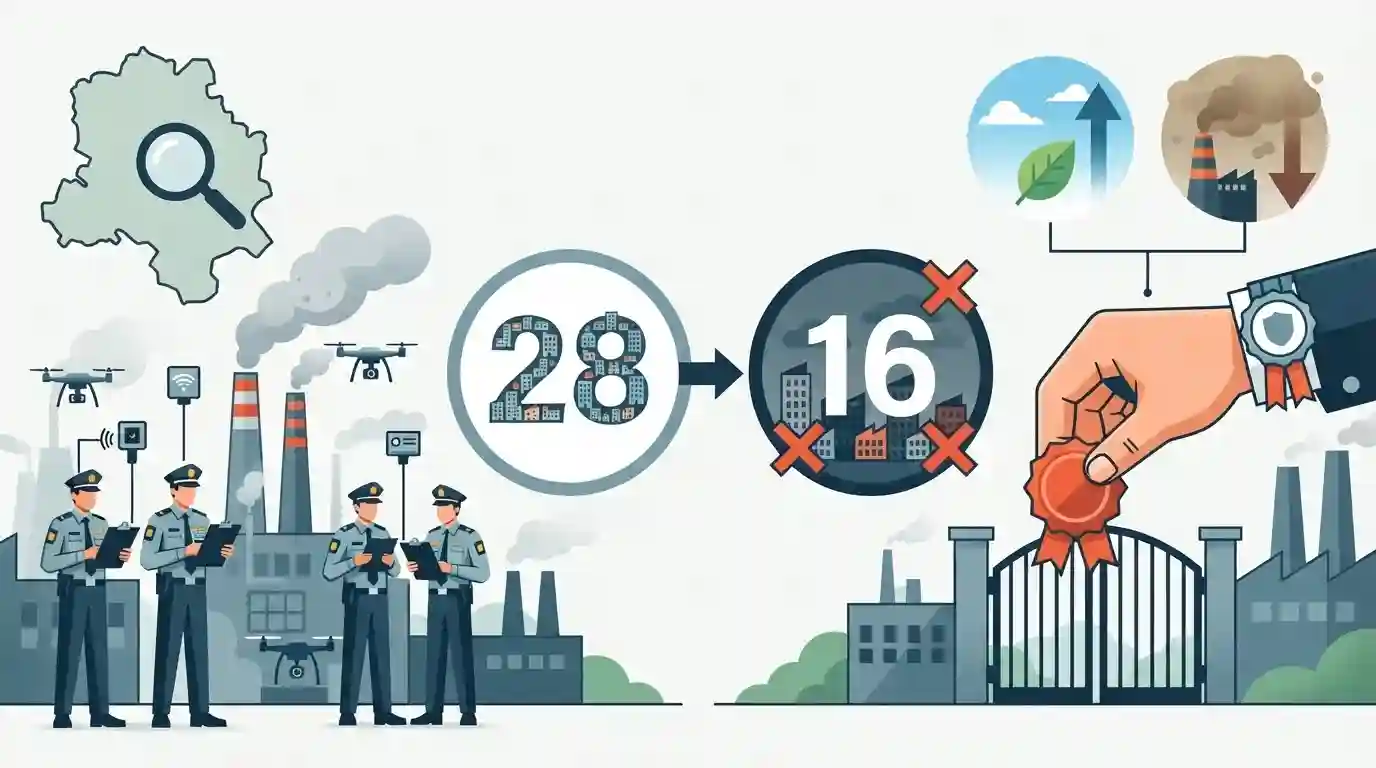
The Commission for Air Quality Management (CAQM) in the NCR and Adjoining Areas conducted a special surprise inspection drive in Loni, Ghaziabad, targeting air pollution defaulters. Of the 28 premises inspected, 16 units were sealed for failing to comply with environmental regulations. This enforcement action underscores the CAQM's active regulatory role and its statutory powers to penalize and shut down non-compliant, polluting entities to improve air quality in the National Capital Region.
Key Points
- The Commission for Air Quality Management (CAQM) carried out a special surprise inspection drive in Loni, Ghaziabad to curb localized air pollution.
- During the drive, 28 premises were inspected and 16 non-compliant units were sealed.
- This strict enforcement highlights CAQM's statutory mandate to monitor, inspect, and penalize polluting industries and construction activities in the NCR.
- Such rigorous enforcement is essential to combat the persistent issue of severe air pollution in the Delhi-NCR region, especially from industrial and local sources.
Important Terms
Commission for Air Quality Management (CAQM)

A statutory overarching body established to coordinate, research, and enforce measures to improve air quality and control pollution in the National Capital Region and its adjoining states.
UPSC context
GS Paper 3 (Environment). Vital for understanding regulatory bodies and institutional measures to combat severe air pollution in Delhi-NCR.
Commission for Air Quality Management in National Capital Region and Adjoining Areas Act, 2021
The parliamentary legislation that formally established the CAQM, granting it overarching statutory powers to penalize polluters, supersede older bodies like EPCA, and regulate regional air quality.
UPSC context
GS Paper 2 & 3. Important for analyzing legislative frameworks and jurisdictional authority in regional environmental crisis management.
Statutory Body
An organization established by an act of Parliament or state legislature, rather than the Constitution, authorized to enforce regulations and penalize non-compliance in its specific domain.
UPSC context
GS Paper 2 (Statutory, Regulatory & Quasi-Judicial Bodies). A foundational governance concept testing the legal backing and authority of regulatory agencies.
Prelims Trap
Appeals against any decision or order of the CAQM lie directly before the Supreme Court of India.
Under the CAQM Act of 2021, appeals against CAQM decisions lie exclusively with the National Green Tribunal (NGT), not the Supreme Court, and civil courts are entirely barred.
Static Concepts Connected
What are the core differences between the CAQM and its predecessor, the EPCA?
- Statutory Basis: CAQM was established under a dedicated 2021 Parliamentary Act, whereas EPCA was created administratively under the Environment (Protection) Act, 1986.
- Penal Authority: CAQM holds independent penal powers of up to five years imprisonment, whereas EPCA lacked direct, robust statutory penal powers.
- Overriding Powers: CAQM's orders override those of state governments and State Pollution Control Boards; EPCA functioned primarily as a monitoring advisory body.
How is the statutory jurisdiction of the CAQM defined and structured?
- Geographical Reach: Covers the entire National Capital Region (NCR) and adjoining areas of Punjab, Haryana, Rajasthan, and Uttar Pradesh.
- Exclusive Appeal: Challenging CAQM orders lies solely with the National Green Tribunal (NGT), completely barring the jurisdiction of civil courts.
Cross-Topic Patterns
Centralized environmental governance vs federalism
CAQM’s power to override State Pollution Control Boards and state directives tests the limits of cooperative federalism in managing transboundary pollution.
Specialized tribunals and civil court ouster
Bypassing civil courts for NGT appeals reflects a legislative trend toward fast-tracking ecological disputes through specialized, technical administrative tribunals.

Statements on CAQM's overriding powers over CPCB/SPCBs and its exclusive appeal jurisdiction under NGT are highly probable Prelims targets.
Linked PYQs · 2
Linked PYQs · 2
- 2021MainsGS3
Describe the key points of the revised Global Air Quality Guidelines (AQGs) recently released by the World Health Organisation (WHO). How are these different from its last update in 2005? What changes in India's National Clean Air Programme are required to achieve these revised standards?
- 2022PrelimsGS1
Which one of the following has been constituted under the Environment (Protection) Act, 1986?
