India and Morocco strengthen bilateral trade and digital partnership
Source:PIB ↗
Why It Matters
The Joint Commission highlights the deepening of India-Morocco relations, serving as an important example of India's strategic outreach to Africa, particularly regarding trade, digital partnerships, and South-South cooperation.
Summary
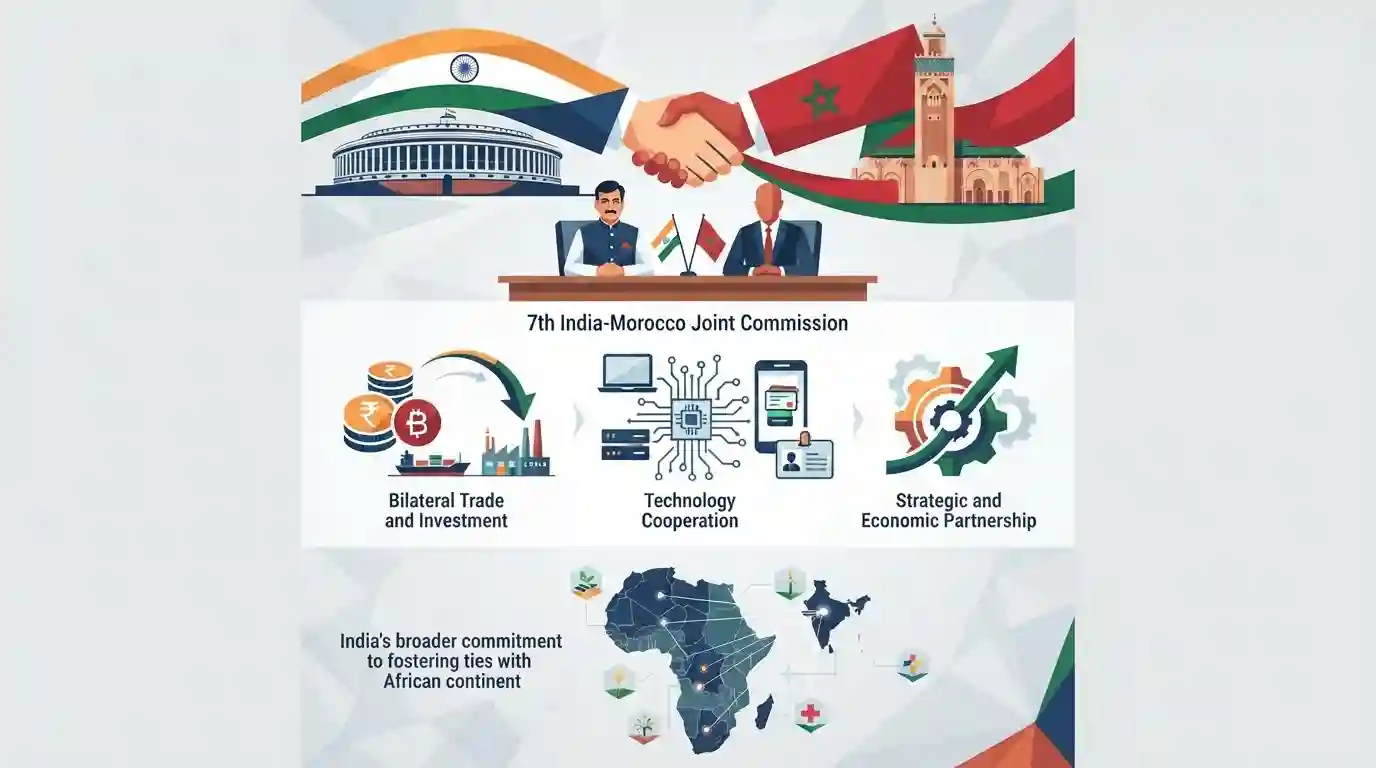
Minister of State for Commerce and Industry and Electronics & Information Technology, Shri Jitin Prasada, successfully concluded his official visit to Morocco, highlighted by co-chairing the 7th India-Morocco Joint Commission. The meeting focused on expanding bilateral trade and investment, alongside deepening cooperation in the technology sector, particularly in IT and Digital Public Infrastructure (DPI). This engagement reaffirms the growing strategic and economic partnership between India and Morocco, reflecting India's broader commitment to fostering robust ties with the African continent.
Key Points
- Minister of State Jitin Prasada co-chaired the 7th India-Morocco Joint Commission during his official visit to Morocco.
- The discussions aimed at expanding bilateral trade, economic partnerships, and exploring new investment opportunities.
- A key focus was placed on enhancing cooperation in the fields of Electronics, Information Technology, and Digital Public Infrastructure (DPI).
- The visit underscores India's strengthening strategic and economic ties with North Africa, promoting South-South cooperation.
Important Terms
India-Morocco Joint Commission

A bilateral institutional mechanism co-chaired at the ministerial level to review, consolidate, and expand economic, commercial, and strategic cooperation, with a focus on trade diversification, investment, and market access.
UPSC context
Relevant for GS Paper 2 (Bilateral Relations). Illustrates institutional efforts to strengthen India-Africa strategic partnerships and secure vital supply chains.
Digital Public Infrastructure (DPI)
Interoperable, shared digital systems—including digital identity, payment interfaces, and data-exchange frameworks—built on open standards to securely deliver public and private services at societal scale.
UPSC context
Key for GS Paper 2 (Governance/IR) and GS 3 (Economy). Highlights India's technological soft power, digital inclusion, and South-South cooperation.
Ministry of Commerce and Industry
The central government ministry responsible for formulating India's foreign trade policy, managing multilateral and bilateral trade agreements, and promoting foreign direct investment and domestic industrial growth.
UPSC context
Central to GS Paper 3 (Economy) and GS 2 (IR). Drives India's global economic integration, bilateral trade negotiations, and export diversification.
Ministry of Electronics & Information Technology (MeitY)
The apex Indian governmental body responsible for IT policy, electronics manufacturing, digital economy promotion, cybersecurity frameworks, and implementing digital governance initiatives across the nation.
UPSC context
Vital for GS Paper 3 (Science & Tech) and GS 2 (Governance). Anchors India's digital transformation, cybersecurity frameworks, and global technological diplomacy.
Prelims Trap
India is self-sufficient in phosphatic fertilizers (DAP) or primarily imports its raw materials from domestic East Asian partners.
Aspirants often assume India is self-sufficient in non-nitrogenous fertilizers or that East Asian/Gulf countries are our primary phosphate suppliers, overlooking Morocco's 60% dominant share.
Static Concepts Connected
Phosphatic Fertilizers and India's Soil Nutrient Balance
- Nutrient Role: Essential for root development, crop strength, and energy transfer within plants.
- NPK Imbalance: Ideal soil ratio is 4:2:1, but cheap urea overuse has heavily skewed this, degrading soil productivity.
- Import Dependency: India is highly import-dependent for rock phosphate and phosphoric acid, mainly sourcing from Morocco.
Digital Public Infrastructure (DPI) & India Stack
- Three Layers: Consists of three layers: Identity (Aadhaar), Payments (UPI), and Data Exchange (DigiLocker).
- Digital Diplomacy: Sharing open-source APIs with developing nations builds strategic goodwill and counters proprietary Western platforms.
- African Integration: Aligns with the African Union's Digital Transformation Strategy to foster inclusive, low-cost financial systems.
Cross-Topic Patterns
Fertilizer Imports + Food Security
India's agricultural yield is directly tied to North African mineral supply chains, making geopolitical stability in Morocco and Jordan critical to domestic food security.
Digital Diplomacy + Global South
Exporting India Stack (UPI, Aadhaar) to Africa serves as a non-debt-inducing soft power tool, countering China's infrastructure-heavy Belt and Road Initiative.

Exam may link India's fertilizer import dependency (phosphates) and food security with strategic diplomacy in North Africa.
Linked PYQs · 3
Linked PYQs · 3
- 2025MainsGS2
India-Africa digital partnership is achieving mutual respect, co-development and long-term institutional partnerships. Elaborate.
- 2021MainsGS2
If the last few decades were of Asia's growth story, the next few are expected to be of Africa's.” In the light of this statement, examine India's influence in Africa in recent years.
- 2024PrelimsGS1
Which of the following countries are well known as the two largest cocoa producers in the world? (a) Algeria and Morocco (b) Botswana and Namibia (c) Côte d'Ivoire and Ghana (d) Madagascar and Mozambique
