India and Japan explore startup and technology collaborations
Source:PIB ↗
ఇది ఎందుకు ముఖ్యం
Enhancing startup and technological linkages with Japan is crucial for bringing venture capital into India, boosting innovation, and reinforcing the strategic bilateral partnership to ensure stability and growth in the Indo-Pacific region.
సారాంశం
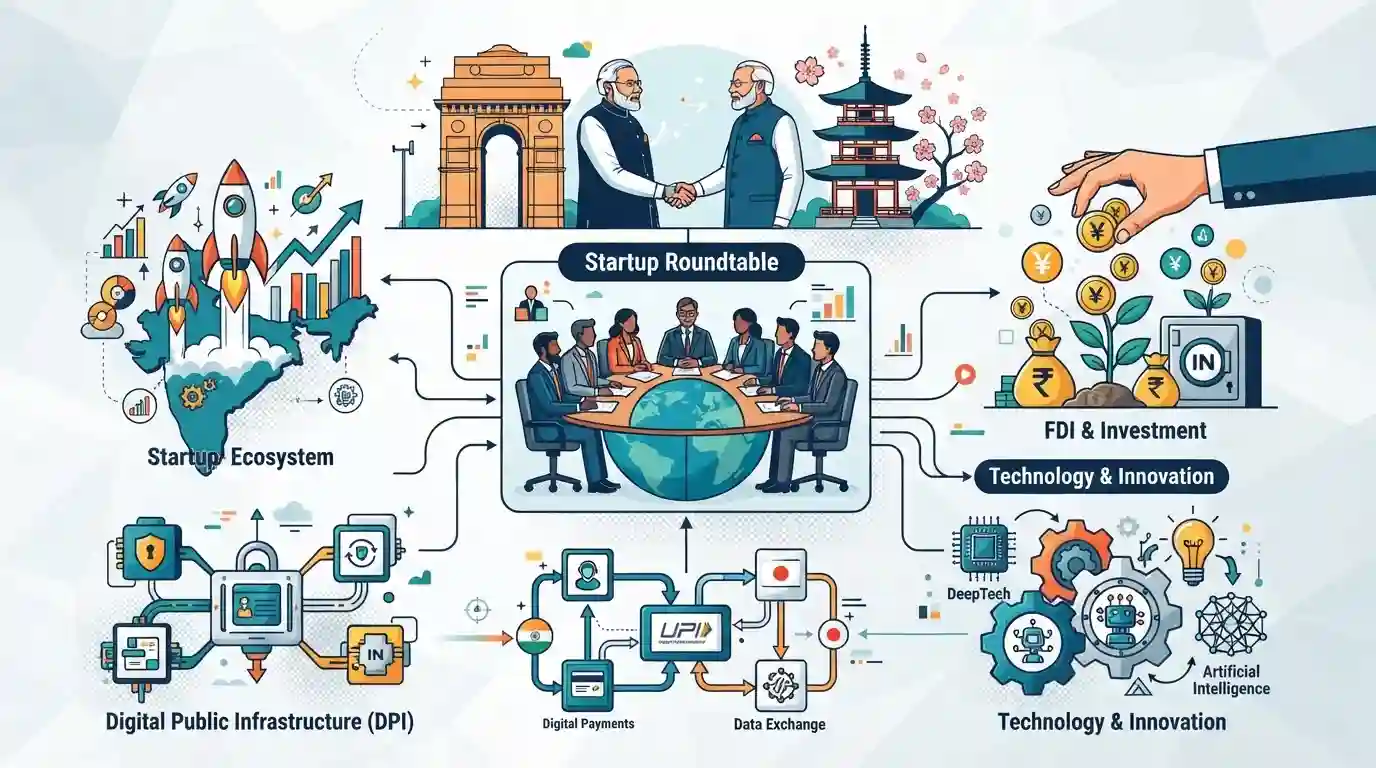
Commerce and Industry Minister Piyush Goyal addressed the India–Japan Startup Roundtable in Tokyo, aiming to deepen bilateral ties through technological innovation and investment. He highlighted India's status as a global startup hub and urged Japanese venture capitalists to invest in Indian enterprises. Emphasizing sectors like DeepTech, Artificial Intelligence, and India's Digital Public Infrastructure (DPI), the Minister proposed that combining India's innovative talent with Japan's technological expertise and capital can drive solutions for global challenges and strengthen the strategic partnership between the two nations.
ముఖ్య అంశాలు
- Union Minister Piyush Goyal addressed the India–Japan Startup Roundtable in Tokyo, underscoring the rapid growth of India's startup ecosystem.
- Highlighted India's position as the world's third-largest startup ecosystem, driven by a strong demographic dividend, innovation, and supportive government policies under 'Startup India'.
- Emphasized potential synergies in emerging technologies, particularly DeepTech, Artificial Intelligence (AI), and India's successful Digital Public Infrastructure (DPI).
- Invited Japanese venture capitalists and institutional investors to increase funding in Indian startups, leveraging the vast domestic market and skilled talent pool.
- Positioned the collaborative tech partnership between India and Japan as a strategic pillar for developing global solutions and enhancing Indo-Pacific supply chain resilience.
ముఖ్యమైన పదాలు
Startup India

A flagship government initiative launched in 2016 to promote entrepreneurship, foster innovation, and build a robust ecosystem for startups by providing regulatory support, funding access, and tax incentives.
UPSC context
Relevant to GS Paper 3 (Economic Development). Tests knowledge of government schemes, job creation strategies, and India's startup ecosystem policies.
Digital Public Infrastructure (DPI)
Foundational, shared digital systems—such as digital identity, payment platforms, and data exchange frameworks—that facilitate secure, inclusive, and scalable delivery of public and private services.
UPSC context
Crucial for GS Paper 2 (Governance) and GS Paper 3 (Technology). Evaluates understanding of digital inclusion, e-governance, and public service delivery.
Foreign Direct Investment (FDI)
Long-term capital investment by a foreign entity into a domestic business (typically acquiring 10% or more equity), bringing in capital, technology, and management expertise to the host country.
UPSC context
GS Paper 3 (Indian Economy). Tests understanding of the external sector, economic growth drivers, FEMA regulations, and global supply chain integration.
Deep Technology (DeepTech)
Innovations rooted in fundamental scientific research and advanced engineering breakthroughs—such as AI, robotics, or quantum computing—aimed at solving complex, large-scale global challenges rather than just business model optimization.
UPSC context
Essential for GS Paper 3 (Science & Technology). Tests awareness of R&D advancement, emerging technologies, and India's shift towards high-tech indigenous manufacturing.
ప్రిలిమ్స్ ఉచ్చు
"The India-Japan Fund (IJF) under NIIF is a wholly sovereign fund entirely financed by the Government of India."
The IJF is not solely funded by India. It is a bilateral fund where the Government of India holds 49% and Japan's JBIC holds 51%.
అనుసంధానమైన స్థిర భావనలు
What is the structure of the National Investment and Infrastructure Fund (NIIF)?
- Government Stake: The Government of India holds a maximum of 49% share, ensuring it operates commercially while acting as a quasi-sovereign wealth fund.
- Regulatory Status: It is registered with SEBI as an Alternative Investment Fund (AIF) Category II.
- Bilateral Mandates: It manages bilateral funds, like the India-Japan Fund (IJF), to attract patient foreign capital for climate mitigation and green mobility.
What is the Supply Chain Resilience Initiative (SCRI)?
- Core Members: It is a trilateral framework launched in 2021 by India, Japan, and Australia.
- Strategic Objective: It aims to reduce over-reliance on single-nation sourcing (China) and enhance manufacturing resilience in the Indo-Pacific.
- Key Methods: Focuses on joint investment promotion, sharing best practices, and the utilization of digital technologies for supply chain tracking.
అంతర-అంశ నమూనాలు
DPI as Strategic Soft Power
India is increasingly pitching its Digital Public Infrastructure (DPI) abroad, linking tech-diplomacy with traditional strategic partnerships (like Quad/Japan) to attract global patient capital.
Gendered Tech Formalization
The Startup India mandate links economic formalization with gender inclusion, highlighted by DPIIT data showing 48% of recognized startups have at least one woman director.

Expect a multi-statement question combining the India-Japan Fund's equity structure, SCRI members, and the DPIIT's BHASKAR registry.
అనుసంధాన PYQలు · 2
అనుసంధాన PYQలు · 2
- 2019MainsGS2
‘The time has come for India and Japan to build a strong contemporary relationship, one involving global and strategic partnership that will have a great significance for Asia and the world as a whole.’ Comment.
- 2015MainsGS3
Success of 'Make in India' programme depends on the success of 'Skill India' programme and radical labour reforms." Discuss with logical arguments.
