Sugar industry growth relies on ethanol blending and fair pricing
Source:PIB ↗
આ શા માટે મહત્વનું છે
The sugar industry is a vital agro-based sector employing millions. Its dynamics directly impact farmer incomes, making pricing mechanisms like FRP highly relevant for UPSC. The shift towards ethanol production bridges agriculture with energy security and environmental sustainability, which are core GS3 themes.
સારાંશ
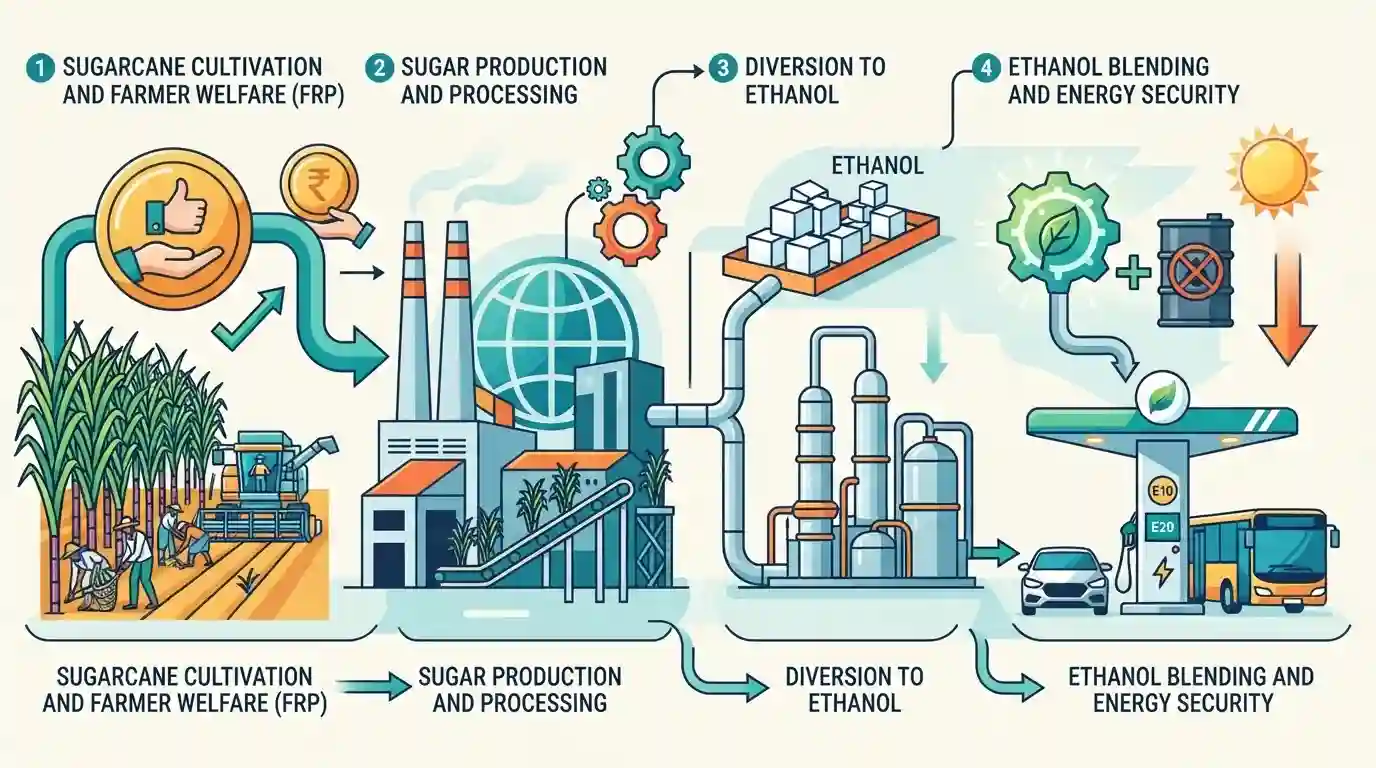
The article details the growth and structural shifts in India's sugar industry, driven by proactive government policies. It highlights India's position as a global leader in sugar production and consumption. Key interventions include the robust implementation of the Fair and Remunerative Price (FRP) to ensure timely payments to sugarcane farmers and the promotion of the Ethanol Blended Petrol (EBP) Programme. By diverting surplus sugar to ethanol, the government has improved mill liquidity, reduced cane arrears, and contributed to India's renewable energy and import substitution goals.
મુખ્ય મુદ્દા
- India has emerged as the world's largest producer and consumer of sugar, and the second-largest exporter.
- The Fair and Remunerative Price (FRP) system ensures minimum guaranteed returns to sugarcane farmers, facilitating timely clearance of cane arrears.
- The Ethanol Blended Petrol (EBP) Programme successfully diverts surplus sugar to ethanol production, enhancing energy security and improving the liquidity of sugar mills.
- Government interventions have stabilized the sugar sector by balancing farmer remuneration, domestic sugar availability, and export policies.
મહત્વપૂર્ણ શબ્દો
Fair and Remunerative Price (FRP)

The legally mandated minimum price that sugar mills are obligated to pay to sugarcane farmers, governed under the Sugarcane (Control) Order, 1966.
UPSC context
GS Paper 3 (Agriculture). Tests knowledge of statutory pricing mechanisms, agricultural policies, and differences between FRP and MSP.
Ethanol Blended Petrol (EBP) Programme
A government initiative launched in 2003 to blend ethanol with petrol, aiming to reduce crude oil import dependency, lower carbon emissions, and boost farmers' incomes.
UPSC context
GS Paper 3 (Energy & Environment). Tests bioenergy targets, National Policy on Biofuels, and import substitution strategies.
Commission for Agricultural Costs and Prices (CACP)
An advisory body under the Ministry of Agriculture and Farmers Welfare that recommends Minimum Support Prices (MSPs) and the Fair and Remunerative Price (FRP).
UPSC context
GS Paper 3 (Agriculture). Tests agricultural price policy, calculation methodologies, and advisory frameworks for crop support.
Cabinet Committee on Economic Affairs (CCEA)
A high-level cabinet committee chaired by the Prime Minister that approves economic policies, including final decisions on agricultural support prices like FRP and MSP.
UPSC context
GS Paper 2 (Governance) & Paper 3. Tests institutional executive decision-making and implementation of crucial agricultural schemes.
પ્રિલિમ્સ ટ્રેપ
Sugarcane pricing is governed under the standard Minimum Support Price (MSP) system of the Ministry of Agriculture.
Sugarcane is uniquely governed by the statutory Fair and Remunerative Price (FRP) under the Sugarcane (Control) Order 1966, not the general MSP framework.
સંલગ્ન સ્થિર ખ્યાલો
Why is the sugarcane industry shifting from North to South India?
- Sucrose Recovery: Tropical climate in South/West India yields sugarcane with higher sucrose content compared to the subtropical North.
- Crushing Season: South India has a longer crushing season (up to 7-8 months) because of moderate, maritime-influenced temperatures.
- Cooperative Model: Better managed sugar cooperatives in states like Maharashtra ensure smoother operations and faster payments.
What distinguishes the Fair and Remunerative Price (FRP) from MSP?
- Statutory Obligation: FRP is legally binding on sugar mills under the Sugarcane (Control) Order, 1966; MSP lacks direct statutory compulsion on private buyers.
- Payer entity: Mills pay farmers the FRP directly, whereas the government is the primary buyer under the MSP procurement model.
- State Advised Price: States can mandate a State Advised Price (SAP) higher than the central FRP, which mills must legally pay.
આંતર-વિષય પેટર્ન
Food vs Fuel: Ethanol and cropping patterns
Diverting sugar and grain crops to ethanol enhances energy security but alters cropping incentives, risking local food price inflation and depleting critical food stock reserves.
Water footprint vs Agri-economics
Sugarcane cultivation in water-stressed Maharashtra creates a conflict between lucrative crop prices (FRP/SAP) and severe groundwater depletion, complicating micro-irrigation policies.

Statements comparing FRP legal backing with MSP, coupled with geographical factors of sucrose yield, are highly likely in GS-3.
સંલગ્ન PYQ · 3
સંલગ્ન PYQ · 3
- 2015PrelimsGS1
The Fair and Remunerative Price (FRP) of sugarcane is approved by the
- 2013MainsGS1
Do you agree that there is a growing trend of opening new sugar mills in southern States of India? Discuss with justification.
- 2025PrelimsGS1
Consider the following substances: I. Ethanol II. Nitroglycerine III. Urea Coal gasification technology can be used in the production of how many of them?
