SIDBI and regional rural banks expand MSME co-lending framework
Source:PIB ↗
Why It Matters
UPSC frequently tests the operational structure of India's banking system, MSME credit constraints, and financial inclusion strategies. Understanding how apex institutions like SIDBI use co-lending models with regional entities (RRBs) to mitigate risk and achieve Priority Sector targets is crucial for Mains GS3 (Mobilization of Resources) and Prelims Economy questions.
Summary
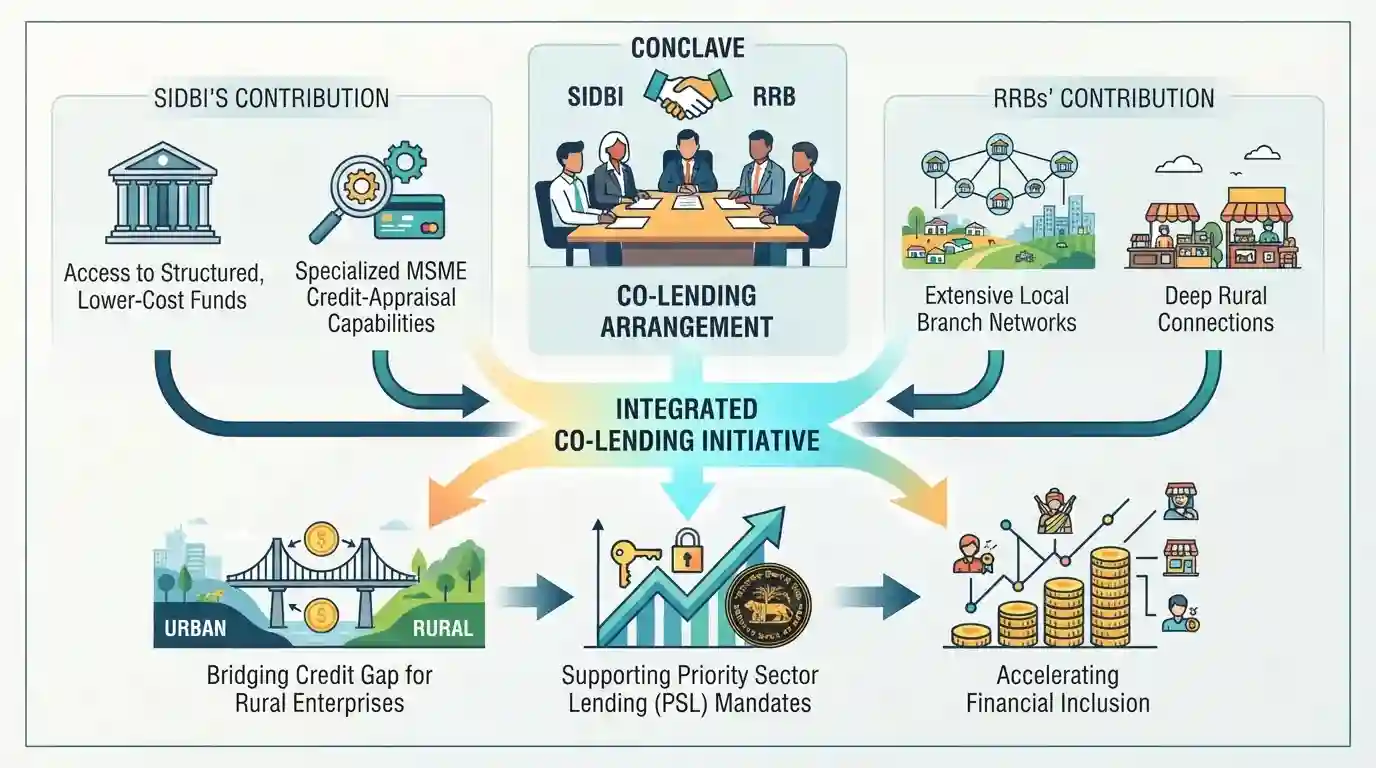
The Small Industries Development Bank of India (SIDBI) convened a conclave with the heads of Regional Rural Banks (RRBs) to discuss expanding their MSME co-lending arrangement. By integrating SIDBI's access to structured, lower-cost funds and specialized MSME credit-appraisal capabilities with the extensive local branch networks of RRBs, the initiative seeks to bridge the credit gap for rural and semi-urban enterprises. This co-lending framework accelerates financial inclusion and supports the Reserve Bank of India’s Priority Sector Lending (PSL) mandates by ensuring targeted credit delivery to micro, small, and medium enterprises.
Key Points
- SIDBI organized a conclave for the heads of Regional Rural Banks (RRBs) to promote and expand their MSME co-lending arrangement.
- The partnership leverages the deep rural and semi-urban branch networks of RRBs alongside SIDBI's specialized MSME underwriting expertise and capital pool.
- Co-lending helps address the credit gap in the MSME sector, enabling last-mile financial inclusion and boosting rural industrialization.
- The initiative directly aligns with the RBI's Priority Sector Lending (PSL) objectives by streamlining credit flow to micro and small enterprises.
Important Terms
Priority Sector Lending (PSL)

A mandatory RBI framework requiring banks to allocate a specific percentage of their loans—like 40% for commercial banks and 75% for RRBs—to vital but credit-constrained sectors such as agriculture, MSMEs, housing, and weaker sections.
UPSC context
Essential for GS Paper 3 (Economy) and Prelims. Tests knowledge of financial inclusion, RBI mandates, and rural credit distribution mechanisms.
RBI Co-Lending Model (CLM)
An RBI framework permitting banks and Non-Banking Financial Companies (NBFCs) to jointly originate and fund loans. The model combines a bank's low-cost capital (taking up to 80% of the risk) with an NBFC's extensive grassroots reach.
UPSC context
Important for GS Paper 3 (Banking). Evaluates understanding of credit delivery innovations, MSME financing, and structural reforms in the banking sector.
Small Industries Development Bank of India (SIDBI)
A statutory body established in 1990 serving as India's principal financial institution for promoting, financing, and developing Micro, Small, and Medium Enterprises (MSMEs). It provides direct lending, ecosystem support, and refinancing to bridge MSME credit gaps.
UPSC context
Relevant for GS Paper 3 (Economy). Frequently tested in Prelims regarding its statutory status, ownership, and role in institutional MSME support.
Regional Rural Banks (RRBs)
Scheduled commercial banks established under the RRB Act of 1976 to serve rural areas. They are jointly owned by the Central Government (50%), Sponsor Banks (35%), and respective State Governments (15%).
UPSC context
Vital for GS Paper 3 (Inclusive Growth). Tests knowledge of rural credit architecture, ownership structure, and their strict 75% Priority Sector Lending target.
Prelims Trap
Regional Rural Banks (RRBs) are subject to the standard 40% Priority Sector Lending target applicable to Scheduled Commercial Banks.
RRBs are mandated to target 75% of their ANBC to priority sectors, reflecting their core developmental and rural mandate.
Static Concepts Connected
What is the regulatory and ownership structure of Regional Rural Banks (RRBs)?
- Genesis & Regulation: Established in 1975 following Narasimham Working Group recommendations; regulated by RBI and supervised by NABARD.
- Ownership Split: Statutorily split among the Central Government (50%), the Sponsor Bank (35%), and the respective State Government (15%).
- PSL Mandate: Mandated to allocate 75% of their Adjusted Net Bank Credit (ANBC) to Priority Sector Lending (PSL).
What is the Co-Lending Arrangement (CLA) framework?
- Core Purpose: A model designed to leverage the low-cost funds of banks alongside the last-mile reach of partner originators (NBFCs/RRBs).
- Risk Retention: Under CLA 2025 directions, the participating originating entity must retain a minimum of 10% share of each loan.
- Asset Classification: If one partner classifies a borrower as SMA/NPA, the other partner must align its classification to protect system stability.
Cross-Topic Patterns
Cooperative federalism in rural banking
The 50:35:15 RRB equity split showcases a tripartite cooperative federal model, where commercial banking efficiency meets local regional public policy.
Co-lending and systemic risk transmission
While co-lending improves credit access, mandatory NPA alignment across partners ensures that localized rural asset quality stress is immediately recognized.

Differentiated PSL targets and risk-sharing norms under the 2025 Co-Lending framework are highly probable UPSC Prelims themes.
Linked PYQs · 5
Linked PYQs · 5
- 2013PrelimsGS1
Priority Sector Lending by banks in India constitutes the lending to
- 2023PrelimsGS1
Consider the following statements with reference to India: 1. According to the 'Micro, Small and Medium Enterprises Development (MSMED) Act, 2006', the 'medium enterprises' are those with investments in plant and machinery between ₹ 15 crore and ₹ 25 crore. 2. All bank loans to the Micro, Small and Medium Enterprises qualify under the priority sector. Which of the statements given above is/are correct?
- 2011PrelimsGS1
In India, which of the following have the highest share in the disbursement of credit to agriculture and allied activities?
- 2022MainsGS3
Is inclusive growth possible under market economy ? State the significance of financial inclusion in achieving economic growth in India.
- 2023MainsGS3
Faster economic growth requires increased share of the manufacturing sector in GDP, particularly of MSMEs. Comment on the present policies of the Government in this regard.
