Indian and Vietnam coast guards hold bilateral maritime meeting
Source:PIB ↗
ఇది ఎందుకు ముఖ్యం
Cooperation between the coast guards of India and Vietnam is a crucial component of India's strategic outreach in Southeast Asia. It enhances collective capabilities in addressing non-traditional maritime threats, secures vital sea lanes, and reinforces a rules-based order in the Indo-Pacific, which is highly relevant for both GS2 (IR) and GS3 (Security).
సారాంశం
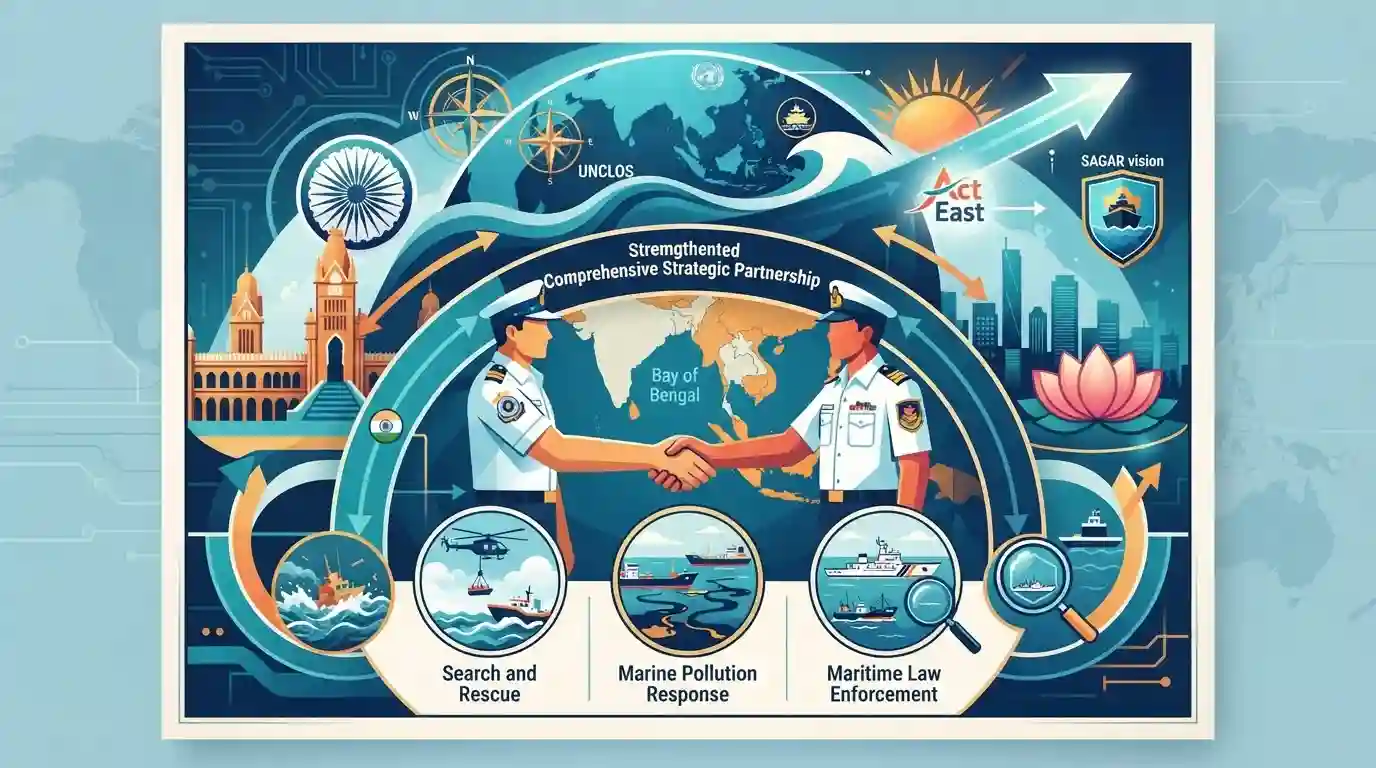
The 7th High-Level Meeting between the Indian Coast Guard and the Vietnam Coast Guard in Chennai signifies a strengthening of maritime ties and the Comprehensive Strategic Partnership between the two countries. Discussions prioritized operational cooperation in search and rescue, marine pollution response, and maritime law enforcement. This ongoing collaboration highlights India's strategic focus on its 'Act East' policy and the SAGAR vision, promoting a free, open, and rules-based Indo-Pacific region in accordance with international legal frameworks like UNCLOS.
ముఖ్య అంశాలు
- The 7th High-Level Meeting between the Indian and Vietnam Coast Guards was held in Chennai to deepen bilateral maritime cooperation.
- Key areas of focus included marine pollution response, search and rescue (SAR) operations, and maritime law enforcement.
- The engagement reinforces the Comprehensive Strategic Partnership between India and Vietnam, aligning with India's 'Act East' policy and SAGAR vision.
- Both nations emphasized the importance of a free, open, and rules-based Indo-Pacific region governed by international law, notably UNCLOS.
ముఖ్యమైన పదాలు
UNCLOS (United Nations Convention on the Law of the Sea)

An international treaty establishing the overarching legal framework for marine and maritime activities. It defines exclusive economic zones, territorial waters, and navigational freedoms for member states.
UPSC context
GS-2 (International Relations). Essential for maritime law, freedom of navigation issues, and resolving geopolitical disputes like in the South China Sea.
SAGAR (Security and Growth for All in the Region)
India's geopolitical maritime vision for the Indian Ocean Region. It emphasizes collective security, sustainable economic development, disaster management, and regional cooperation among littoral states.
UPSC context
GS-2 (IR). Vital for questions on India's Indian Ocean strategy and its role as a 'net security provider'.
Act East Policy
A diplomatic initiative launched in 2014 to cultivate deep economic, strategic, and cultural ties with Southeast and East Asian nations, acting as a regional counterweight.
UPSC context
GS-2 (IR). Tests India's strategic outreach in the Indo-Pacific, ASEAN centrality, and counterbalancing efforts against regional hegemony.
Comprehensive Strategic Partnership
A high-level diplomatic designation indicating deep mutual trust, extensive cooperation in defense and economics, and shared strategic goals. India and Vietnam elevated ties to this in 2016.
UPSC context
GS-2 (Bilateral Relations). Relevant for evaluating the depth and elevation of India's foreign alliances, particularly in the Indo-Pacific region.
Indian Coast Guard (ICG)
A statutory maritime law enforcement and search-and-rescue agency operating under the Ministry of Defence. It safeguards India's maritime zones, prevents smuggling, and protects marine environments.
UPSC context
GS-3 (Internal Security). Tests India's coastal security architecture, border management, and maritime disaster response capabilities.
ప్రిలిమ్స్ ఉచ్చు
"The Indian Navy is the nodal agency for responding to marine oil spills in India's maritime zones."
The Indian Coast Guard (ICG), not the Navy, acts as the Central Coordinating Authority for marine pollution response under the National Oil Spill Disaster Contingency Plan.
అనుసంధానమైన స్థిర భావనలు
What is the mandate of the Indian Coast Guard vs the Indian Navy?
- Jurisdiction: ICG handles non-military maritime law enforcement, anti-smuggling, and Search and Rescue (SAR) within India's EEZ.
- Pollution Response: ICG serves as the central coordinating authority for the National Oil Spill Disaster Contingency Plan (NOSDCP).
- Wartime Role: The Navy is the primary maritime defense force; the ICG assists the Navy during wartime operations.
What are the key maritime zones established by UNCLOS?
- Territorial Sea: Extends up to 12 nautical miles from the baseline, where the coastal state exercises full sovereignty over airspace, water, and seabed.
- Contiguous Zone: Extends up to 24 nautical miles from baseline; used to enforce customs, taxation, immigration, and pollution laws.
- Exclusive Economic Zone: Extends up to 200 nautical miles, granting the coastal state sovereign rights for exploring and exploiting natural marine resources.
అంతర-అంశ నమూనాలు
Act East + South China Sea
Vietnam's central role in India's Act East Policy frequently intersects with freedom of navigation concerns in the contested South China Sea, prompting India to bolster maritime capacity building in Southeast Asia.
SAGAR + Quad Maritime Domain Awareness
India's SAGAR vision has organically bridged with the Quad’s Indo-Pacific Maritime Domain Awareness (IPMDA) initiative, utilizing coast guard diplomacy to counter non-traditional security threats like illegal fishing.

Expect match-the-pair questions on maritime exercises (like Sahyog Hop Tac) or multi-statement questions tying SAGAR to UNCLOS mandates.
అనుసంధాన PYQలు · 3
అనుసంధాన PYQలు · 3
- 2025MainsGS3
Why is maritime security vital to protect India's sea trade? Discuss maritime and coastal security challenges and the way forward.
- 2022MainsGS3
What are the maritime security challenges in India ? Discuss the organisational, technical and procedural initiatives taken to improve the maritime security.
- 2022PrelimsGS1
With reference to the United Nations Convention on the Law of Sea, consider the following statements : 1. A coastal state has the right to establish the breadth of its territorial sea up to a limit not exceeding 12 nautical miles, measured from baseline determined in accordance with the convention. 2. Ships of all states, whether coastal or land-locked, enjoy the right of innocent passage through the territorial sea. 3. The Exclusive Economic Zone shall not extend beyond 200 nautical miles from the baseline from which the breadth of the territorial sea is measured. Which of the statements given above are correct?
