Critical Minerals Innovation Hackathon and Supply Chain Security
Source:PIB ↗
কেন এটি গুরুত্বপূর্ণ
Securing critical minerals is vital for India's strategic autonomy, energy security, and transition to a green economy. Understanding government initiatives like the Hackathon and the National Critical Mineral Mission is crucial for GS3 (Economic Development, Resource Mobilization, and Technology), particularly in analyzing efforts to reduce import dependence and promote domestic innovation in mineral processing.
সারসংক্ষেপ
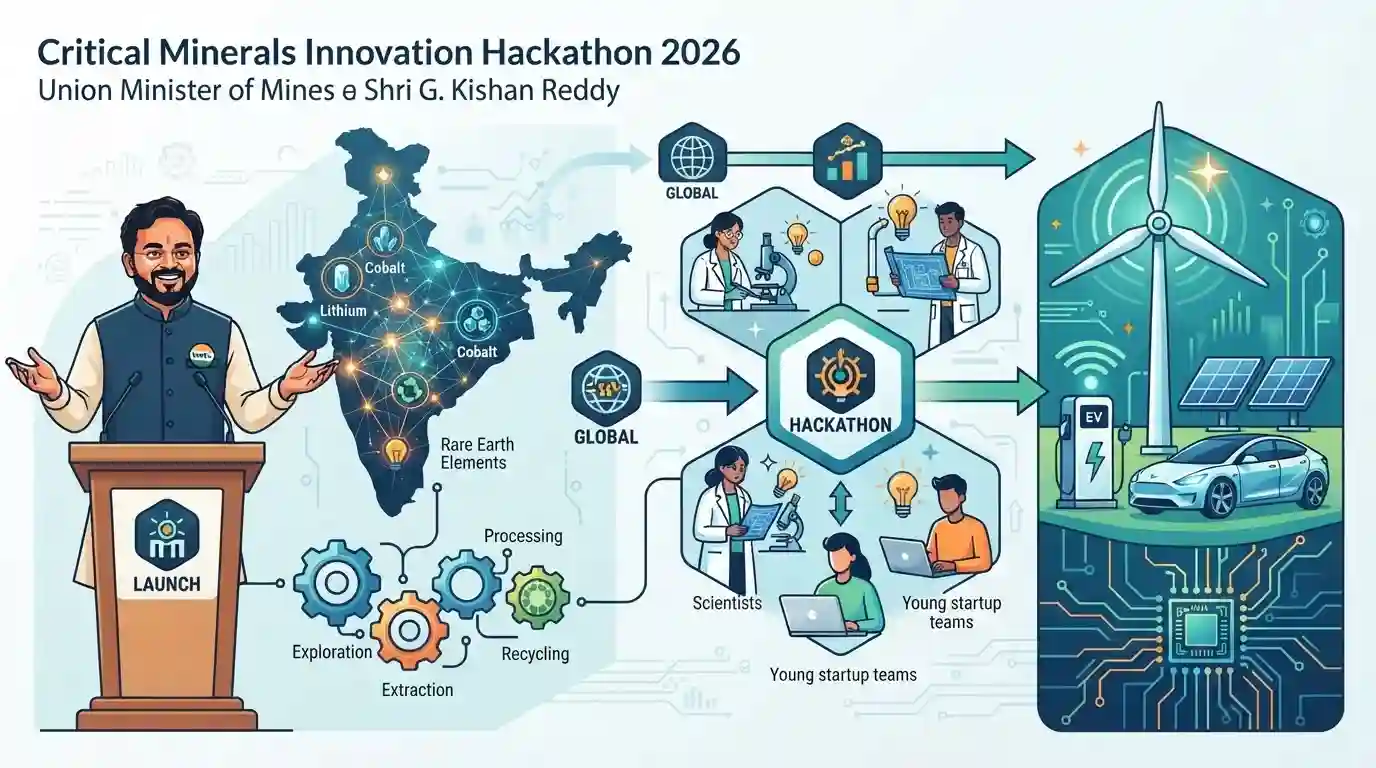
Union Minister of Mines Shri G. Kishan Reddy launched the Critical Minerals Innovation Hackathon 2026 to promote domestic research and technological development in the critical minerals sector. The hackathon seeks innovative solutions from startups, academia, and industry for the efficient exploration, extraction, processing, and recycling of strategic resources such as lithium, cobalt, and rare earth elements. This initiative aims to strengthen self-reliance in mineral supply chains, which is vital for India's clean energy transition, electric vehicle manufacturing, and high-tech industries, ultimately reducing the country's dependence on foreign imports.
মূল বিষয়
- Union Minister of Mines Shri G. Kishan Reddy launched the Critical Minerals Innovation Hackathon 2026 to foster indigenous innovation in the mineral sector.
- The initiative invites startups, researchers, and industry to develop technologies for the exploration, extraction, processing, and recycling of critical minerals.
- Aims to secure India's supply chains for strategic minerals (like lithium, cobalt, and rare earths) essential for the clean energy transition, electric vehicles (EVs), and electronics.
- Aligns with the broader goals of Atmanirbhar Bharat to reduce import dependency and build domestic capacity in critical mineral processing.
গুরুত্বপূর্ণ শব্দ
National Critical Mineral Mission (NCMM)

A strategic initiative (FY 2024-25 to 2030-31) launched by India to secure the domestic supply chain of 30 identified critical minerals through exploration, mining, recycling, and international acquisitions.
UPSC context
GS Paper III (Indian Economy & Resource Security); tests policies for energy transition and import-dependence reduction.
Critical Minerals Innovation Hackathon 2026
A collaborative initiative launched by the Ministry of Mines to foster technology-driven solutions for critical mineral challenges, focusing on open-data prospectivity mapping and R&D patent tracking.
UPSC context
GS Paper III (Science & Tech / Energy Transition); tests innovation strategies for domestic mineral security.
JNARDDC (Jawaharlal Nehru Aluminium Research Development and Design Centre)
A Central Government Autonomous Body under the Ministry of Mines, established in 1989 as a Centre of Excellence for research in non-ferrous metals, recycling, and critical minerals.
UPSC context
GS Paper III (Infrastructure & Science & Tech); tests key R&D institutions supporting industrial growth and circular economy.
Ministry of Mines
The nodal ministry of the Government of India responsible for the survey, exploration, mining, administration, and sustainable development of non-coal, non-petroleum, and non-atomic mineral resources.
UPSC context
GS Paper II (Government Policies & Interventions); tests understanding of governance and regulatory frameworks for natural resources.
প্রিলিমস ফাঁদ
Lithium and Beryllium are exclusively reserved for government mining as they are classified as atomic minerals.
The MMDR Amendment Act 2023 de-listed six minerals, including lithium, beryllium, and titanium, from the 'atomic' list, opening their exploration and mining to the private sector.
সংযুক্ত স্থির ধারণা
How has the MMDR Act been amended to boost critical mineral exploration?
- Atomic List De-listing: Six minerals, including lithium, titanium, and niobium, were removed from the 'atomic' category in 2023 to permit private sector mining.
- Exploration Licences (EL): A new license regime was introduced to encourage private sector participation in the reconnaissance and prospecting of deep-seated and critical minerals via competitive e-auctions.
Which critical minerals is India currently 100% dependent on imports for?
- Total Import Dependency: India relies entirely on imports for 10 key minerals out of the 30 recognized as strategically vital by the Ministry of Mines.
- Key Minerals: This 100% import-dependent list includes Lithium, Cobalt, Nickel, Vanadium, Niobium, Germanium, Rhenium, Beryllium, Tantalum, and Strontium.
আন্তঃবিষয় প্যাটার্ন
Critical Minerals & Geopolitics
Domestic innovation and recycling targets strongly align with India's membership in the US-led Minerals Security Partnership (MSP) to de-risk strategic supply chains away from China.
Circular Economy & E-Waste Rules
The NCMM's incentive scheme for critical mineral recycling directly supports the Extended Producer Responsibility (EPR) targets mandated under the updated E-Waste (Management) Rules, 2022.

Expect a multi-statement question combining MMDR 2023 de-listing, India's 100% import dependency list (Li, Co, Ni), and NCMM targets.
সংযুক্ত PYQ · 4
সংযুক্ত PYQ · 4
- 2026PrelimsGS1
Which of the following statements about Rare Earth Elements (REEs) and Critical Minerals is/are correct ? 1. Modern technological innovations including Artificial Intelligence, robotics and space exploration extensively utilise Rare Earth Elements (REEs). 2. China has the highest share in mining of REEs followed by India. 3. The Government of India launched the National Critical Mineral Mission (NCMM) in 2025 to establish a robust framework for self-reliance in the critical mineral sector. 4. Rare Earth Elements are a set of 13 metallic elements. Select the answer using the code given below :
- 2025PrelimsGS1
In the context of electric vehicle batteries, consider the following elements : I. Cobalt II. Graphite III. Lithium IV. Nickel How many of the above usually make up battery cathodes?
- 2025MainsGS3
Mineral resources are fundamental to the country's economy and these are exploited by mining. Why is mining considered an environmental hazard? Explain the remedial measures required to reduce the environmental hazard due to mining.
- 2023MainsGS3
The adoption of electric vehicles is rapidly growing worldwide. How do electric vehicles contribute to reducing carbon emissions and what are the key benefits they offer compared to traditional combustion engine vehicles?
